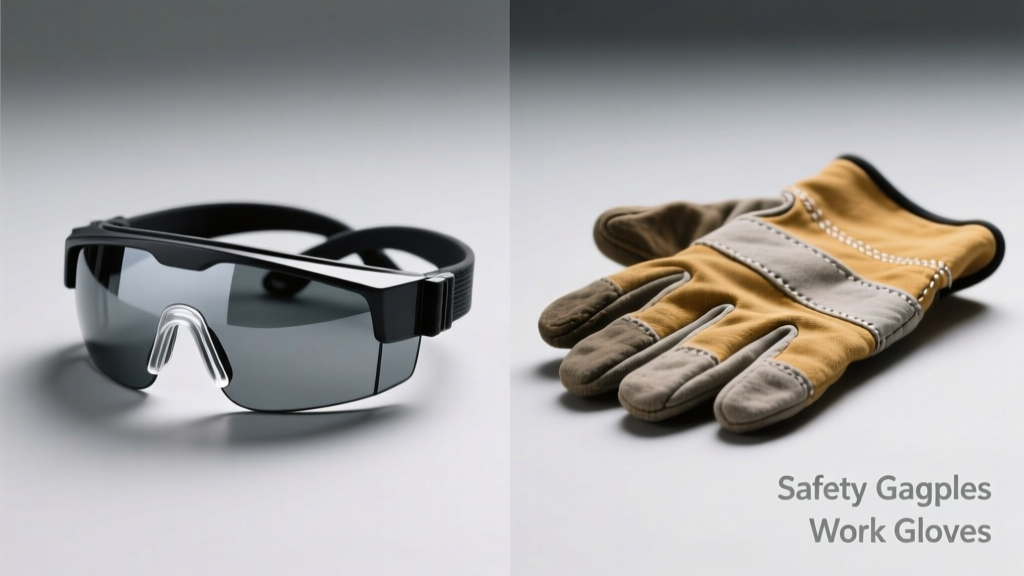
You’re prepping for a job—maybe sanding drywall, handling solvents, or wiring an electrical panel—and you pause: Do I grab the goggles first? The gloves? Or both? It’s not about which is ‘better’ in the abstract—it’s about which hazard you’re actually facing right now.
Quick Verdict
Safety goggles and work gloves serve fundamentally different protective roles: goggles shield eyes from impact, splashes, and airborne particles; gloves protect hands from cuts, chemicals, heat, and abrasion. Neither replaces the other. According to OSHA’s 2022 Personal Protective Equipment Standard, over 70% of eye injuries occur when workers aren’t wearing eye protection—even when gloves are worn. Meanwhile, the U.S. Bureau of Labor Statistics reports hand injuries account for nearly 25% of all workplace injuries, most of which happen without proper glove use. You don’t choose between them—you assess the hazard and layer protection accordingly.
Side-by-Side Comparison
| Feature | Safety Goggles | Work Gloves |
|---|---|---|
| Primary hazard coverage | Impact, chemical splash, dust, UV, fine particulates | Cuts, punctures, abrasion, chemical permeation, thermal exposure |
| ANSI/ISEA certification | ANSI Z87.1–2020 (impact & optical clarity) | ANSI/ISEA 105–2023 (cut, chemical, heat resistance levels) |
| Typical replacement cycle | 6–12 months (if undamaged; inspect straps & lenses weekly) | Days to weeks (depends on task intensity; cut-resistant gloves lose integrity after ~20–30 hours of abrasive use) |
| Fit dependency | Critical: poor seal = compromised splash/airborne protection | Critical: too loose = reduced dexterity & grip; too tight = fatigue & reduced blood flow |
| Common failure modes | Fogging, scratched lenses, strap breakage, improper fit allowing gap at temples | Punctures, chemical breakthrough, seam wear, thumb crotch tears, degraded grip |
Deep Dive on Safety Goggles
Goggles create a sealed barrier around the eyes—unlike safety glasses, they prevent lateral, upward, or downward entry of debris or liquids. That seal matters: the National Institute for Occupational Safety and Health (NIOSH) found that 40% of reported chemical splash injuries involved workers wearing safety glasses instead of goggles, even when SDS sheets explicitly required goggle-level protection.
Pros
- Full circumferential seal prevents splash, mist, and fine dust ingress
- Compatible with prescription inserts (e.g., Uvex Stealth OTG models)
- Anti-fog coatings (like 3M™ Scotchgard™) extend usable time in humid environments
- Available with side shields, ventilation options, and UV filtering for welding prep
Cons
- Fogging remains a top complaint—especially during high-exertion tasks or in cold-to-warm transitions
- Can interfere with respirator fit if not designed for dual-use (e.g., no-gap goggle/respirator combos like MSA Advantage® 8000)
- Limited peripheral vision compared to safety glasses (though newer wraparound designs narrow this gap)
- Not rated for ballistic impact unless specifically marked Z87.1+ (high-velocity testing)
Deep Dive on Work Gloves
A good glove isn’t just leather or nitrile—it’s engineered for specific threat profiles. A mechanic’s cut-resistant Kevlar®-lined glove won’t stop hydrofluoric acid, and a chemical-resistant butyl glove offers zero cut protection. The ANSI/ISEA 105–2023 standard grades gloves across six performance categories, including cut resistance (A1–A9), chemical permeation (1–4), and heat resistance (1–5). Misreading those ratings leads directly to injury: a 2021 CPSC review linked 18% of reported chemical burns to glove selection errors.
"Glove failure isn’t always dramatic—it’s often invisible. A single pinhole in a nitrile glove exposed to acetone can allow full permeation in under 30 seconds. Always check breakthrough time data for your specific chemical—not just the generic 'chemical resistant' label." — Dr. Lena Torres, Industrial Hygiene Lead, NIOSH, 2023
Pros
- Wide material variety: nitrile (oils/solvents), leather (abrasion/heat), Dyneema® (cut + dexterity), aluminized (flash fire)
- Dexterity-focused options exist—like Showa 375 ultra-thin nitrile gloves with textured fingertips for electronics assembly
- Reusable options (e.g., rubber-coated cotton) reduce long-term cost vs. disposables
- Some integrate RFID chips or conductive threads for smart-tool interaction
Cons
- Reduced tactile feedback impairs fine motor control—critical for tasks like PCB soldering or dental lab work
- Heat buildup inside non-breathable gloves causes sweat-induced slippage and skin maceration
- No universal standard for grip performance—wet, oily, or greasy surface tests vary by manufacturer
- Proper sizing requires measuring hand circumference *and* length—many users wear gloves 1–2 sizes too large
When to Choose Goggles vs Gloves
It’s rarely an either/or decision—but here’s where one takes priority:
- Choose goggles first when working with pressurized sprays (e.g., paint booth cleaning), grinding metal (sparks + flying fragments), or handling concentrated acids—even if gloves are also worn.
- Choose gloves first during repetitive manual handling (e.g., palletizing glass bottles), operating rotating machinery (where entanglement risk outweighs eye splash risk), or working with cryogenic liquids (gloves prevent frostbite; goggles alone won’t save fingers).
- Never skip both in labs handling Class B solvents (e.g., xylene, MEK) or construction sites with overhead work—OSHA cites dual PPE omission in 62% of citations for chemical exposure incidents (2023 Enforcement Report).
Alternatives to Consider
Depending on your environment, supplemental or hybrid solutions may outperform standard goggles or gloves alone:
- Face shields add secondary splash/impact coverage—but must be worn *over* goggles, never instead of them (ANSI Z87.1–2020 §6.2.2)
- Cut-resistant sleeves extend protection up the forearm for chainsaw or metal-stamping work
- Anti-fog wipes and coated lens sprays improve goggle reliability in HVAC or food processing
- Hybrid gloves with integrated knuckle guards (e.g., Mechanix Wear FastFit® Pro) bridge cut + impact needs without sacrificing dexterity
Can I wear safety goggles and gloves at the same time?
Yes—and it’s often required. But compatibility matters: bulky gloves can snag goggle straps, and oversized goggles may shift when adjusting gloves mid-task. Opt for low-profile goggle designs (e.g., Pyramex® i-Flex) paired with form-fitting gloves. Always perform a fit check: blink rapidly while moving your head side-to-side—no lens fogging or strap slippage should occur.
Do prescription glasses eliminate the need for goggles?
No. Regular eyeglasses offer zero impact or splash protection. Prescription safety goggles (like DeWalt DPG82-11) or over-glasses (OTG) models are certified alternatives—but only if marked Z87.1 and tested for your task’s hazard profile. Never assume your optometrist’s frames meet ANSI standards.
Are disposable gloves enough for chemical handling?
Rarely. Most exam-grade nitrile gloves (e.g., Medline) have breakthrough times under 10 minutes for common solvents like acetone or toluene. For sustained exposure, consult the glove manufacturer’s chemical resistance guide—and pair with a verified chemical resistance chart. If the chart shows “NR” (not recommended) or “E” (poor), upgrade immediately.
Why do my goggles fog up even with anti-fog coating?
Fogging occurs when warm, moist air from your breath or skin meets cooler lens surfaces. Anti-fog coatings degrade with cleaning (especially alcohol-based wipes) and repeated abrasion. Replace coatings every 2–4 weeks in high-humidity jobs—or switch to goggles with built-in ventilation channels and dual-pane lenses (e.g., Uvex Ultrasonic).
How often should I replace my work gloves?
Inspect before *every* use: look for holes, stiffening, discoloration, or loss of elasticity. Replace cut-resistant gloves after 20–30 hours of abrasive contact (e.g., handling rebar or sandpaper). Chemical gloves should be discarded after a single exposure to strong oxidizers (e.g., bleach, peroxides) unless validated for reuse by the manufacturer.
Bottom line: goggles guard what you see; gloves guard what you touch. Your safest setup isn’t the flashiest gear—it’s the right gear, worn correctly, for the hazard in front of you. And more often than not, that means both.