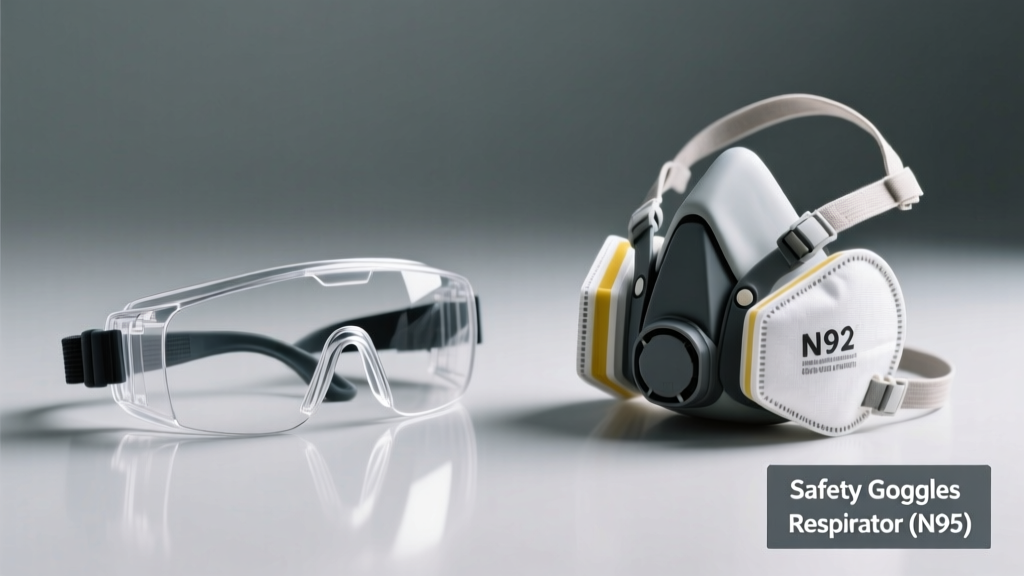
You’re prepping for a DIY tile demolition, sanding old paint off wood, or cleaning up after a mold inspection—and suddenly you’re stuck: do you grab the goggles or the respirator? Or both? It’s not just about comfort—it’s about whether your eyes stay clear of splinters or your lungs avoid inhaling silica dust that can cause irreversible scarring.
Quick Verdict
Neither is universally "better." Safety goggles protect your eyes from impact, splashes, and UV; respirators filter airborne particles, vapors, or gases from your lungs. They address different hazards—and OSHA requires both when tasks involve simultaneous eye and respiratory risks, like grinding concrete or spraying solvent-based coatings. Choosing one over the other leaves a critical protection gap.
Side-by-Side Comparison
| Feature | Safety Goggles | Respirator |
|---|---|---|
| Primary hazard blocked | Impact, chemical splash, UV, fine debris | Airborne particulates (e.g., dust, mold spores), vapors, gases |
| Certification standard (U.S.) | ANSI Z87.1-2020 | N95, P100, or NIOSH-approved organic vapor cartridges |
| Fits over prescription glasses? | Yes—most wraparound styles do | Some half-mask models do; full-face respirators eliminate the need |
| Reusable lifespan | 6–12 months with proper cleaning (scratches compromise seal) | Filters replaced every 8–40 hours depending on contaminant load; mask body lasts 6–12 months |
| Fit testing required? | No | Yes—for tight-fitting N95s and all elastomeric respirators per OSHA 1910.134 |
Deep Dive on Safety Goggles
Safety goggles create a sealed barrier around the eyes using indirect ventilation (to prevent fogging while blocking splashes) and soft, flexible gaskets. Polycarbonate lenses resist impact up to 150 ft-lbs—enough to stop a flying staple or metal shard. They’re mandatory in labs handling acids and essential during angle-grinding, where sparks and fragments travel at 200+ mph.
Pros
- Prevent chemical burns to the cornea—critical when mixing muriatic acid for concrete etching
- Block 99.9% of UV-B and UV-C radiation during welding prep or UV-cured resin work
- Lightweight and compatible with hard hats via strap attachments
Cons
- No respiratory protection—even high-seal goggles don’t stop inhalation of fine dust below 10 microns (like crystalline silica)
- Fogging occurs in humid conditions unless anti-fog coating is applied or ventilation channels are properly sized
- Can’t be worn with long eyelash extensions or certain facial hair without compromising seal
Deep Dive on Respirators
A respirator filters air before it reaches your airway. Disposable N95s capture 95% of 0.3-micron particles—including asbestos fibers and mold spores—but only if fit-tested and worn without facial hair interfering with the seal. Reusable elastomeric respirators with P100 filters block 99.97% of oil- and non-oil-based particles and last longer under heavy use.
According to the National Institute for Occupational Safety and Health’s 2022 Fit Testing Compliance Report, 68% of workers who skipped annual fit testing failed qualitative tests—meaning their N95 offered less than 50% filtration efficiency during actual use.
"A respirator without fit testing is like a seatbelt without clicking it—technically present, but functionally useless." — Dr. Lena Torres, Industrial Hygiene Specialist, NIOSH, 2023
Pros
- Essential for preventing silicosis during concrete cutting—OSHA estimates 2.3 million U.S. workers are exposed to silica above permissible limits annually
- Vapor cartridges (e.g., OV/AG) protect against solvents like toluene in spray-paint booths
- Full-face models integrate eye protection, eliminating need for separate goggles (but require dual certification: ANSI Z87.1 + NIOSH approval)
Cons
- Doesn’t shield eyes from physical impact—splash from a tipped acetone container can still burn unprotected eyes
- Increased breathing resistance may trigger discomfort or fatigue during 90-minute drywall sanding sessions
- Not suitable for oxygen-deficient environments (e.g., confined sewer trenches) without supplied-air systems
When to Choose Goggles vs Respirator
Choose goggles alone only when the hazard is strictly ocular: buffing metal with a rotary tool (sparks), handling sodium hydroxide drain cleaner (splash risk), or working under UV lamps. Choose a respirator alone only in low-risk, non-impact scenarios like sweeping up settled drywall dust in an open garage.
But in most real-world trades—tile removal, attic insulation cleanup, or furniture refinishing—you need both. The U.S. EPA estimates that 14% of household water usage is from leaks, but that pales next to the 40% of occupational eye injuries linked to inadequate or missing eye protection (Bureau of Labor Statistics, 2023 Workplace Injury Report).
Alternatives to Consider
Full-face respirators combine certified eye and respiratory protection in one unit—but add weight and heat buildup. Powered air-purifying respirators (PAPRs) offer superior filtration and cooling airflow, ideal for extended mold remediation, though they cost $500–$1,200. For light-duty tasks like gardening or sweeping, ASTM F2871-compliant safety glasses with side shields offer basic splash/impact coverage but lack the sealed gasket of true goggles.
Can I wear goggles over a respirator?
Yes—if the respirator is a half-mask (covering nose/mouth only). But ensure the goggles’ strap doesn’t displace the respirator’s seal. Test by performing a negative-pressure check: cover filter openings and inhale gently. If the mask collapses and holds, the seal is intact.
Do prescription safety goggles exist?
Absolutely. Options include insert-style (goggle fits over regular glasses), built-in prescription lenses (ground to your Rx), and wraparound frames with diopter inserts. Avoid clip-ons—they shift during movement and break the seal.
Is an N95 enough for sanding wood?
Only if the wood is untreated and free of finishes. Sanding stained or painted wood releases formaldehyde and VOCs—requiring an N95 plus organic vapor cartridge. Untreated pine dust is classified as a Group 1 carcinogen by IARC, making P100 filtration advisable for repeated exposure.
Why do my goggles fog up with a respirator on?
Exhaled breath escapes upward from the respirator’s top edge and hits the cooler goggle lens. Solutions: use a respirator with an exhalation valve positioned downward, apply anti-fog spray (tested brands here), or switch to a full-face respirator with integrated lens.
Are safety goggles required with a full-face respirator?
No—if the full-face unit is certified to ANSI Z87.1 *and* NIOSH standards (look for dual markings on the facepiece). Many users mistakenly layer goggles, which compromises the respirator’s fit and increases pressure points.
Can I reuse disposable N95s during supply shortages?
NIOSH permits limited reuse *only* if the mask remains structurally intact, unsoiled, and hasn’t been used during aerosol-generating procedures. Store between uses in a breathable paper bag for ≥72 hours to allow viral decay. Never wash or sanitize with alcohol—it degrades electrostatic filtration.
If your task involves airborne hazards *and* anything that could strike, splash, or burn your eyes, skip the false choice. Get certified goggles *and* a properly fitted respirator—or invest in a dual-certified full-face unit. Your eyes regenerate corneal cells every 7 days; your lung tissue doesn’t regenerate at all.