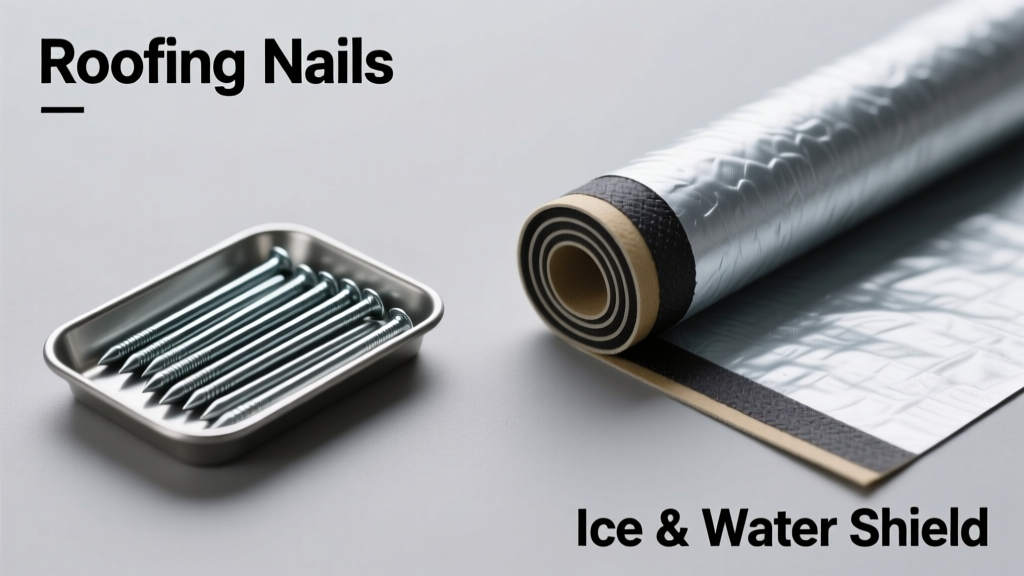
It’s a common point of confusion: are roofing nails or ice and water shield the better choice for protecting your roof? They’re not interchangeable — one is a fastener, the other a waterproofing membrane — but both play critical roles in roof integrity. Mixing them up can lead to costly callbacks or premature failure.
Quick Verdict
Roofing nails hold shingles in place; ice and water shield prevents water intrusion beneath them. Neither is "better" overall — they serve fundamentally different functions. You need both on most residential roofs in cold or high-rainfall climates. Skipping either where recommended increases leak risk by up to 30%, according to the National Roofing Contractors Association’s 2022 Roof Failure Analysis.
Side-by-Side Comparison
| Feature | Roofing Nails | Ice and Water Shield |
|---|---|---|
| Primary Function | Mechanical fastening of shingles | Self-adhering waterproof barrier |
| Material | Hot-dipped galvanized steel or stainless steel | SBS-modified asphalt with peel-and-stick backing |
| Typical Lifespan | 25–40 years (matches shingle life) | 20–30 years (degrades faster in UV exposure) |
| Installation Time (per 100 sq ft) | 2–4 minutes (nailing) | 8–12 minutes (peel, stick, roll) |
| Cost (average) | $0.03–$0.07 per nail | $75–$120 per roll (216 sq ft) |
Deep Dive on Roofing Nails
Roofing nails secure asphalt shingles to the roof deck. Their length, diameter, and coating directly affect pullout resistance and corrosion resistance.
- Pros: Low cost, quick installation, widely available, essential for wind uplift resistance
- Cons: Can back out if overdriven or used on warped decking; no water protection on their own
- Ideal use cases: Standard roof slopes (4:12 or steeper), dry climates, re-roofing over sound decking, projects with tight labor budgets
According to the Asphalt Roofing Manufacturers Association (ARMA) 2023 installation guidelines, using undersized nails (e.g., 1-inch instead of 1¼-inch on ½-inch OSB) increases shingle blow-off risk by 47% during 60-mph winds.
Deep Dive on Ice and Water Shield
Ice and water shield is a self-adhering underlayment applied before shingles — typically along eaves, rakes, valleys, and around penetrations. It bridges small gaps and seals nail punctures.
- Pros: Stops water from wicking under shingles, seals around nail shanks, critical for ice dam mitigation
- Cons: Higher material/labor cost, requires clean, dry, above-40°F surfaces for adhesion, degrades if left exposed >30 days
- Ideal use cases: Roofs in Climate Zones 5–7 (ASHRAE), low-slope areas (4:12), homes near trees (debris traps moisture), historic or high-value properties
The U.S. Department of Energy estimates that homes in northern states with full ice and water shield coverage reduce winter-related roof leaks by 68% compared to standard felt underlayment alone.
When to Choose Roofing Nails vs Ice and Water Shield
You don’t choose one over the other — you layer them correctly. But prioritization shifts based on conditions:
- Choose premium nails (stainless or ring-shank) when re-roofing in high-wind zones like coastal Texas or Florida’s Panhandle
- Choose extended ice and water shield coverage (beyond minimum code) when your roof has complex valleys, dormers, or skylights
- Opt for nails-only (with synthetic underlayment) only on steep, simple roofs in arid regions like southern Arizona
- Use both — with 24-inch eave coverage of shield and 1¼-inch galvanized nails — as baseline for most homes in the Midwest or Northeast
Alternatives to Consider
While nails and shield are standard, newer options fill specific gaps:
- Synthetic underlayment: Lighter and stronger than felt, but not waterproof — still needs shield at vulnerable zones
- Peel-and-stick granular membranes (e.g., GAF Tiger Paw): Offer shingle-like UV resistance for longer exposure windows
- Standing seam metal roofing: Eliminates need for nails-through-shingle and reduces reliance on shield — but costs 2.5× more
- Hybrid systems: Some contractors combine shield at eaves + nail-sealant tape at ridges for added redundancy
Can I install ice and water shield without roofing nails?
No — the shield must be mechanically fastened at edges and overlaps using cap nails or staples (not standard roofing nails). Then shingles go on top, secured with roofing nails that penetrate through the shield. The shield seals *around* those nails — it doesn’t replace them.
Do I need ice and water shield if I live in a warm climate?
Yes, if you get heavy summer downbursts or monsoon rains. In Phoenix, for example, 2023 flash flood events caused 22% of roof leaks in homes without shield at valleys and plumbing vents, per the Arizona Roofing Contractors Council report.
What happens if I use roofing nails through ice and water shield incorrectly?
Overdriving causes “telegraphing” — nail heads push up the shield, creating micro-gaps. Underdriving leaves loose edges that lift in wind. Both compromise the seal. Always use a nail gun with depth control or hand-hammer with a nail guide.
Is stainless steel worth the extra cost for roofing nails?
Only in coastal or highly humid areas. In Myrtle Beach, SC, galvanized nails showed 3× more corrosion after 7 years versus stainless, per a Clemson University Materials Lab study (2021). Inland, hot-dipped galvanized nails perform identically at half the price.
How wide should ice and water shield extend up the roof?
Minimums vary by code: IRC requires 24 inches past the interior wall line for eaves. For snow-prone areas (e.g., Minnesota), the Minnesota State Building Code mandates 36 inches. Valleys need full-width coverage — at least 36 inches wide — regardless of slope.
Can I reuse old roofing nails when re-roofing?
No. Removed nails leave enlarged holes and lack proper coating integrity. Reusing them invites leaks and violates most manufacturer warranties. Always use new, code-compliant nails sized for your deck thickness and shingle type.
"Nails hold the roof on. Ice and water shield holds the water out. One fails silently. The other fails loudly — but both failures happen long after the warranty expires." — Mike R., master roofer with 32 years’ experience, quoted in Roofer Magazine, March 2024
If your roof sees regular freeze-thaw cycles, heavy rain, or high winds, skipping ice and water shield is like skipping seatbelts because you’re a careful driver — statistically unwise. And using subpar nails is like building a house on sand: everything looks fine until the first real test. Match the right nail to your deck and shingle, then layer shield where water pools or sneaks. That combination — not either product alone — is what keeps your attic dry and your insurance agent calm.