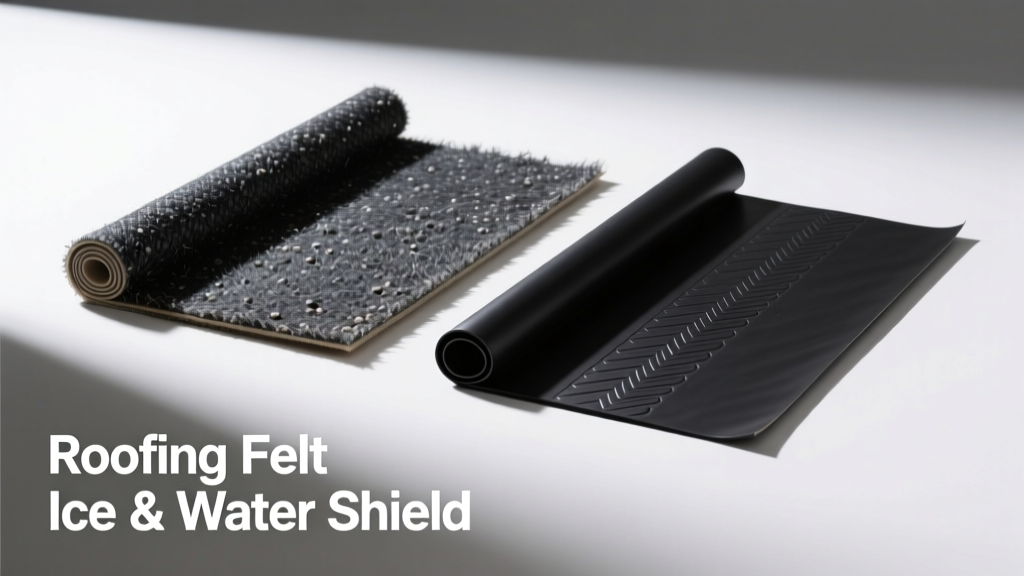
Choosing between roofing felt and ice and water shield feels like picking between a reliable old pickup and a weatherproof SUV—both get the job done, but under very different conditions. Contractors, DIYers, and homeowners in snowy or rainy regions face real trade-offs in cost, labor, and long-term performance.
Quick Verdict
Roofing felt is the budget-friendly, breathable workhorse for standard-slope roofs in mild climates. Ice and water shield is the premium, adhesive-backed barrier essential for low-slope roofs, valleys, eaves, and regions with ice dams or heavy rainfall. Neither is universally 'better'—it’s about matching material to risk profile and building code requirements.
Side-by-Side Comparison
| Feature | Roofing Felt (15- or 30-lb) | Ice and Water Shield |
|---|---|---|
| Material composition | Asphalt-saturated organic or fiberglass mat | SBS-modified asphalt with rubberized polymer and peel-and-stick backing |
| Water resistance | Water-resistant (sheds water temporarily); not waterproof | Fully waterproof—even when punctured or overlapped poorly |
| Installation method | Stapled or capped; requires fasteners | Self-adhering; bonds directly to clean, dry sheathing |
| Lifespan (under shingles) | 10–15 years (degrades faster if exposed pre-roofing) | 20+ years; UV-rated versions last up to 180 days uncovered |
| Cost per square (100 sq ft) | $4–$8 (15-lb) or $7–$12 (30-lb) | $25–$45 (standard), $50+ (premium UV-stable or granulated) |
| Code requirement | Required by IRC for all steep-slope roofs | Mandated within 24" of eaves in Climate Zones 5–8 (IRC R905.2.7) |
Deep Dive on Roofing Felt
Roofing felt—especially 30-pound—has been the industry standard underlayment for over a century. It’s made by saturating a base mat (organic or fiberglass) with asphalt, then coating it for added protection.
Pros
- Affordable and widely available at big-box and roofing supply stores
- Allows roof deck to breathe—reduces trapped moisture when paired with proper attic ventilation
- Easier to cut, handle, and repair mid-installation than sticky membranes
- Compatible with most nail guns and traditional fastening methods
Cons
- No adhesion—can billow or shift in wind before shingle installation
- Not waterproof: water can wick laterally along fibers or penetrate nail holes
- Degrades quickly when left exposed to UV light (15-lb lasts ~2 weeks; 30-lb ~30 days)
- Doesn’t seal around fasteners—leak paths remain at nail penetrations
According to the Insurance Institute for Business & Home Safety's 2023 report on residential roofing failures, 68% of ice-dam-related leaks occurred where standard felt was used without supplemental membrane at eaves—even with proper ventilation.
Deep Dive on Ice and Water Shield
Developed in the 1980s for northern climates, ice and water shield is a self-adhering, rubberized asphalt membrane designed to seal around nails and bridge minor gaps in sheathing. Modern versions include UV inhibitors, granule coatings for walkability, and reinforced polyester carriers.
Pros
- Creates a continuous, watertight barrier—seals nail penetrations instantly
- Resists hydrostatic pressure from ice dam buildup or wind-driven rain
- Stays in place during high winds or multi-day install delays
- Meets or exceeds ASTM D1970 standards for peel adhesion and low-temp flexibility
Cons
- Higher material and labor cost—requires careful surface prep (clean, dry, debris-free)
- Can trap moisture beneath if installed over damp or green OSB
- Difficult to reposition once applied; misalignment often means cutting and patching
- Not recommended for full-roof coverage on steep-slope, well-ventilated roofs unless specified
"In cold climates, skipping ice and water shield at eaves isn’t just risky—it’s a violation of the International Residential Code. That 24-inch minimum isn’t arbitrary; it’s based on decades of field data showing where ice dams consistently breach." — John R. Hensley, Certified Roofing Contractor & ICC Instructor, 2022
When to Choose Roofing Felt vs Ice and Water Shield
Use roofing felt as your primary underlayment on standard-pitch roofs (6:12 or steeper) in Climate Zones 1–4—think central Texas, Georgia, or southern California—where ice dams are rare and rainfall is moderate. Reserve ice and water shield for critical zones: eaves, rakes, valleys, dormers, skylight perimeters, and low-slope sections (≤ 4:12). In Climate Zones 5–8—including Minnesota, Vermont, and Washington state—the IRC requires it within 24 inches of all eaves and rakes.
For new construction in mixed-humid zones (like Tennessee or North Carolina), many builders now use synthetic underlayment over the field and ice and water shield only at high-risk zones—a balanced approach gaining traction per the National Association of Home Builders’ 2023 Builder Trends Report.
Alternatives to Consider
While felt and ice/water shield dominate the market, newer options fill specific niches:
- Synthetic underlayment: Polypropylene or polyethylene sheets—lighter, stronger, and more tear-resistant than felt, with better UV resistance (up to 6 months). Priced between felt and shield ($12–$22/sq).
- Peel-and-stick hybrids: Products like GAF StormGuard® Plus combine SBS-modified asphalt with a nonwoven polyester scrim—offering enhanced puncture resistance and easier handling than traditional shield.
- Self-adhering granulated membranes: Designed for walkability and UV stability (e.g., CertainTeed WinterGuard® HT), ideal for complex roofs or multi-day installs.
None replace ice and water shield’s sealing capability at nail points—but they’re strong alternatives for field coverage where breathability and durability matter.
Can I use roofing felt over ice and water shield?
No—this creates a vapor trap. Ice and water shield is impermeable. Adding felt on top prevents outward drying and risks moisture accumulation in the roof deck. Always follow manufacturer instructions: shield goes directly on clean sheathing, then shingles go on top.
Is 30-lb felt better than 15-lb for snow-prone areas?
Marginally—but not enough to replace ice and water shield. While 30-lb felt offers higher tear strength and slightly longer UV tolerance, it still lacks adhesive sealing. The U.S. Department of Energy notes that in Zone 6+, felt alone reduces ice-dam leakage risk by less than 12% compared to shield.
How long can ice and water shield stay exposed before shingling?
Standard versions: 30 days max. UV-stable versions (e.g., Grace Ultra® or Malarkey LegacyShield®): up to 180 days. Always check the product datasheet—and never leave any underlayment exposed through summer heat cycles without verification.
Do I need ice and water shield on a shed roof?
Yes—if the shed has a low slope (< 4:12) or sits in a shaded, north-facing location prone to snow accumulation. For a 6:12 or steeper shed in Atlanta? Felt suffices. But for a 2:12 garage addition in Maine? Shield is non-negotiable—and likely required by local code.
Can I install ice and water shield in cold weather?
Yes—but with caveats. Most manufacturers require substrate temperatures above 40°F (4°C) for proper adhesion. Below that, warm the roll indoors first and use a roller with extra pressure. Avoid installation below 25°F, per cold-weather roofing best practices.
Does roofing felt help with sound insulation?
Minimally. Neither felt nor shield provides meaningful acoustic dampening. If noise reduction is a priority—say, for a home office under the roof—consider adding a layer of rigid foam insulation above the sheathing or using shingles with built-in sound-dampening mats.
Ultimately, your choice hinges less on preference and more on physics, climate, and code. Roofing felt remains a capable, economical layer where water intrusion risk is low. Ice and water shield answers a specific, high-consequence threat—one that doesn’t forgive oversight. When in doubt, consult your local building department and review your roof warranty requirements: many shingle manufacturers void coverage if shield isn’t used where mandated.