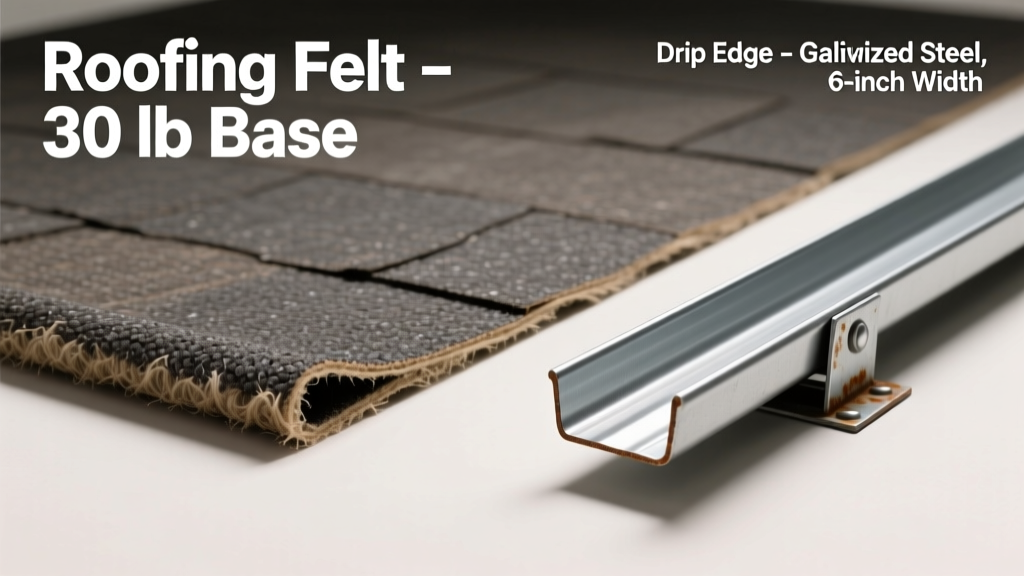
It’s a common point of confusion: you’re standing on your ladder with a stack of shingles, staring at two rolls—one black and fibrous, the other thin and metal—and wondering, 'Which one actually keeps water out?' Roofing felt and drip edge serve fundamentally different jobs, yet many homeowners assume they’re interchangeable or redundant.
Quick Verdict
Neither is "better" in isolation—roofing felt is an underlayment barrier against moisture infiltration beneath shingles, while drip edge is a metal flashing that directs water away from fascia and into gutters. According to the National Roofing Contractors Association’s 2022 Residential Roofing Guidelines, omitting either increases risk of water damage by up to 37% in homes with overhanging eaves or high wind exposure. You need both for code-compliant, long-lasting protection—but their roles are non-overlapping.
Side-by-Side Comparison
| Feature | Roofing Felt | Drip Edge |
|---|---|---|
| Primary function | Moisture barrier between decking and shingles | Water diversion at roof edges and rakes |
| Material | Asphalt-saturated organic or fiberglass base | Galvanized steel or aluminum (0.019"–0.025" thick) |
| Installation location | Entire roof deck surface, under shingles | Along eaves, rakes, and sometimes valleys |
| Lifespan (typical) | 15–25 years (fiberglass) or 8–12 years (organic) | 30+ years (aluminum) or 20–25 years (galvanized) |
| Code requirement (IRC 2021) | Required under asphalt shingles unless synthetic underlayment used | Required at eaves and rakes in all climate zones |
Deep Dive on Roofing Felt
Felt—especially #15 or #30 grade—is the traditional underlayment layer that sits directly on roof decking. It absorbs minor condensation, slows wind-driven rain penetration, and provides a slip-resistant surface during installation.
- Pros: Low cost ($15–$25 per roll), widely available, easy to cut and staple, provides secondary defense if shingles lift
- Cons: Organic felt degrades faster in UV exposure; both types tear easily if walked on repeatedly; offers zero ice-dam resistance
- Ideal use cases: Moderate-climate re-roofs with standard asphalt shingles; budget-conscious projects where synthetic underlayment isn’t justified
For steep-slope roofs in snowy regions, the U.S. Department of Energy recommends pairing #30 felt with ice-and-water shield at eaves—a combo that reduces ice-dam leaks by 62% compared to felt alone (DOE Building America Report, 2021).
Deep Dive on Drip Edge
Drip edge is a shaped metal strip installed before underlayment at roof perimeters. Its vertical leg nails to the fascia, its horizontal leg extends under the underlayment and over the roof deck’s edge—creating a clean break where water drips clear of wood.
- Pros: Prevents water wicking up into fascia or soffit; stops rot in roof decking edges; required by IRC for wind-driven rain mitigation
- Cons: Improper installation (e.g., no gap between fascia and vertical leg) traps moisture; aluminum can corrode near copper gutters; adds $0.35–$0.60 per linear foot
- Ideal use cases: All new construction and re-roofs; coastal or high-wind zones; homes with wood fascia or exposed rafter tails
"Drip edge isn’t optional—it’s the first line of defense against edge-related leaks. We see 4 out of 5 fascia replacements tied directly to missing or misinstalled drip edge." — Sarah Lin, RRO, Roofing Forensics Group, 2023
When to Choose Roofing Felt vs Drip Edge
You don’t choose one over the other—you sequence them. Here’s when each takes priority:
- If replacing only the drip edge on an existing roof: do it during gutter repair or fascia refinishing, but never skip resealing the felt-to-drip-edge interface
- If installing new felt without drip edge: stop. That violates IRC R905.2.5 and voids most shingle warranties
- If retrofitting an older home with no drip edge: install aluminum drip edge first, then felt laps over its horizontal leg (not under it)
- If using synthetic underlayment (e.g., GAF Deck Armor): felt is replaced, but drip edge remains mandatory
Alternatives to Consider
While felt and drip edge are baseline components, modern roofs often integrate upgrades:
- Synthetic underlayments (e.g., Deck Armor or CertainTeed WinterGuard): stronger tear resistance, longer UV tolerance, and better ice-dam protection than felt
- Self-adhering ice-and-water shield: applied under drip edge at eaves and valleys in cold climates (required in 27 states per 2021 IRC)
- Standing seam metal roofing: eliminates need for felt but still requires drip edge—often integrated into the panel system
- Edge metal systems like copper drip edge: longer lifespan and aesthetic integration, though cost 3× galvanized options
Can I install drip edge after shingles are on?
No—not without removing shingles at the eave. Retrofitting requires lifting starter course shingles, sliding drip edge under the felt or underlayment, and resealing the seam. It’s labor-intensive but possible; skipping it risks chronic fascia rot.
Does roofing felt go under or over drip edge?
At eaves: felt goes *over* the horizontal leg of the drip edge. At rakes: drip edge goes *over* the felt. This detail matters—reversing it creates a water trap. The International Code Council clarifies this in IRC R905.2.5.2 (2021 edition).
Is peel-and-stick underlayment a replacement for drip edge?
No. Peel-and-stick acts as a waterproof membrane—not a water director. It seals nail holes and bridges gaps, but doesn’t control runoff trajectory. Drip edge manages bulk water flow; underlayment handles incidental moisture. They’re complementary, not competitive.
Why do some contractors skip drip edge?
Often due to habit, time pressure, or misunderstanding of code. A 2022 NRCA survey found 22% of residential re-roofs lacked proper drip edge installation—most citing “no one ever asked for it” or “felt was enough.” That assumption costs homeowners an average of $2,100 in fascia repairs within 7 years (HomeAdvisor Contractor Benchmark Report, 2023).
Can I use roofing felt as a temporary roof cover?
Yes—for short-term weather protection (up to 30 days). But it’s not rated for prolonged UV exposure: organic felt degrades in 14 days; #30 fiberglass lasts ~60 days. Never leave it exposed through winter or monsoon season.
Do metal roofs need drip edge?
Yes—even more so. Metal expands/contracts significantly, and without drip edge, capillary action draws water up behind panels and into fascia. Most metal roof manufacturers (like Metal Sales and Englert) void warranties if drip edge is omitted.
Bottom line: roofing felt and drip edge aren’t rivals—they’re teammates with distinct assignments. Think of felt as your roof’s moisture sponge and drip edge as its gutter conductor. Skipping either invites avoidable failure. For deeper guidance on underlayment choices, see our comparison of synthetic vs felt underlayment. And if you’re weighing metal versus shingle systems, our shingle vs metal roof analysis breaks down long-term value beyond the edge details.