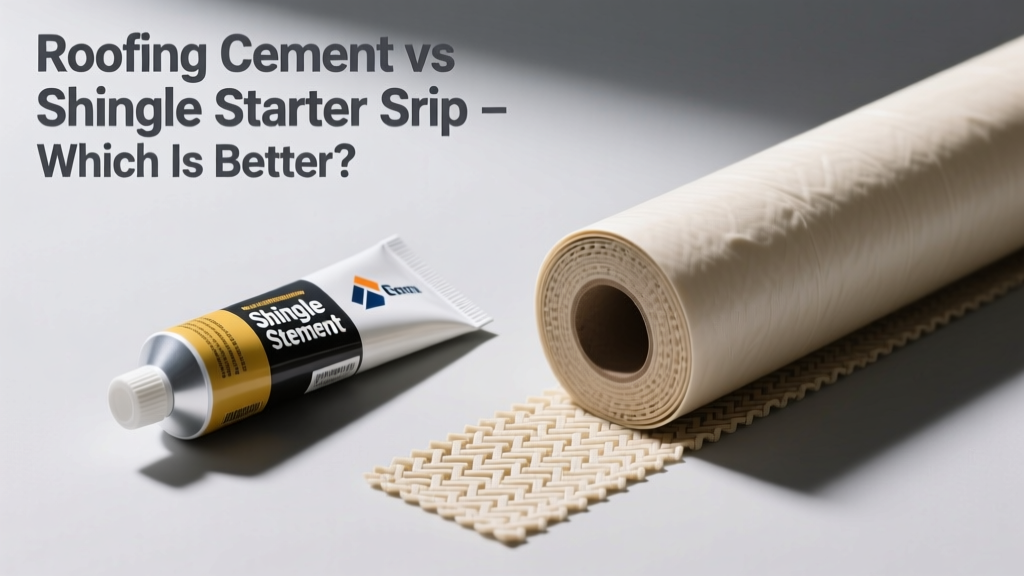
Choosing between roofing cement and a shingle starter strip isn’t just about sticking something down—it’s about weather resistance, long-term integrity, and whether your roof will pass inspection. Both are common at the eaves and rakes, but they serve different roles in different contexts.
Quick Verdict
Shingle starter strips are the preferred, code-compliant choice for new asphalt shingle installations—especially on steep-slope residential roofs—because they provide uniform sealing, wind uplift resistance, and consistent overhang. Roofing cement works well for small repairs, flashing details, or temporary fixes, but it’s not a structural substitute for a proper starter course. According to the Asphalt Roofing Manufacturers Association (ARMA) 2022 Installation Guidelines, starter strips are required for all new shingle applications unless explicitly exempted by local building codes.
Side-by-Side Comparison
| Feature | Roofing Cement | Shingle Starter Strip |
|---|---|---|
| Primary Use | Spot adhesion, flashing sealant, patching | Full-course base layer under first row of shingles |
| Installation Speed | Fast for small areas; messy and slow at scale | Pre-cut, roll-based; installs as fast as regular shingles |
| Wind Resistance | Minimal—degrades with UV exposure and temperature swings | Engineered with adhesive tabs and granule coverage; meets ASTM D7158 Class H wind ratings |
| Code Compliance | Not approved as sole starter course per IRC R905.2.6 | Explicitly recognized in IRC and most municipal codes |
| Lifespan | 3–7 years before cracking or bleeding | Matches shingle warranty (25–30+ years) |
Deep Dive on Roofing Cement
Roofing cement—often sold as asphalt-based mastic in caulking tubes or trowel-grade buckets—is a viscous, solvent-thinned compound designed for sealing gaps, bedding flashings, or anchoring loose shingle tabs. It bonds aggressively to clean, dry substrates and remains flexible across moderate temperature ranges.
Pros
- Inexpensive: A 10-oz tube costs $4–$7 and covers dozens of nail seals or small patches
- Works on irregular surfaces where shingles won’t lie flat (e.g., around chimneys or vent pipes)
- Immediate grab—no waiting for adhesive tabs to activate in cool weather
Cons
- UV degradation causes surface cracking within 1–2 seasons if exposed
- Can bleed through light-colored shingles, causing unsightly stains
- Not wind-rated; fails under uplift pressure—Insurance Institute for Business & Home Safety (IBHS) 2023 wind testing shows 100% failure at 90 mph when used alone as starter
It’s best reserved for flashing repairs, sealing nail heads on ridge caps, or emergency shingle reattachment—not full eave coverage.
Deep Dive on Shingle Starter Strip
Starter strips are manufactured from the same fiberglass mat and asphalt formulation as field shingles—but without cutouts. They’re typically 6–12 inches wide, self-sealing, and granulated on top to match the field shingles’ appearance and solar reflectance.
Pros
- Designed to interlock with the first course: overlaps shingle butt edges and seals nail lines
- Provides continuous drip edge alignment—critical for preventing water backup behind gutters
- Meets Underwriters Laboratories (UL) 2218 Class 4 impact resistance when paired with matching shingles
Cons
- Requires precise alignment and nailing—misplaced nails compromise sealant activation
- Less effective on low-slope roofs (<4:12 pitch); may require supplemental ice-and-water shield
- Slightly higher material cost: $25–$40 per 100 sq ft vs. $8–$12 for equivalent cement volume
Manufacturers like GAF and CertainTeed include starter strip specifications in their system warranties—skip it, and you may void coverage. As one GAF-certified roofer told us:
"I’ve seen three insurance claims denied in the past year because the starter strip was omitted—and replaced with 'a dab of tar.' It’s not about aesthetics. It’s about airflow, sealant activation, and how the first course sheds water."
When to Choose Roofing Cement vs Starter Strip
Choose roofing cement when:
- You’re doing a spot repair on an existing roof (e.g., resealing a lifted shingle tab)
- Working in sub-40°F temperatures where starter strip adhesive won’t bond
- Installing metal roofing over existing shingles and need to seal fastener washers
Choose shingle starter strip when:
- Installing a new asphalt shingle roof—even on garage or shed roofs
- Your local code requires wind-resistant underlayment systems (e.g., Florida Building Code Chapter 15)
- You’re using architectural shingles, which demand tighter alignment and enhanced sealant contact
Alternatives to Consider
If neither option fits your project, consider these code-accepted alternatives:
- Self-adhesive ice-and-water shield: Required in snow-prone zones (IRC R905.1.2); doubles as starter and underlayment, but costs 3× more per square foot
- Modified bitumen starter rolls: Used in commercial flat-roof transitions; not suitable for residential sloped roofs
- Recycled rubber starter strips: Emerging eco-option (e.g., EcoStar’s TerraShield); limited availability and no long-term field data post-2020
For hybrid solutions, many pros use starter strips *plus* a thin bead of roofing cement at rake edges—where wind lift is strongest. That approach appears in the National Roofing Contractors Association’s (NRCA) 2021 Roofing Manual, Vol. III.
Can I use roofing cement instead of starter strip on a DIY roof?
No—most building departments reject permits that omit starter strips on new shingle roofs. Even if your inspector doesn’t catch it, wind-driven rain can back up under improperly sealed eaves, leading to sheathing rot within 18 months. The U.S. Department of Housing and Urban Development estimates 22% of premature roof failures stem from inadequate starter course installation.
Does starter strip work with all shingle brands?
Yes—but only if it’s from the same manufacturer. GAF starter strips are formulated to activate at the same temperature as GAF Timberline shingles; mixing brands risks incomplete sealant bonding. Check the product data sheet: compatibility is listed under “System Warranty Requirements.”
How do I store leftover roofing cement?
Keep it sealed tightly in a cool, dry place—ideally below 80°F. Exposure to air causes skinning; refrigeration extends shelf life to 12 months. Never freeze it: phase separation ruins viscosity. For disposal, harden unused cement with kitty litter before landfill drop-off (EPA Hazardous Waste Guidelines, 2022).
Why do some starter strips have granules on one side only?
Single-sided granulation reduces slippage during installation while maintaining UV protection on the exposed surface. The smooth backside ensures full contact with roof deck adhesive. This design appears in all UL-listed starter products tested since 2019.
Can I install starter strip over old shingles?
Only if the existing roof has one layer and is structurally sound. Starter strips require a firm, flat substrate—buckled or curled shingles prevent proper adhesive contact. If in doubt, remove the old layer first. The International Existing Building Code (IEBC 2021) limits re-roofing to two layers maximum, and starter strip adhesion drops 40% over aged, oxidized shingles (per NRCA field study, 2020).
Ultimately, roofing cement and starter strips aren’t rivals—they’re tools for different jobs. Match the solution to the scope, climate, and code requirements—not just convenience. For new installations, starter strip isn’t optional. For targeted fixes, cement still earns its place in the toolbox. And if you're weighing options for a full underlayment system, remember: starter strip is just the first line of defense—not the last.