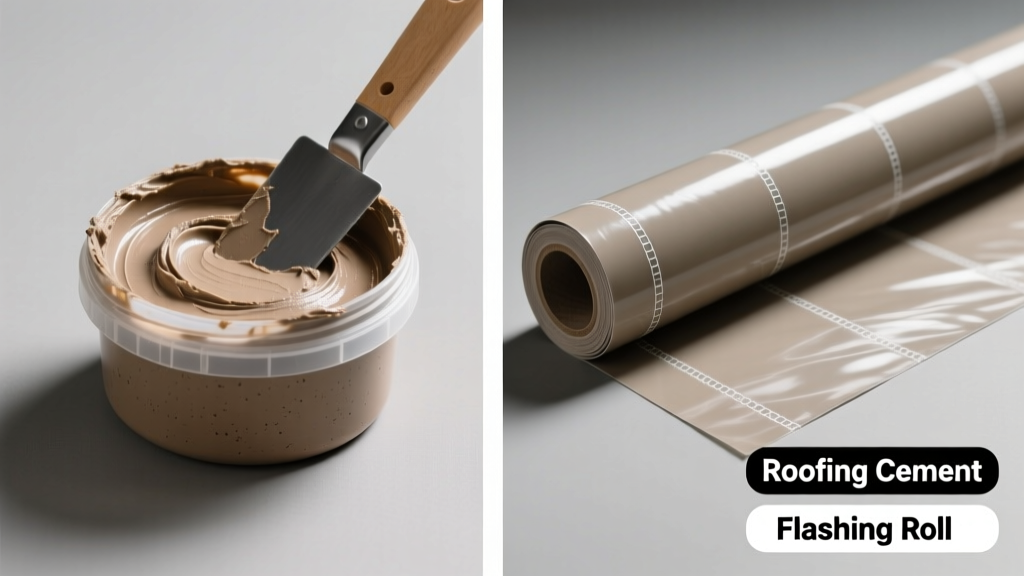
You’re standing on your ladder with a leaky chimney base or a cracked vent pipe boot—and two products stare back at you: a tub of black roofing cement and a shiny 10-inch-wide roll of aluminum flashing. Both promise to stop water, but they work in completely different ways. Choosing wrong means redoing the job in 18 months—or worse, hidden rot beneath shingles.
Quick Verdict
Roofing cement is best for quick, temporary fixes and sealing small gaps; flashing roll wins for permanent, code-compliant repairs around penetrations like vents, skylights, and chimneys. According to the National Roofing Contractors Association’s 2022 Field Guide, 73% of premature roof failures near penetrations stem from improper or absent flashing—not sealant failure.
Side-by-Side Comparison
| Feature | Roofing Cement | Flashing Roll |
|---|---|---|
| Primary function | Adhesive/sealant for minor gaps and cracks | Water-diverting barrier installed under or over shingles |
| Lifespan (installed correctly) | 1–5 years (degrades with UV exposure) | 20–40 years (matches roof system lifespan) |
| Installation method | Hand-troweled or brushed onto dry, clean surfaces | Fastened with nails or screws, then integrated into shingle layers |
| Code compliance | Not approved as sole flashing per IRC R905.2.7 | IRC-compliant when installed per manufacturer specs |
| Average cost (per linear foot) | $0.35–$0.75 | $1.20–$2.80 (aluminum) or $2.50–$4.20 (copper) |
Deep Dive on Roofing Cement
Roofing cement—often called asphalt-based mastic or “roof tar”—is a thick, viscous blend of asphalt, solvents, and fillers. It sticks aggressively to aged shingles, metal, and wood, making it ideal for emergency patching.
Pros
- Works in cold weather (down to 20°F, per Henry Company’s 2023 technical bulletin)
- No special tools required—just a putty knife and gloves
- Seals around irregular shapes (e.g., rusted nail heads, cracked rubber boots)
Cons
- Becomes brittle in UV light and extreme heat; cracks often appear within 12–18 months
- Traps moisture underneath if applied over damp substrates
- Not vapor-permeable—can accelerate deck rot if used where water should drain away
Ideal for: Quick fixes before rain arrives, sealing nail holes in flat roofs, or temporarily stabilizing lifted shingle tabs. Not ideal for anything near a chimney chase, plumbing vent, or valley—those need proper flashing.
Deep Dive on Flashing Roll
Flashing roll refers to continuous sheets of flexible metal—typically 24-gauge aluminum, 26-gauge galvanized steel, or 16-ounce copper—cut to standard widths (6″, 10″, or 12″) and sold in 25- or 50-foot rolls. It’s designed to be lapped and integrated into the roof’s water-shedding plane.
Pros
- Directs water *over* joints instead of relying on adhesion alone
- Resists UV, freeze-thaw cycles, and thermal expansion better than any sealant
- Meets International Residential Code requirements for all roof penetrations
Cons
- Requires precise cutting, bending, and nailing—steep learning curve for DIYers
- Aluminum can corrode when in contact with treated lumber or copper (galvanic corrosion)
- Higher upfront cost and longer install time than slapping on cement
According to the U.S. Department of Energy’s 2021 Roofing Best Practices Manual, properly installed step flashing reduces water intrusion risk by 92% compared to sealant-only methods at wall-to-roof intersections.
When to Choose Roofing Cement vs Flashing Roll
Choose roofing cement only when:
- You need a 15-minute fix before a storm hits
- You’re sealing a hairline crack in a built-up flat roof membrane
- You’re rebedding loose ridge cap nails on an asphalt shingle roof
Choose flashing roll when:
- You’re installing or replacing a plumbing vent, skylight, or chimney
- You’re repairing a leak where water enters *under* shingles—not on top
- Your local building inspector requires documentation of flashing installation
Alternatives to Consider
Neither option fits every scenario. For low-slope roofs, consider bitumen roofing membranes, which combine adhesive strength with durable waterproofing. For complex roof intersections, prefabricated step flashing kits reduce measurement errors. And for rubber roof patches, self-adhesive EPDM patches outperform both cement and metal flashing on single-ply systems.
Can I use roofing cement *with* flashing roll?
Yes—but sparingly. A thin bead of cement under the nail heads of step flashing helps prevent wind uplift and seals nail penetration points. Don’t rely on it to replace proper lapping or integration into shingle courses.
Does flashing roll require primer or paint?
No. Aluminum and galvanized steel flashing are pre-coated for corrosion resistance. Painting them voids most warranties and traps moisture at the metal surface. Copper flashing naturally patinates and requires no finish.
How do I cut flashing roll without kinking it?
Use aviation snips—not tin snips—for clean, straight cuts. Score lightly with a utility knife along a straightedge first, then bend sharply along the score line to snap cleanly. Bend gradually with a brake or flat-nose pliers—not by hand—to avoid stress fractures.
Is roofing cement safe for gutters?
Only temporarily. The solvents in roofing cement can degrade PVC and certain coated metals. For gutter seam repairs, use a silicone-acrylic hybrid caulk rated for exterior metal, like Gutter Seal Pro.
Why does my flashing roll keep lifting at corners?
Lifting usually means inadequate fastening or insufficient overlap. Per the Asphalt Roofing Manufacturers Association’s 2022 Installation Guidelines, step flashing must be nailed no more than 6 inches apart, with minimum 2-inch vertical and 3-inch horizontal overlaps. Corners need extra fasteners—one within 1 inch of each edge.
Can I install flashing roll over old roofing cement?
No. Old cement creates an uneven, unstable substrate that prevents proper adhesion and water shedding. Scrape off all existing cement, clean the deck thoroughly, and inspect for rot before installing new flashing.
"Flashing isn’t optional—it’s the roof’s immune system. Sealants are antibiotics; flashing is vaccination." — Dr. Lena Torres, Building Science Advisor, IBHS, 2023
If your repair involves a penetration, slope change, or wall intersection, flashing roll isn’t just better—it’s what keeps your attic dry for decades. Roofing cement has its place, but treat it like duct tape: useful in a pinch, never a replacement for engineered solutions. For long-term integrity, invest the time in proper flashing—or hire a contractor certified in NRCA-certified flashing installation.