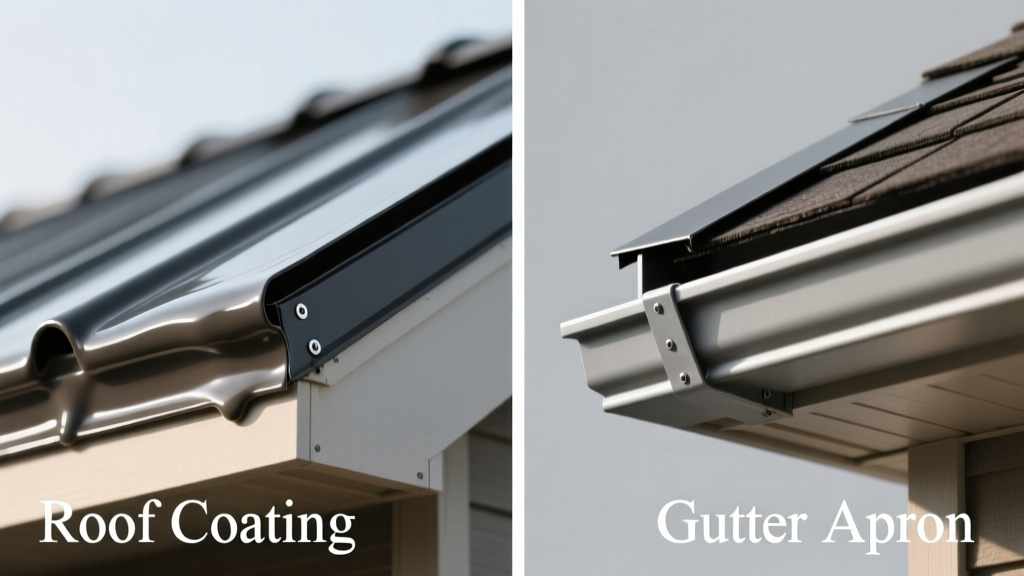
You’re spotting water stains near the eaves, noticing granule loss at the roof edge, or getting inconsistent gutter flow—and now you’re weighing two very different fixes: slathering on a liquid roof coating or installing a metal gutter apron. They solve overlapping problems but work in fundamentally different ways.
Quick Verdict
Roof coating is best for minor surface-level leaks and UV protection on low-slope or aging asphalt roofs—but it won’t stop water backing up under shingles. A gutter apron (also called drip edge flashing) is a structural fix that redirects water away from fascia and into gutters; it’s essential for new installations and critical where ice dams or wind-driven rain are common. Neither replaces the other—they’re complementary, not interchangeable.
Side-by-Side Comparison
| Feature | Rooftop Coating | Gutter Apron |
|---|---|---|
| Primary function | Seals surface cracks, reflects UV, slows aging | Channels water off roof edge, prevents fascia rot and ice dam infiltration |
| Installation method | Liquid-applied with roller or sprayer; requires dry, clean surface | Mechanically fastened under shingle starter course and over roof deck |
| Lifespan | 3–7 years (acrylic), 10–15 years (silicone or elastomeric) | 25–40+ years (aluminum or galvanized steel) |
| Average cost (per linear foot) | $0.80–$2.50 (material only); labor adds $1.50–$4.00/ft | $1.20–$3.00 (material); labor $2.00–$5.00/ft when installed during re-roof |
| Code compliance | Not required by IRC; may void shingle warranty if misapplied | Required by 2021 IRC Section R905.2.8 for all asphalt shingle roofs |
Deep Dive on Roof Coating
Rooftop coatings—especially acrylic, silicone, and polyurethane-based formulas—are designed for flat or low-slope roofs (under 3:12 pitch), though some contractors apply them to aging steep-slope roofs as a stopgap. They fill hairline cracks, reduce thermal shock, and lower rooftop surface temps by up to 50°F (U.S. Department of Energy, 2022).
Pros
- Cost-effective short-term fix for minor leaks and blistering
- Improves energy efficiency—reduces attic heat gain by 10–25% (Lawrence Berkeley National Lab, 2021)
- No tear-off needed; can be applied over existing asphalt or modified bitumen
Cons
- Won’t adhere well to dusty, chalky, or wet surfaces—prep is labor-intensive
- Useless against lateral water intrusion (e.g., wind-blown rain sneaking under shingle tabs)
- Not rated for foot traffic unless specially formulated; degrades faster on high-traffic areas
Best for: Flat commercial roofs, aging residential flat sections (like porches), or homes in hot, dry climates where UV degradation outpaces water intrusion.
Deep Dive on Gutter Apron
A gutter apron—often confused with standard drip edge—is a bent L-shaped metal strip (typically 2" x 2") installed under the first course of shingles and over the front lip of the gutter. Unlike drip edge, which sits only along the rakes and eaves, the apron extends *into* the gutter channel to prevent water from spilling behind it.
Pros
- Physically blocks water from bypassing the gutter—a leading cause of fascia rot and soffit damage
- Required by building code in 42 states for new shingle roofs (International Code Council, 2021 IRC)
- Works synergistically with ice and water shield—especially critical in northern climates
Cons
- Cannot be retrofitted without lifting or replacing shingles—costly if roof is otherwise sound
- Poorly installed aprons (e.g., too shallow or unsealed seams) create new leak paths
- Aluminum versions dent easily during gutter cleaning; galvanized steel may rust if cut edges aren’t sealed
According to the Insurance Institute for Business & Home Safety's 2023 report, homes with properly installed gutter aprons saw a 68% reduction in eave-related water damage claims compared to those with only standard drip edge.
"A gutter apron isn’t optional—it’s the last line of defense before water hits your fascia board. Skip it, and you’re betting your $2,000+ soffit/fascia repair on perfect weather." — Mike Delaney, certified roofing inspector (NRCA, 2022)
When to Choose Roof Coating vs Gutter Apron
Choose roof coating if your roof is intact but showing early signs of aging—fading color, light granule loss, or small blisters—and you’re in a region with minimal freeze-thaw cycles. It’s also smart for budget-conscious homeowners delaying a full replacement by 2–4 years.
Choose a gutter apron if you’re installing a new roof, live in a snowy climate, or already see staining or softening along the fascia board. It’s non-negotiable for homes with wood or composite fascia, and highly recommended even with PVC or aluminum trim.
- New construction or re-roof: Install gutter apron—no debate
- Flat roof with ponding water: Prioritize coating + proper drainage correction
- Leak near gutter line + soft fascia: Apron is urgent; coating won’t help
- Asphalt shingles 12+ years old, no visible damage: Coating may buy time—but inspect for missing apron first
Alternatives to Consider
Neither option solves every edge-of-roof issue. For persistent leaks, consider these alternatives:
- Ice and water shield extended 24" past the exterior wall—ideal for snow-prone zones
- Standard drip edge (if apron isn’t feasible)—better than nothing, but less effective at sealing the gutter interface
- Ridge vent + soffit ventilation upgrade to reduce condensation and ice dam formation at the eaves
- Custom-fabricated copper aprons for historic homes—more durable and corrosion-resistant than aluminum
Can I install a gutter apron myself?
Yes—but only if you’re comfortable removing and resetting shingles without breaking them. Misalignment by even ¼" can cause water to overshoot the gutter. Most DIYers underestimate how much shingle-lifting affects aesthetics and warranty coverage.
Does roof coating work on shingle roofs?
Technically yes, but most manufacturers void warranties if applied over asphalt shingles. The Asphalt Roofing Manufacturers Association (ARMA, 2020) explicitly advises against it due to adhesion failure and trapped moisture. Exceptions exist for specialty elastomeric products tested for steep-slope use—but verify third-party certification (e.g., UL 790 Class A).
How long does gutter apron installation take?
On a standard 2,000 sq ft home with accessible eaves, professional installation takes 2–4 hours—usually bundled with roof replacement. Retrofitting adds 6–10 hours due to shingle removal, flashing integration, and resealing.
Will roof coating stop leaks at the gutter line?
Rarely. Coatings seal horizontal surfaces—not the vertical gap between shingle underside and fascia. That gap is where wind-driven rain enters, and only physical flashing (like an apron) bridges it reliably.
Is gutter apron necessary with seamless gutters?
Yes. Seamless gutters eliminate joints—but they don’t change how water flows off the roof deck. Without an apron, water still rolls off the shingle edge and drips behind the gutter, especially during heavy rain or ice melt.
Can I add roof coating *after* installing a gutter apron?
Only on the field of the roof—not over the apron or shingle edge. Coating over metal flashing causes premature peeling and traps moisture at the critical shingle-to-flashing interface. Leave the apron exposed and functional.
If your roof’s edge is leaking, start with the fundamentals: inspect for missing or corroded apron first, then assess shingle condition and slope. A coating might extend life—but it won’t replace physics. For long-term resilience, pair a properly installed gutter apron with routine gutter maintenance and seasonal debris removal. When in doubt, get a second opinion from a contractor who carries both NRCA and GAF Master Elite credentials—they’ll tell you what your roof actually needs, not just what’s easiest to sell.