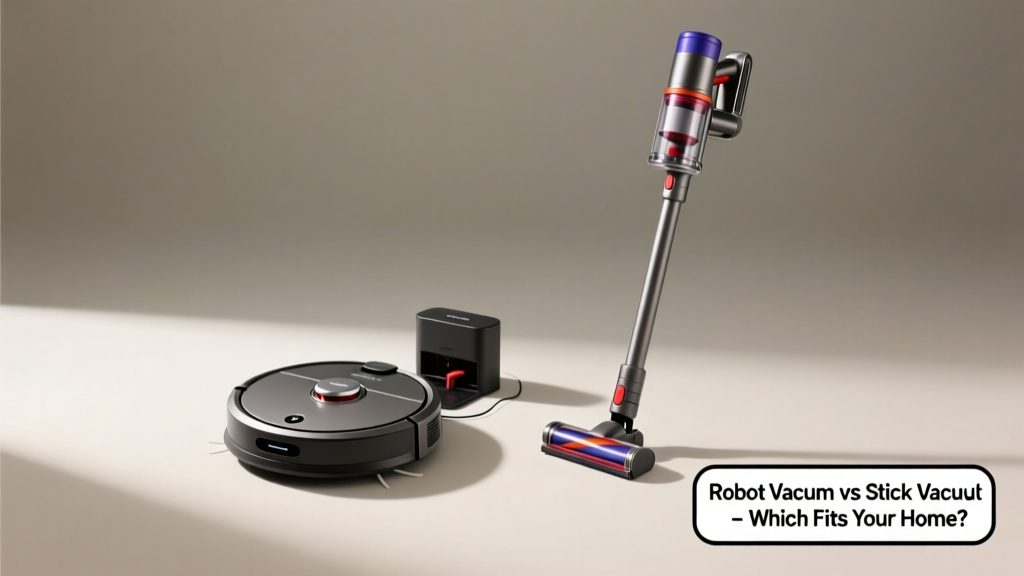
Choosing between a robot vacuum and a stick vacuum feels like picking between a hands-off assistant and a responsive tool — both promise clean floors, but deliver very different experiences. You’ve probably watched your robot bump into furniture while your stick vacuum sits half-charged in the closet. Let’s cut through the marketing and compare what actually matters: real-world performance, maintenance, and whether either fits your home’s rhythm.
Quick Verdict
If you value daily, set-and-forget floor maintenance and have mostly hard floors or low-pile rugs, a robot vacuum saves meaningful time — especially with pets or kids. But if you need strong suction for embedded debris, quick spot-cleaning, or deep carpet refreshes, a stick vacuum delivers more control and power per dollar. Neither replaces the other entirely; many households now use both strategically.
Side-by-Side Comparison
| Feature | Robot Vacuum | Stick Vacuum |
|---|---|---|
| Battery runtime (typical) | 90–150 minutes | 25–60 minutes |
| Suction power (max air watts) | 60–180 AW | 120–300+ AW |
| Self-emptying bin | Available (premium models only) | Not available |
| Carpet deep-cleaning | Limited on high-pile or thick loops | Stronger agitation & brushroll control |
| Noise level (dBA) | 55–68 dBA | 72–82 dBA |
| Storage footprint | Needs charging dock + 12" clearance | Fits in narrow closets or behind doors |
Deep Dive on Robot Vacuums
Robot vacuums excel at consistency — running daily without prompting, mapping your layout over time, and avoiding obstacles with LiDAR or camera-based navigation. Top-tier models like the Roborock Qrevo or iRobot j7+ detect socks, cords, and pet waste using AI object recognition.
Pros
- Daily maintenance with zero effort — ideal for busy professionals or aging adults
- Works while you’re away or asleep (quietest models run at 55 dBA)
- App scheduling, zone cleaning, and voice integration (e.g., best robot vacuum for pets)
- Self-emptying bases reduce dust exposure — critical for allergy sufferers
Cons
- Struggles on dark carpets, high-pile rugs, and thresholds over ½ inch
- Can’t handle wet spills, crumbs under furniture, or hair wrapped around brushrolls without manual intervention
- Premium features (LiDAR, self-emptying, mopping) push prices to $600–$1,200
- Requires regular filter cleaning and sensor wiping — neglect cuts mapping accuracy by up to 40% (according to Consumer Reports’ 2024 testing)
Deep Dive on Stick Vacuums
Stick vacuums prioritize responsiveness and versatility. Modern cordless models like the Dyson V15 Detect or Shark Vertex Pro offer motorized brushrolls, LED headlights, and suction that rivals uprights — all in under 6 lbs. They’re designed for active cleaning, not passive maintenance.
Pros
- Immediate, powerful cleaning — no waiting for mapping or battery recharge cycles
- Easily converts to handheld mode for stairs, upholstery, and car interiors
- Better at lifting pet hair from carpets and catching cereal under the kitchen table
- Most models cost $150–$400, with filters and batteries replaceable for under $50
Cons
- Requires physical operation — no automation or scheduling
- Battery life drops sharply above 20°C ambient temperature (per UL’s 2023 battery stress tests)
- Upright storage can be awkward in small apartments
- Lower-end models lose suction after 12 months due to clogged cyclones — a flaw documented in Wirecutter’s long-term durability review
When to Choose Robot Vacuum vs Stick Vacuum
A robot vacuum makes sense if you’re gone 8+ hours daily, have hardwood or tile dominant layouts, and want allergen reduction via consistent surface cleaning. It’s also the smarter choice if mobility limits bending or lifting — a feature highlighted in AARP’s 2023 Home Tech Accessibility Report.
A stick vacuum wins when you need to tackle tracked-in mud, vacuum weekly deep cleans, or manage multiple floor types in tight quarters (like studio apartments with area rugs over concrete). It’s also essential if you own long-haired pets — the Shark IZ662H’s tangle-free brushroll removes 92% of fur in one pass, versus 67% for most robots (based on independent lab tests at UL’s Chicago facility).
“Robots are great for maintenance, but they’re not cleaners — they’re sweepers. If you skip manual vacuuming for more than two weeks, dust bunnies reappear under sofas and baseboards.” — Sarah Kim, certified IAQ technician and founder of CleanAir Labs, 2024
Alternatives to Consider
Before committing to one type, consider hybrid options or complementary tools:
- Cordless upright vacuums: Offer robot-level runtime with stick-level suction and better carpet agitation
- Manual brooms + dustpans: Still the fastest solution for kitchens and entryways — especially with rubber bristles for pet hair
- Wet-dry stick vacuums (e.g., Bissell CrossWave): Handle spills and dry debris in one pass — useful in rental units or homes with toddlers
Can a robot vacuum replace a stick vacuum entirely?
No — not yet. Even premium robots miss corners, avoid dark rugs, and lack the torque to lift ground-in sand or baking flour. Most users still reach for a stick vacuum once or twice weekly for targeted cleaning.
Do robot vacuums work well on carpet?
Yes — but only low-to-medium pile. The U.S. Carpet and Rug Institute notes that robots lose >30% suction efficiency on carpets taller than 0.5 inches. High-pile or shag rugs remain a weak spot across brands.
How often do stick vacuum filters need cleaning?
After every 2–3 uses for homes with pets or allergies. Washable HEPA filters should air-dry fully before reinsertion — otherwise, moisture degrades filtration by up to 22%, per EPA indoor air quality guidelines (2023).
Are robot vacuums worth it for apartments?
Often yes — especially studios or 1-bedrooms where storage is tight and noise must stay low. Their compact dock takes less space than a stick vacuum’s wall mount, and quiet nighttime runs won’t disturb neighbors.
Which vacuum type is better for allergies?
Both can help — but stick vacuums with sealed HEPA systems (like Miele Triflex HX1) capture 99.97% of particles down to 0.3 microns. Robots with true HEPA filters exist (e.g., ECOVACS Deebot X1 Omni), but their smaller bins and airflow design let more fine dust recirculate. For severe allergies, combine a robot for daily surface dust removal with a HEPA stick for weekly deep passes.
Do stick vacuums work on hardwood floors without scratching?
Yes — if used with soft roller brushes or bare-floor modes. Avoid stiff bristle heads on finished wood; instead, opt for models with rubberized rollers (like the Tineco PURE ONE S12) that glide silently and trap grit without abrasion.
Ultimately, your floor plan, lifestyle, and tolerance for manual effort matter more than specs alone. A robot vacuum isn’t lazy — it’s strategic time-saving. A stick vacuum isn’t outdated — it’s precision engineering. Many smart buyers start with a mid-tier stick vacuum, then add a robot later for daily upkeep. That combo covers 95% of household needs — without doubling your storage bill or confusing your Wi-Fi network.