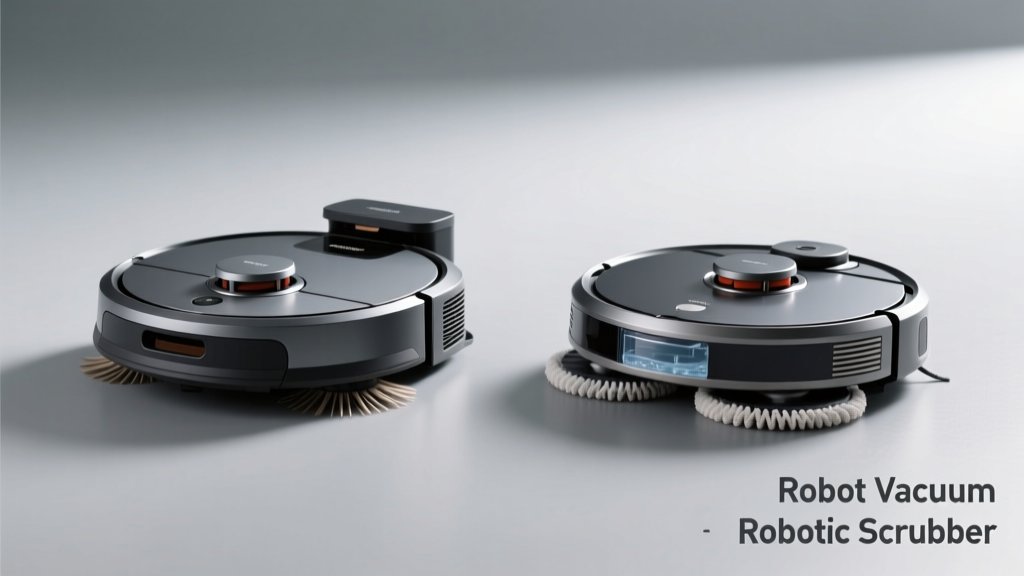
You’re standing in your kitchen, staring at dust bunnies under the island and a faint coffee ring on the tile—and you’re wondering: should you get a robot vacuum or a robot scrubber? It’s not just about convenience; it’s about whether the device actually handles your floor type, debris, and lifestyle.
Quick Verdict
A robot vacuum excels at daily dry pickup—dust, pet hair, cereal crumbs—but does nothing for sticky spills or grime. A robot scrubber tackles light mopping, smudges, and dried-on residue, but struggles with loose debris and requires more setup. Neither replaces a deep clean, but they solve different problems: one manages what falls, the other addresses what sticks.
Side-by-Side Comparison
| Feature | Robot Vacuum | Robotic Scrubber |
|---|---|---|
| Cleaning action | Suction + brushroll (dry only) | Rotating pads + water tank + light pressure (wet only) |
| Battery life (avg.) | 90–150 minutes | 45–75 minutes |
| Water capacity | None | 250–450 mL |
| Floor types supported | Hard floors, low-pile carpet | Tile, sealed hardwood, LVP, vinyl — not carpet |
| Debris handling | Excels with dry particulates (hair, dust, crumbs) | Poor with loose debris; clogs easily if not pre-vacuumed |
| Auto-empty compatibility | Yes (e.g., iRobot Combo j9+, Roborock S8 Pro Ultra) | No — tanks must be emptied and cleaned manually |
Deep Dive on Robot Vacuums
Robot vacuums are mature tech—over 60% of U.S. smart home owners with hard floors own one (CIRP, 2023). They navigate well around furniture, map multi-room layouts reliably, and handle daily maintenance without supervision.
Pros
- Strong suction (up to 6,000 Pa on premium models like the Roborock Qrevo)
- Works unattended overnight or while you’re at work
- Many support voice control, scheduling, and no-go zones via app
- Low maintenance: empty bin weekly, clean brushes monthly
Cons
- No wet cleaning — won’t lift dried juice, grease, or footprints
- Struggles with dark rugs, black tiles, and high-gloss surfaces (navigation errors)
- Can scatter larger debris (e.g., popcorn kernels, pet kibble) instead of capturing it
If your main issue is pet hair floating across laminate or dust building up near entryways, a robot vacuum like the best robot vacuum for pet hair solves that consistently. But don’t expect it to replace your Swiffer.
Deep Dive on Robotic Scrubbers
Robotic scrubbers are newer and less standardized. Most use dual spinning microfiber pads and controlled water release—some even add vibration or light scrubbing pressure. Their effectiveness hinges on floor porosity and how much prep you do first.
Pros
- Removes light surface grime, smudges, and dried spills better than wiping by hand
- Consistent pressure and motion reduce streaking on tile and vinyl
- Models like the Ecovacs Deebot X1 Omni integrate auto-wash, auto-dry, and vacuum-mop combo
Cons
- Requires pre-cleaning: vacuum first, or pads gum up with hair and lint
- Limited runtime means small areas per charge — a 500 sq ft kitchen may need two cycles
- Water tanks leak if overfilled; pads must be rinsed and air-dried after every use
According to the U.S. EPA’s 2023 Indoor Air Quality Guide, damp mopping reduces allergen resuspension by up to 40% compared to dry sweeping—making scrubbers especially useful for allergy-prone households with sealed hard floors.
"Most users buy scrubbers expecting ‘set-and-forget’ mopping—but forget that robot scrubbers aren’t autonomous cleaners. They’re autonomous *moppers*—and only work well when paired with a vacuum-first routine." — Lena Cho, Home Robotics Tester at Wirecutter (2024)
When to Choose Robot Vacuum vs Scrubber
Choose a robot vacuum if: you have pets shedding year-round, live in a high-traffic apartment with mostly hard floors, or want zero-touch dry cleanup. Choose a scrubber if: your floors show daily scuffs (e.g., kids’ footprints on tile), you cook often and deal with light grease splatter, or you’ve already got a vacuum and want to cut down on manual mopping.
For homes with both needs, consider a vacuum-mop combo robot—but know that most still compromise on either suction power or scrubbing pressure. The Roborock S8 Pro Ultra delivers 6,000 Pa suction *and* sonic mopping, but costs $1,300 and weighs 8.2 lbs—making it harder to lift onto countertops for tank refills.
Alternatives to Consider
Before committing to either robot, ask: is automation really solving your biggest pain point? Sometimes simpler tools deliver more reliability:
- Spin mop + bucket system (e.g., O-Cedar EasyWring): $35, covers 400 sq ft in 8 minutes, no charging or app needed
- Cordless stick vacuum with soft roller (e.g., Dyson V8 Fluffy): $250, handles dry + light damp wipe with optional accessory
- Steam mop (e.g., Bissell PowerFresh): $120, sanitizes and lifts grime without chemicals—but not for daily use on engineered wood
Can a robot vacuum clean under furniture?
Yes—if it’s under 3.6 inches tall. Most modern vacuums (like the Eufy X8 Hybrid) clear standard sofa legs and bed frames. Low-profile models like the Roborock S7 MaxV Ultra drop to 3.3 inches, but lose some battery capacity to fit.
Do scrubbers damage hardwood floors?
Only if used incorrectly. Sealed hardwood is safe; unsealed or oiled floors are not. Always check manufacturer specs—and never let water pool. The National Wood Flooring Association warns that repeated moisture exposure causes cupping, especially near HVAC vents.
How often do scrubber pads need replacing?
Every 2–3 months with daily use, or sooner if fraying or discoloration appears. Microfiber pads last longer than sponge-based ones, but require machine washing (cold, no fabric softener) to maintain absorbency.
Are robot vacuums noisy?
Most run at 55–68 dB—similar to a quiet conversation. Turbo mode on high-end models hits 72 dB, comparable to a shower. If noise matters, schedule cleaning during daytime hours or choose a model with a ‘Quiet Mode’ (e.g., Neato D10).
Can scrubbers handle pet urine residue?
No. They spread diluted urine rather than neutralize it. For organic stains, use an enzymatic cleaner first—then follow with a scrubber for general maintenance. The American Kennel Club recommends avoiding steam or excessive moisture on accident sites to prevent odor reactivation.
Neither robot is a magic wand—but used intentionally, each fills a real gap in your cleaning rhythm. Match the tool to the mess, not the marketing. And if your floors are mostly carpet? Skip both and look into upright vacuums built for deep pile.