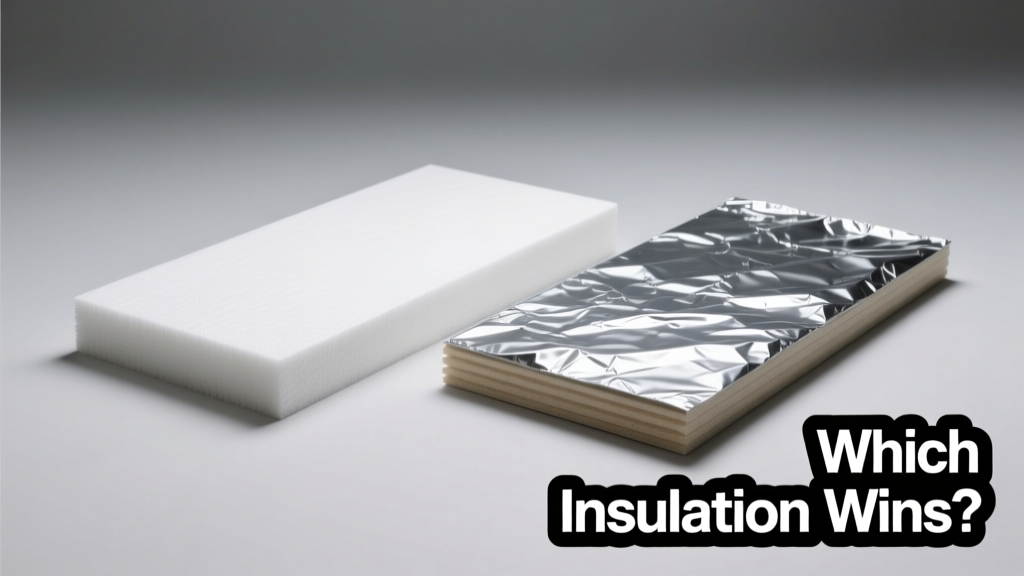
You’re upgrading insulation and staring at two very different materials: one’s a dense, inch-thick panel you tape and seal; the other’s a shiny foil sheet stapled to rafters. It’s not just apples and oranges—it’s conduction versus radiation. Choosing wrong means wasted money, comfort gaps, or even moisture trouble.
Quick Verdict
Rigid foam board delivers measurable, consistent thermal resistance (R-4 to R-6.5 per inch) and air sealing—ideal for walls, foundations, and unvented roofs. Radiant barrier reflects up to 97% of radiant heat but adds zero R-value and only works where there’s an air gap and significant solar-driven heat gain—best in hot, sunny attics. Neither replaces the other; they solve different physics problems.
Side-by-Side Comparison
| Feature | Rigid Foam Board | Radiant Barrier |
|---|---|---|
| R-value per inch | R-4.0 (XPS) to R-6.5 (polyiso) | R-0 (no conductive resistance) |
| Primary heat control method | Blocks conduction & convection | Reflects radiant heat |
| Installation complexity | Moderate: requires cutting, sealing seams, fastening | Low: staple or staple-and-drape over rafters |
| Air sealing capability | Yes—when seams are taped and edges sealed | No—does not stop air leakage |
| Moisture sensitivity | XPS resists water; EPS absorbs if exposed; polyiso needs facing | Foil degrades if condensation forms behind it |
| Typical cost (per sq ft) | $0.40–$1.20 (material only) | $0.15–$0.35 (material only) |
Deep Dive on Rigid Foam Board
Rigid foam board comes in three main types: extruded polystyrene (XPS), expanded polystyrene (EPS), and polyisocyanurate (polyiso). XPS is blue or pink, moisture-resistant, and holds R-5 per inch. EPS (white beadboard) is cheaper but compresses more easily and gains R-value slowly as it ages. Polyiso offers the highest R/inch (up to R-6.5) but loses efficiency below 40°F and requires a facer to protect the core.
Pros
- Adds real, quantifiable R-value—critical in cold climates or where code requires minimum wall R-values
- Acts as an effective air barrier when installed with sealed seams (reducing infiltration by up to 30%, per Building Science Corporation’s 2022 field studies)
- Works well below grade (e.g., foundation insulation) and in unvented cathedral ceilings
Cons
- Requires careful detailing: gaps around windows, electrical boxes, or rim joists undermine performance
- Polyiso and XPS contain HFC blowing agents with high global warming potential (though newer formulations like Honeywell’s Solstice® reduce this impact)
- Not fire-rated alone—must be covered with 15-minute thermal barrier (e.g., drywall) in living spaces per IRC R316
Deep Dive on Radiant Barrier
Radiant barrier consists of low-emissivity aluminum foil laminated to kraft paper, plastic film, or cardboard. It works only when facing an air space—and only against radiant heat transfer, which dominates in attics on summer afternoons. Its effectiveness drops sharply if dust accumulates on the foil surface or if installed without a ≥3/4" air gap.
Pros
- Cost-effective way to reduce attic surface temperatures—studies by the Florida Solar Energy Center show peak roof deck temps drop 10–25°F in summer
- Lightweight and easy to retrofit into existing attics (e.g., stapled to underside of rafters)
- No off-gassing concerns; non-toxic and Class A fire-rated when laminated properly
Cons
- Zero R-value—won’t slow conductive or convective heat flow
- Ineffective in cold climates or shaded roofs; can even increase heating loads slightly in winter by reflecting interior heat back upward
- Condensation risk if installed directly against roof sheathing without ventilation—especially in humid regions like the Southeast
When to Choose Rigid Foam Board vs Radiant Barrier
Choose rigid foam board if you’re insulating basement walls, exterior sheathing during a re-siding project, or building a new energy-efficient home in Climate Zones 4–8. It’s mandatory for meeting IECC 2021 above-grade wall requirements in most northern states. Choose radiant barrier only if you have a vented attic in Climate Zones 1–3 (think Phoenix, Houston, or Orlando) and already meet minimum ceiling R-value (R-38) but still suffer from oppressive afternoon heat gain.
"Radiant barriers cut cooling loads—but only when installed correctly over a ventilated attic floor or under rafters with an air gap. In 70% of homes we audited in Texas, improper installation reduced effectiveness by over half." — Dr. Danny Parker, FSEC, 2023 Attic Performance Report
Alternatives to Consider
Don’t limit yourself to just these two. Spray foam insulation (open- or closed-cell) bridges both conductive and radiant control while air-sealing—but costs 3× more than rigid foam. Dense-packed cellulose offers high R-value and excellent sound damping in walls and attics, though it settles slightly over time. For hybrid solutions, consider rigid foam + radiant barrier combo in hot-climate attics: foam on the roof deck plus foil under rafters.
Can I install radiant barrier over existing fiberglass batts?
No—this creates a moisture trap. Foil must face an air space. Laying it directly on top of batts eliminates the required gap and risks condensation in winter. Instead, staple it to rafter undersides or hang it beneath the rafters as a draped sheet.
Does rigid foam board need a vapor barrier?
It depends on your climate and assembly. XPS (perm rating ~1.1) acts as a Class III vapor retarder—often sufficient in mixed-humid zones. In cold climates (Zones 6–8), interior vapor retarders (e.g., latex paint) are usually adequate; adding polyethylene behind drywall risks trapping moisture. Always consult our vapor barrier guide for zone-specific advice.
Will radiant barrier lower my electric bill?
Yes—but modestly. The U.S. Department of Energy estimates 5–10% cooling energy reduction in hot, sunny climates—if installed correctly and paired with adequate attic ventilation and existing insulation. It won’t move the needle in cloudy, mild, or cold regions.
Can I use rigid foam board in an attic?
Absolutely—and increasingly common. When applied to the underside of roof decking (unvented roof assembly), it prevents ice dams and allows higher R-values than blown-in options. Just ensure proper dew point control: use at least 40% of total R-value as foam (e.g., R-20 foam + R-30 cellulose for R-50 total) in Zone 5+ per ASHRAE 90.1.
Is foil-faced polyiso the same as radiant barrier?
No. Foil facing on polyiso reduces its own radiant exchange *within the board*, but it doesn’t function as a standalone radiant barrier unless installed with an adjacent air gap. Its primary value remains its high R/inch—not reflection.
Neither material is universally "better." Rigid foam tackles the full spectrum of heat flow; radiant barrier targets one narrow band—intensely useful in specific conditions, irrelevant elsewhere. Match the tool to the job: insulation for steady-state loss, reflection for solar-driven spikes. And remember: air sealing and proper ventilation often matter more than either choice alone. For deeper guidance, see our attic insulation options and wall insulation types comparisons.