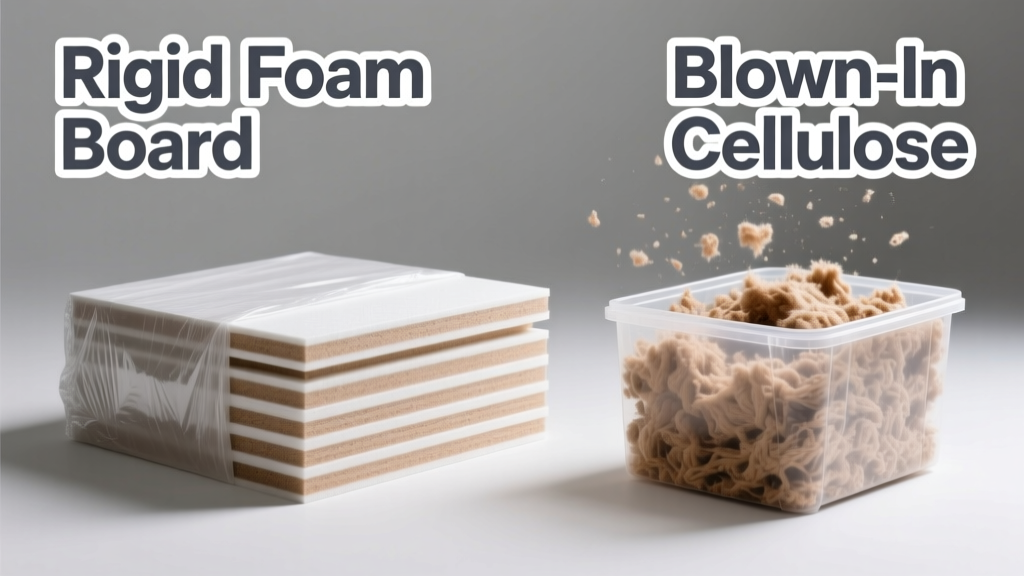
Choosing between rigid foam board and blown-in cellulose isn’t just about R-value—it’s about where you’re insulating, what’s behind the walls, and whether you’re building new or retrofitting an older home. Both materials solve heat loss, but they do it in fundamentally different ways—and misalignment with your project can mean higher bills, moisture trouble, or costly callbacks.
Quick Verdict
Rigid foam board wins for continuous exterior sheathing, basement walls, and applications needing high R-value per inch and vapor control. Blown-in cellulose excels in existing wall cavities, attics, and eco-conscious retrofits where air sealing and affordability matter more than compressive strength. Neither is universally better—your structure’s age, climate zone, and assembly details decide the winner.
Side-by-Side Comparison
| Feature | Rigid Foam Board | Blown-In Cellulose |
|---|---|---|
| R-value per inch | 3.6–6.5 (XPS: 5.0, Polyiso: 6.5) | 3.2–3.7 (settled) |
| Air sealing ability | Moderate (requires taped seams) | High (fills gaps, conforms to obstructions) |
| Moisture resistance | Low permeability (XPS: 1.1 perm; Polyiso: 0.8–2.0) | Permeable (1–3 perms); absorbs & redistributes moisture |
| Installation method | Manual cutting, fastening, seam taping | Machine-blown through holes or open attic floor |
| Material composition | Petroleum-based plastic (XPS, EPS, Polyiso) | Recycled newsprint (80%+ post-consumer content) |
| Fire resistance | Flame spread 5–25 (Class A when covered) | Treated with borates (flame spread ~25, Class A) |
Deep Dive on Rigid Foam Board
Rigid foam board comes in three main types: extruded polystyrene (XPS), expanded polystyrene (EPS), and polyisocyanurate (polyiso). XPS offers consistent R-5 per inch and high compressive strength—ideal for below-grade use. Polyiso delivers the highest R-value per inch (up to R-6.5) but loses efficiency below 40°F. EPS is the most affordable but has lower R-value and higher water absorption.
Pros
- Superior R-value per inch—critical where space is tight (e.g., cathedral ceilings or rim joists)
- Acts as a vapor retarder (especially XPS and polyiso), reducing condensation risk in cold climates
- Provides structural bracing when installed over studs and sheathed properly
- Resistant to mold, rot, and insects when installed correctly
Cons
- Requires meticulous seam taping and flashing integration to prevent thermal bridging and air leakage
- Not biodegradable; XPS contains HFC blowing agents with high global warming potential (GWP)
- Poor fire performance when exposed—must be covered with 15-minute thermal barrier (e.g., drywall)
- Difficult to retrofit into existing walls without major demolition
According to the Insurance Institute for Business & Home Safety’s 2023 report on residential envelope performance, homes with continuous exterior rigid foam saw 22% less heating energy use in Zone 6 compared to cavity-only insulation—but only when seams were fully sealed and windows integrated with the drainage plane.
Deep Dive on Blown-In Cellulose
Blown-in cellulose is densely packed into wall cavities or attic floors using specialized equipment. It’s made from shredded, borate-treated newspaper and performs best when installed at densities of 3.0–3.5 lbs/ft³. Its fibrous, conforming nature helps reduce convective looping inside walls—a weakness of fiberglass batts.
Pros
- Excellent air infiltration reduction—studies show up to 30% better air sealing than fiberglass batts in stud cavities (Oak Ridge National Laboratory, 2021)
- High recycled content and low embodied energy—EPA estimates cellulose uses 10x less energy to manufacture than XPS
- Natural fire and pest resistance from borate treatment (no off-gassing)
- Cost-effective for attic upgrades and retrofit wall fills—typically $1.20–$1.80 per square foot installed
Cons
- Loses R-value if wet and not dried quickly; prolonged saturation compromises integrity
- Can settle over time if under-dense—leading to top-of-wall voids (mitigated by dense-pack method)
- Requires access points (drill-and-fill) for walls, which may damage finishes or require patching
- Not suitable for below-grade or direct-contact-with-soil applications
When to Choose Rigid Foam Board vs Blown-In Cellulose
Choose rigid foam board when insulating exterior sheathing on new construction, insulating basement concrete walls, or adding continuous insulation over existing siding during a re-siding project. It’s also the go-to for roof assemblies requiring dew point control—like unvented cathedral ceilings in cold climates.
Opt for blown-in cellulose when upgrading insulation in older homes with balloon framing, filling irregular attic spaces around ductwork and plumbing, or meeting Passive House air-tightness targets on a budget. It’s especially effective in mixed-humid climates where vapor-open assemblies help manage seasonal moisture drive.
Alternatives to Consider
If neither rigid foam nor cellulose fits your constraints, consider these alternatives:
- Closed-cell spray foam for air sealing + high R/inch—but at 3–4x the cost
- Mineral wool boards for fire resistance and moisture tolerance in rainscreen cavities
- Dense-packed fiberglass as a non-dust, non-irritant option for contractors avoiding cellulose dust
Can I combine rigid foam and cellulose?
Yes—and it’s often ideal. Use 1–2 inches of exterior XPS or polyiso over sheathing to interrupt thermal bridging, then fill stud cavities with dense-packed cellulose. This hybrid approach meets IECC 2021 requirements for Zone 5+ while balancing cost, performance, and drying potential.
Does cellulose cause corrosion on electrical wiring?
No—modern borate-treated cellulose is non-corrosive. UL testing confirms no increased corrosion versus ambient air. However, avoid contact with bare NM cable splices unless protected by junction boxes; this applies to all loose-fill insulations.
Is rigid foam safe around recessed lights?
Only if rated IC (Insulation Contact) and installed per manufacturer specs. Non-IC fixtures require ≥3 inches of clearance—rigid foam must be cut back or replaced with mineral wool in those zones. Always verify fixture labeling and local code amendments.
How long does blown-in cellulose last?
Properly installed dense-pack cellulose lasts the life of the structure—50+ years—with no degradation in R-value. The U.S. Department of Energy notes that cellulose maintains >95% of its original performance when kept dry and undisturbed (DOE Building Technologies Office, 2022).
Does rigid foam need a vapor barrier in my climate?
Not necessarily—and adding one can be harmful. In most climates, the foam itself acts as the vapor retarder. Installing an interior polyethylene barrier with exterior foam risks trapping moisture in the wall cavity. Consult your local building code’s vapor retarder class table (IRC Table R702.7) before layering barriers.
There’s no universal “best” insulation—only the best choice for your assembly, budget, and goals. Rigid foam gives you precision and control where space and moisture management are critical. Cellulose gives you whole-assembly performance where affordability, sustainability, and air sealing take priority. Match the material to the job—not the other way around.