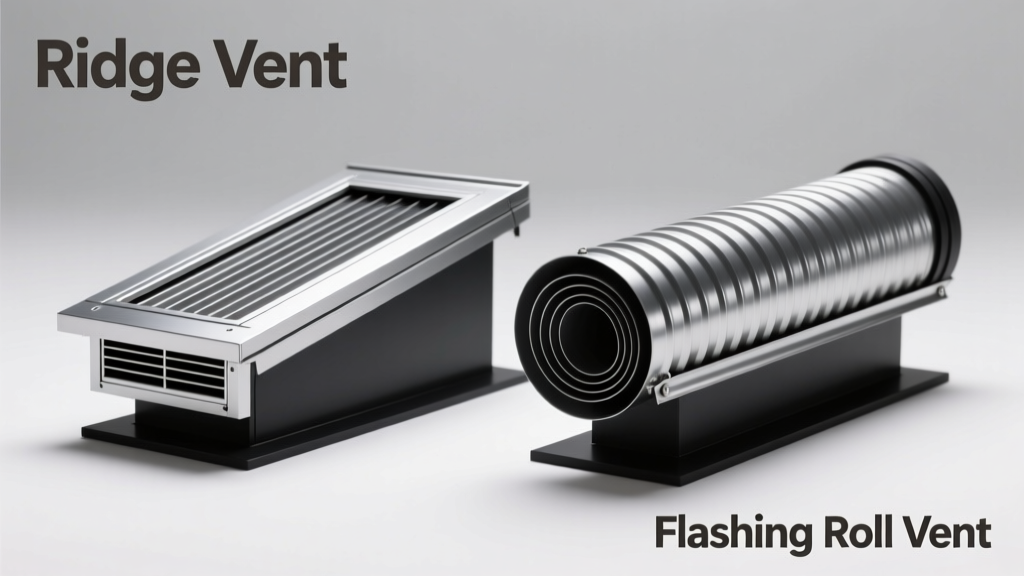
Choosing between a ridge vent and a flashing roll isn’t just about price—it’s about airflow, moisture control, and long-term roof integrity. Homeowners and contractors often stall at this decision because both look similar from the ground but function very differently under the shingles.
Quick Verdict
Ridge vents win for whole-roof, passive attic ventilation in standard sloped roofs with consistent rafter spacing. Flashing rolls excel as localized, low-profile solutions for complex rooflines (dormers, valleys, or intersecting planes) where ridge installation isn’t feasible—or when retrofitting over existing decking without removing shingles. Neither is universally 'better'; context determines superiority.
Side-by-Side Comparison
| Feature | Ridge Vent | Flashing Roll |
|---|---|---|
| Installation method | Requires full ridge cap removal; installed along entire ridge line after sheathing cutout | Applied directly over existing roof deck or under shingles at penetrations or transitions |
| Airflow capacity (net free area) | 18–22 sq. in. per linear foot (e.g., Air Vent ShingleVent II) | 3–7 sq. in. per linear foot (varies by profile; e.g., GAF Cobra Roll) |
| Weather resistance | High—integrated baffle system deflects wind-driven rain and snow | Moderate—relies on proper lapping and sealant; vulnerable to ice damming if improperly overlapped |
| Labor intensity | High—requires precise cutting, alignment, and new ridge cap installation | Low to moderate—rolls out like underlayment; minimal cutting or fastening |
| Typical cost (material only, per linear foot) | $2.40–$4.10 (vented ridge cap + accessory) | $1.35–$2.80 (self-adhering or nail-on roll) |
Deep Dive on Ridge Vent
Ridge vents are continuous, low-profile exhaust systems installed along the peak of a roof. They rely on natural convection—hot, moist air rises and escapes through the vent while cooler air enters via soffit vents, creating balanced airflow.
- Pros: Highest net free area per foot; uniform exhaust across the entire ridge; wind-powered enhancement (Bernoulli effect); compatible with most asphalt shingle systems; meets 2021 IRC R806.2 ventilation requirements when paired with adequate intake
- Cons: Requires structural ridge cutout—can’t be added without disturbing existing ridge cap; ineffective on roofs with <3:12 pitch or irregular ridges; performance drops significantly without matched soffit intake (U.S. Department of Energy estimates 40% of ridge-vented attics are under-ventilated due to missing intake)
- Ideal use cases: New construction or full reroof on gable or hip roofs with ≥4:12 pitch; homes in humid climates (e.g., Southeast U.S.) where moisture buildup risks sheathing rot; attics with cathedral ceilings needing reliable exhaust.
Deep Dive on Flashing Roll
Flashing rolls—often self-adhering or nail-on membranes—are flexible, asphalt-saturated strips used to seal transitions and provide limited, targeted ventilation. While not designed as primary exhaust, some modern versions (like CertainTeed’s VentSure Roll) integrate micro-perforations for auxiliary airflow.
- Pros: Installs over existing roofing in minutes; ideal for valleys, dormer junctions, or skylight perimeters; doubles as waterproofing layer; no framing modifications needed; works on low-slope sections (<3:12) where ridge vents fail
- Cons: Minimal net free area—cannot replace whole-roof exhaust; prone to clogging from debris or granule shedding; lacks internal baffles, so wind can force rain inward during horizontal storms
- Ideal use cases: Retrofit projects where tearing off the ridge cap isn’t viable; roofs with multiple roof planes or complex geometry; historic homes with non-standard ridge profiles; supplemental ventilation near roof penetrations.
When to Choose Ridge Vent vs Flashing Roll
Select ridge vent if your roof has one continuous, straight ridge, you’re doing a full tear-off, and your attic has at least 50% of required soffit intake (per attic ventilation calculator guidelines). Choose flashing roll if you’re patching a leak-prone valley, adding ventilation near a chimney chase, or working on a cottage with intersecting gables and no accessible ridge line.
According to the National Roofing Contractors Association’s 2022 Best Practices Guide, ridge vents should supply ≥50% of total exhaust capacity in code-compliant systems—flashing rolls rarely contribute more than 5–10% unless layered across large transition zones.
"Flashing rolls are ventilation *enablers*, not ventilation *engines." — Dr. Lena Cho, Building Science Advisor, IBHS, 2023
Alternatives to Consider
Don’t limit yourself to just these two. Evaluate other options based on your roof’s constraints and goals:
- Turbine vents: Wind-powered, high-capacity exhaust—but noisy and prone to freezing in cold climates
- Continuous soffit vents: Critical intake partners; never install ridge vent without them
- Static roof louvers: Good for flat or low-slope roofs, but require roof penetration and regular cleaning
- Solar-powered attic fans: Active exhaust with measurable CFM—but add wiring, maintenance, and upfront cost ($350–$600/unit)
Can I use flashing roll *instead* of a ridge vent?
No—not for whole-roof exhaust. Flashing roll lacks the net free area and consistent airflow path needed to meet minimum ventilation standards (1:150 or 1:300 ratio per IRC). It’s a supplement, not a substitute.
Do ridge vents leak if installed correctly?
Rarely—when installed per manufacturer specs (with proper shingle overlap, end caps, and starter strip), ridge vents have a failure rate under 2% over 10 years, per the 2023 GAF Warranty Claims Report. Most leaks stem from improper nailing or skipped end dams.
Is flashing roll compatible with metal roofs?
Yes—with caveats. Use butyl-backed or peel-and-stick flashing rolls rated for metal substrates (e.g., Grace Ultra HT). Avoid standard asphalt-based rolls on standing seam roofs; thermal expansion can break adhesion. Always check compatibility with your metal panel manufacturer.
How do I know if my attic is properly ventilated?
Check for three signs: (1) No frost on rafters in winter, (2) interior roof deck temperature within 10°F of outside ambient in summer, and (3) no musty odor or visible mold on insulation. Use an infrared thermometer and a digital hygrometer—read our how to test attic ventilation guide for step-by-step instructions.
Can I install ridge vent over existing shingles?
No. Ridge vent requires cutting away the ridge cap and underlying sheathing to create the vent channel. You’ll need to remove the top course of shingles on both sides of the ridge and install new ridge cap shingles over the vent. Attempting to layer it over intact shingles creates gaps, leaks, and voids warranties.
Does flashing roll require maintenance?
Yes—annually inspect for lifted edges, granule accumulation, or sealant cracking. Clear debris from perforated versions with a soft brush; never pressure-wash, as it degrades adhesive bonds. Replace every 12–15 years, even if visually intact—the rubberized asphalt dries out and loses elasticity.
If your roof has clean lines and you’re starting fresh, ridge vent delivers superior, code-compliant airflow. But if your roof looks like a puzzle—and you need ventilation where traditional methods won’t fit—flashing roll is the pragmatic, adaptable choice. Match the tool to the job, not the brochure.