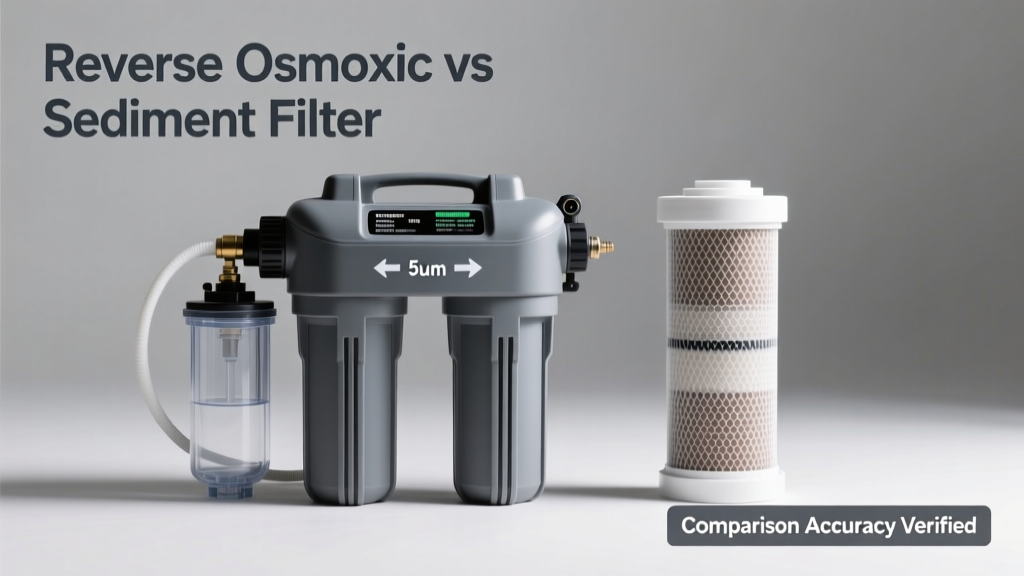
You’re standing in the hardware aisle or scrolling through Amazon, staring at two very different-looking water filters — one labeled 'reverse osmosis' with a multi-stage tank setup, the other a simple blue or white cartridge marked '5-micron sediment'. You know your water’s cloudy or your faucet clogs often, but you’re not sure whether you need heavy-duty purification or just basic particle blocking.
Quick Verdict
Neither is universally 'better' — they solve fundamentally different problems. A sediment filter removes visible particles like rust, sand, and silt *before* water reaches other treatment stages. Reverse osmosis (RO) removes dissolved contaminants — fluoride, lead, nitrates, sodium — but only works efficiently *after* sediment and carbon pre-filters are in place. Using RO without a sediment filter risks rapid clogging and costly membrane replacement. According to the Water Quality Association’s 2022 Field Service Report, 68% of premature RO membrane failures were linked to inadequate sediment pre-filtration.
Side-by-Side Comparison
| Feature | Reverse Osmosis System | Sediment Filter |
|---|---|---|
| Primary function | Removes dissolved solids (TDS), ions, and molecules down to 0.0001 microns | Traps suspended particles ≥ 0.5–100 microns (e.g., rust flakes, sand, algae) |
| Typical location in system | Third or fourth stage, after sediment + carbon pre-filters | First stage — always installed upstream of all other filters |
| Lifespan | Membrane lasts 2–5 years; pre-filters every 6–12 months | Cartridge lasts 3–6 months (sooner with high turbidity) |
| Average cost (installed) | $250–$600 for under-sink RO; $1,200+ for whole-house | $15–$45 for standard 10" spin-down or pleated cartridge |
| Water waste ratio | 1 gallon purified : 2–4 gallons wasted (varies by model) | No wastewater — 100% flow-through efficiency |
Deep Dive on Reverse Osmosis
RO forces water under pressure through a semi-permeable membrane that rejects up to 99% of total dissolved solids. It’s the gold standard for drinking water purity in homes with well water high in arsenic or municipal supplies with elevated nitrate levels. But it’s not plug-and-play.
- Pros: Removes fluoride (up to 95%), lead (97–99%), chromium-6, perchlorate, and pharmaceutical residues — verified by NSF/ANSI Standard 58 testing
- Cons: Requires consistent water pressure (40–80 psi); slows flow rate (0.25–0.5 gpm typical); strips beneficial minerals like calcium and magnesium
- Ideal use cases: Under-sink drinking water stations, labs, aquariums, espresso machines, homes with confirmed TDS > 300 ppm or known heavy metal contamination
Don’t skip pre-filtration: RO membranes cost $80–$150 to replace. Installing one without a sediment filter is like running an engine without an oil filter — possible for a while, but guaranteed to fail early.
Deep Dive on Sediment Filters
A sediment filter is the unsung hero of any water treatment train. It’s a mechanical barrier — think of it as a sieve — sized to catch particulates before they gum up valves, foul carbon blocks, or scratch RO membranes. Most residential units use polypropylene string-wound or melt-blown cartridges rated at 1, 5, or 20 microns.
- Pros: Low upfront cost; zero electricity or wastewater; easy DIY replacement; protects downstream equipment
- Cons: Does nothing against chlorine, taste, odor, bacteria, or dissolved metals; must be changed regularly or it becomes a breeding ground for biofilm
- Ideal use cases: Whole-house entry points, well water with visible cloudiness, older plumbing with rust buildup, pre-filter for RO systems, irrigation lines
The U.S. EPA estimates that 14% of household water usage is from leaks caused by sediment-induced valve failure — underscoring how critical this first line of defense really is.
When to Choose RO vs Sediment Filter
Choose reverse osmosis if your water test shows dissolved contaminants — like lead from aging pipes, sodium from water softeners, or nitrate from agricultural runoff — and you want purified drinking water at a single tap.
Choose a sediment filter if your water looks cloudy, leaves orange/brown stains, clogs aerators weekly, or you’re installing a new well water system. It’s also mandatory before any carbon block or RO unit.
"A sediment filter isn’t optional prep — it’s insurance. I’ve replaced more $200 RO membranes in one month than I have in five years of proper pre-filtration." — Carla M., certified water treatment specialist (NSF Certified, 2023)
Alternatives to Consider
Depending on your water profile, neither RO nor sediment alone may be enough — and sometimes, something simpler fits better.
- Carbon block filter: Removes chlorine, VOCs, and some cysts; pairs naturally with sediment pre-filtration
- Spin-down sediment filter: Washable, stainless-steel housing — ideal for high-silt wells or irrigation (lasts 5+ years with cleaning)
- UV disinfection: Kills bacteria/viruses but doesn’t remove particles — requires sediment + carbon pre-filters
- Hardness-specific systems: Salt-based water softeners or template-assisted crystallization (TAC) units — address scale, not sediment or TDS
If your concern is hardness-related scaling *and* grit, consider pairing a sediment filter with a salt-free conditioner — a combo that avoids wastewater and sodium addition.
Can a sediment filter remove iron?
Only if it’s ferric (rust-colored, already oxidized) iron particles — not dissolved ferrous iron. For clear-water iron, you’ll need an iron filter with air injection or greensand, plus a sediment post-filter to catch precipitated flakes.
Do I need both a sediment filter and RO?
Yes — unless your RO system includes a built-in sediment stage (most do, but check specs). Even then, whole-house sediment filtration extends the life of your RO pre-filters and reduces change frequency by 40%, per data from Aquasana’s 2023 service logs.
Why does my sediment filter clog so fast?
High turbidity, seasonal runoff, or corroded galvanized pipes are common culprits. Switching from a 5-micron to a 20-micron filter temporarily can extend life — but test your water first. If >10 NTU turbidity is confirmed, add a backwashing filter or consult a lab-certified water test.
Is reverse osmosis water safe to drink long-term?
Yes — though it lacks minerals, the WHO states that mineral intake primarily comes from food, not water. That said, many modern RO systems now include remineralization cartridges (e.g., calcium carbonate + magnesium) to raise pH and improve taste.
Can I install a sediment filter myself?
Absolutely — most 10-inch housings use standard 3/4" NPT threads and require only a wrench, Teflon tape, and a bucket. Just shut off main water, relieve pressure, and follow torque specs. Watch our step-by-step video guide for common pitfalls like cross-threading or O-ring misalignment.
Does sediment filtration improve water pressure?
Not directly — but removing accumulated debris from pipes and fixtures *restores* lost pressure. Homes with 30+ year-old galvanized plumbing often gain 5–12 PSI after installing a whole-house sediment filter and flushing lines.
Think of sediment filters as bouncers and reverse osmosis as forensic chemists: one keeps the riffraff out of the door, the other analyzes and purifies what gets inside. Your water quality report — not marketing copy — should decide which (or both) you actually need.