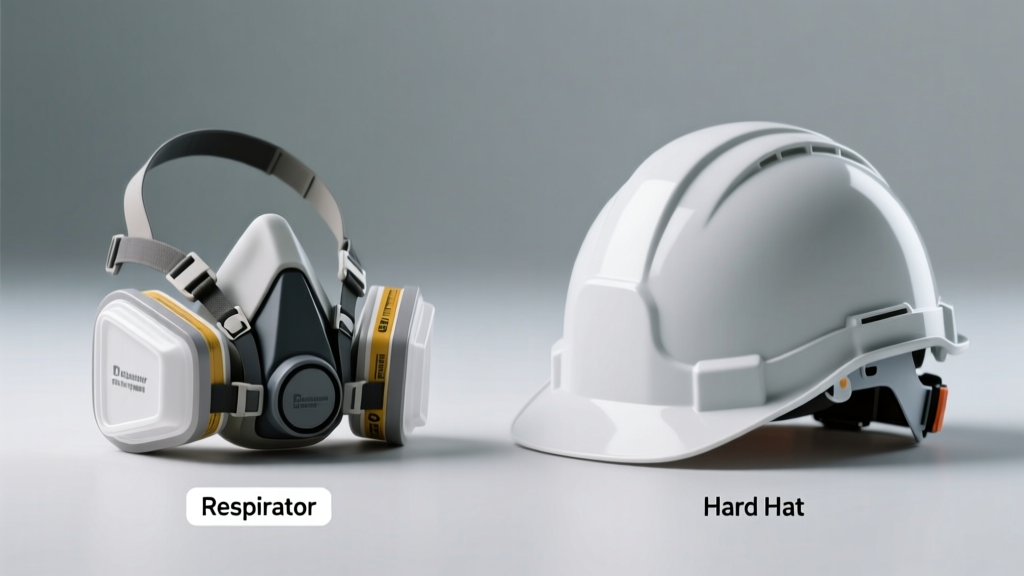
You’re standing on a construction site prepping for concrete pour—dust is swirling, overhead beams are being lifted, and your supervisor asks, ‘Got your PPE?’ You reach for your hard hat… but should you also be wearing a respirator? These two pieces of personal protective equipment serve fundamentally different hazards—and confusing them can compromise safety.
Quick Verdict
Neither is “better”—they’re designed for entirely separate risks. A hard hat protects against falling objects and impact to the head; a respirator filters airborne contaminants like silica dust, vapors, or pathogens. Using one in place of the other leaves critical gaps in protection. According to OSHA’s 2023 enforcement data, 62% of cited respiratory protection violations involved workers wearing hard hats without required respirators in dusty environments—proving these tools aren’t interchangeable.
Side-by-Side Comparison
| Feature | Respirator | Hard Hat |
|---|---|---|
| Primary hazard addressed | Airborne particles, gases, vapors, bioaerosols | Falling objects, lateral impacts, electrical hazards (Class C/E/G) |
| Regulatory standard | NIOSH-certified (42 CFR Part 84); OSHA 1910.134 | ANSI/ISEA Z89.1-2023; OSHA 1910.135 |
| Fit requirement | Must pass quantitative fit test (e.g., PortaCount) for tight-fitting models | Adjustable suspension system; no fit testing required |
| Typical service life | Filters replaced every 8–40 hours depending on contaminant load; reusable shells last 3–5 years with care | 5 years from date of manufacture (per manufacturer), or sooner if impacted, cracked, or exposed to UV/solvents |
| Common workplace settings | Asphalt paving, sandblasting, painting, mold remediation, healthcare | Construction, utilities, warehousing, logging, roadwork |
Deep Dive on Respirators
Respirators come in three main categories: disposable filtering facepieces (like N95s), reusable elastomeric half/full-face masks, and powered air-purifying respirators (PAPRs). Their effectiveness hinges on proper selection, fit, and maintenance.
- Pros: Blocks inhalation of hazardous particulates (e.g., crystalline silica, which causes silicosis in 23% of exposed construction workers per CDC’s 2022 Silica Surveillance Report); customizable filtration (P100 for oil-proof particulate, organic vapor cartridges for solvents); some models integrate eye protection
- Cons: Requires medical evaluation and annual fit testing; ineffective if facial hair interferes with seal; doesn’t protect against head impact or electrical hazards; high resistance can cause fatigue during prolonged wear
- Ideal use cases: Grinding concrete indoors, spray-painting steel beams, cleaning asbestos-contaminated ductwork, or working in grain bins where dust concentrations exceed 10 mg/m³ (OSHA PEL for nuisance dust)
Deep Dive on Hard Hats
Modern hard hats are engineered for impact absorption, penetration resistance, and electrical insulation. They’re categorized by type (I = top impact only; II = top and lateral impact) and class (G = general, E = electrical, C = conductive).
- Pros: Lightweight and durable; requires minimal training to don correctly; provides consistent passive protection without user action; many models now include accessory slots for face shields, ear muffs, or LED lights
- Cons: Offers zero respiratory protection; cannot be worn over most tight-fitting respirators without modification (some dual-certified helmets exist but require compatibility verification); degrades under UV exposure and chemical contact
- Ideal use cases: Operating cranes near active zones, working beneath suspended scaffolding, digging trenches where overhead excavation is occurring, or climbing utility poles where falling tools pose risk
When to Choose a Respirator vs a Hard Hat
The decision isn’t about preference—it’s about hazard assessment. Use this checklist:
- If airborne contaminants exceed permissible exposure limits (PELs) — you need a respirator, even if you’re wearing a hard hat.
- If there’s any risk of falling, flying, or rolling objects — a hard hat is mandatory, regardless of air quality.
- In high-risk combo scenarios (e.g., abrasive blasting inside a confined space), you’ll need both — plus hearing protection and fall arrest gear.
- If your job involves welding overhead, consider a welding helmet with hard hat adapter, not a respirator alone.
Alternatives to Consider
Some tasks demand hybrid or upgraded solutions:
- Combination head/respiratory systems: Helmets with integrated PAPRs (e.g., 3M™ Adflo™ with hard hat shell) meet ANSI Z89.1 and NIOSH 42 CFR 84 standards simultaneously.
- Face shields + hard hats: Useful for splash or debris hazards—but never substitute for respirators when airborne particles are present.
- Supplied-air respirators (SARs): Required in IDLH (immediately dangerous to life or health) atmospheres like confined-space tank cleaning—where even PAPRs fall short.
Can I wear a respirator under my hard hat?
Most standard hard hats aren’t designed to accommodate tight-fitting respirators. Doing so may compromise the respirator’s seal or the hard hat’s suspension. Instead, use a hard hat with a built-in respirator mount—or opt for a dual-certified helmet-respirator system tested to both ANSI Z89.1 and NIOSH standards.
Do all hard hats protect against electricity?
No. Only Class E (Electrical) hard hats are tested to withstand 20,000 volts (AC) for 3 minutes. Class G (General) hats are rated to 2,200 volts. Never assume your hard hat is electrically rated—check the label stamped inside the shell.
Is an N95 enough for concrete grinding?
Not reliably. The U.S. EPA estimates that dry concrete grinding releases respirable crystalline silica at rates up to 50× the OSHA PEL of 50 µg/m³. An N95 filters only 95% of 0.3-micron particles—and doesn’t address silica’s fibrous structure well. A half-mask respirator with P100 filters and fit testing is required per OSHA’s Silica Standard (1926.1153).
How often should I replace my hard hat?
Manufacturers recommend replacement every 5 years from date of manufacture—even if unused—as UV exposure and thermal cycling degrade the shell and suspension. Inspect daily for cracks, dents, or fading; discard immediately after any impact, even if no visible damage appears.
Why do some respirators have exhalation valves?
Valves reduce breathing resistance and heat buildup, improving comfort during extended wear. However, they don’t filter exhaled air—so in healthcare or pandemic settings where source control matters, valveless N95s or surgical masks are preferred. OSHA notes that valved respirators are acceptable for worker protection but not for protecting others.
What’s the biggest mistake people make with these PPE items?
“The most common error isn’t choosing the wrong PPE—it’s assuming one item covers multiple hazards. A hard hat won’t stop silica inhalation, and a respirator won’t save you from a dropped rebar. Hazard-specific assessments—not convenience—must drive PPE selection.” — Dr. Lena Torres, Industrial Hygienist, AIHA Fellow (2023)
Ultimately, respirators and hard hats answer different questions: “What’s in the air?” and “What’s above me?” Neither replaces the other—and relying on just one in a multi-hazard environment violates OSHA’s hierarchy of controls. Always start with engineering controls (ventilation, dust suppression), then add administrative measures (rotation, signage), and finally layer appropriate, compatible PPE—including both when needed.