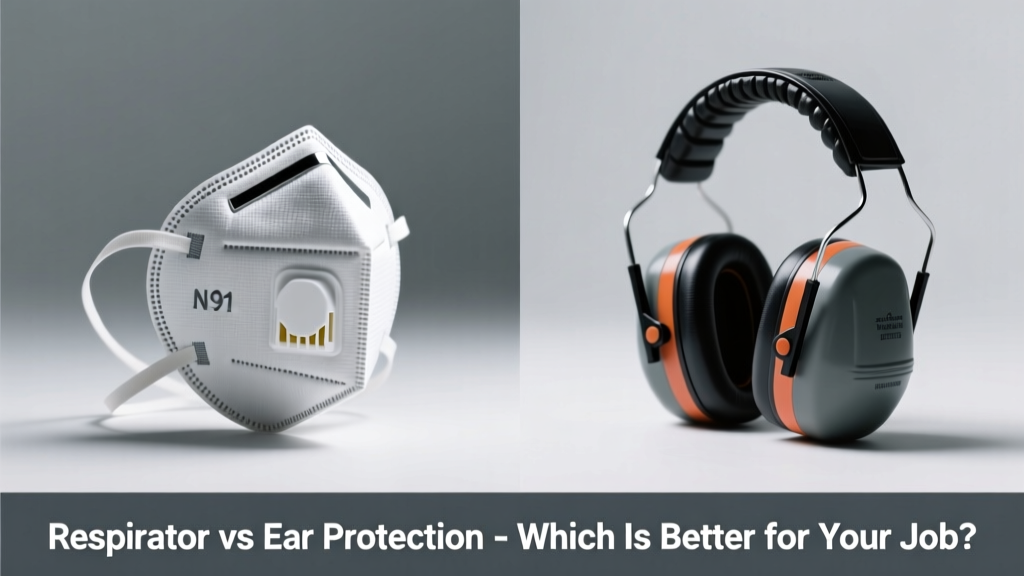
You’re standing on a construction site, sanding concrete while a jackhammer thumps nearby. Your safety checklist says 'PPE required' — but which kind? Respirators protect lungs from silica dust; ear protection guards against noise-induced hearing loss. They solve different hazards — yet many workers assume one covers both, or worse, skip one entirely.
Quick Verdict
Neither is 'better' — they’re non-interchangeable tools for distinct threats. A respirator does nothing for decibel exposure; earplugs won’t filter airborne crystalline silica. According to the National Institute for Occupational Safety and Health (NIOSH), over 22 million U.S. workers face hazardous noise levels daily, while 5 million are exposed to respiratory hazards like welding fumes or wood dust — often in the same shift. Using only one leaves critical gaps in protection.
Side-by-Side Comparison
| Feature | Respirator | Ear Protection |
|---|---|---|
| Primary hazard addressed | Airborne particles, gases, vapors (e.g., silica, isocyanates, mold spores) | Excessive noise (e.g., >85 dBA over 8-hour TWA) |
| Regulatory standard | NIOSH-approved (e.g., N95, P100, supplied-air) | ANSI S3.19-2022 (for attenuation rating) |
| Fit testing required? | Yes — for half/full-face respirators (OSHA 1910.134) | No — but proper insertion and seal verification matters |
| Average service life (reusable) | Filter cartridges: 8–40 hours depending on contaminant concentration | Ear muffs: 2–5 years; foam plugs: single-use or 1–3 days with cleaning |
| Common failure mode | Improper fit, expired filters, facial hair interference | Incorrect insertion, worn-out cushions, sharing between users |
Deep Dive on Respirators
Respirators shield your respiratory system from inhalation hazards — including fine particulates like PM2.5, chemical vapors, and biological agents. NIOSH-certified filtering facepiece respirators (FFRs) like N95s block at least 95% of 0.3-micron particles. Higher-tier options — P100 filters or powered air-purifying respirators (PAPRs) — handle oil-based aerosols and offer greater comfort during long shifts.
Pros
- Essential for tasks involving sanding, grinding, spray painting, or working in mold-damaged buildings
- P100 filters capture 99.97% of airborne particles, including asbestos and lead dust
- Reusable elastomeric half-masks cut long-term costs versus disposable FFRs
Cons
- Requires annual fit testing for tight-fitting models — not optional under OSHA rules
- Does not protect against noise; may even amplify certain frequencies due to occlusion effect
- Can cause heat stress, breathing resistance, or communication challenges on noisy sites
For example, drywall sanding generates respirable crystalline silica — a known carcinogen. Without a properly fitted N95 or better, workers inhale particles that embed deep in lung tissue. The U.S. EPA estimates that 1 in 10 construction workers develops silicosis after chronic unprotected exposure.
Deep Dive on Ear Protection
Ear protection reduces sound pressure reaching the inner ear — preventing permanent threshold shift (PTS), the clinical term for noise-induced hearing loss. Effective options include foam earplugs (SNR 29–33 dB), reusable silicone plugs (SNR 25–28 dB), and over-the-ear muffs (SNR 20–31 dB). Dual protection — plugs + muffs — is required in environments exceeding 100 dBA, such as aircraft hangars or steel mills.
Pros
- Simple to deploy — no medical evaluation or fit test needed for basic models
- Highly effective when used correctly: consistent use of SNR 30+ plugs cuts risk of hearing loss by 86% (NIOSH, 2022)
- Compatible with most respirators — though some full-face respirators interfere with muff seals
Cons
- Offers zero protection against dust, fumes, or gases
- Effectiveness drops sharply if inserted incorrectly — up to 70% of users fail basic seal checks
- Muffs limit peripheral awareness and can’t be worn with certain hard hat attachments
"Hearing loss is the third most common chronic physical condition in adults — and it’s 100% preventable with consistent, correct use of ear protection." — Dr. Jennifer Stewart, Audiology Director, NIOSH, 2023
When to Choose Respirator vs Ear Protection
Choose a respirator when your task generates airborne contaminants — regardless of noise level. Think: grinding metal, sweeping sawdust, applying two-part epoxy, or cleaning HVAC ducts. Choose ear protection when noise exceeds 85 dBA for an 8-hour time-weighted average — even if air quality is pristine, like near operating compressors or CNC machines.
But here’s the reality: many jobs demand both. According to OSHA’s 2023 enforcement data, 68% of citations related to respiratory protection occurred alongside unaddressed noise hazards — meaning employers often prioritize one over the other, risking dual exposure.
- Welding in a confined space? Use a PAPR and high-SNR earplugs — welding fumes + 100+ dBA arc noise
- Demolition with concrete cutting? N95 + earmuffs — silica dust + jackhammer impact
- Paint spraying in a booth? Organic vapor cartridge respirator + low-profile muffs — solvent vapors + booth fan noise
Alternatives to Consider
Don’t default to standalone solutions. Integrated PPE systems exist — like respirators with built-in communication mics and passive noise reduction (e.g., 3M™ FR-2000 Series), or earmuffs with integrated respirator ports for dual-use compatibility. For light-duty indoor work, consider engineering controls first: local exhaust ventilation for dust, or acoustic enclosures for noisy equipment — both reduce reliance on PPE.
You might also explore respirator fit testing procedures or compare earplugs versus earmuffs for nuanced choices within each category. And if your worksite has both hazards, review OSHA’s dual protection PPE guidelines for compliant layering strategies.
Can I wear earplugs and a respirator at the same time?
Yes — but not all combinations work well. Foam earplugs usually pair cleanly with N95s. However, large earmuffs can break the seal of half-face respirators. Opt for low-profile muffs or banded earplugs (like loop-style or canal caps) when wearing elastomeric masks.
Do disposable respirators protect against noise?
No. Standard N95s provide negligible noise reduction — typically less than 1 dB. Some specialty models (e.g., Moldex® 2200 series) add passive attenuation, but they’re rare and still fall far short of certified hearing protection.
Is a full-face respirator enough for loud environments?
No. While full-face units cover ears partially, their primary design isn’t acoustic. Lab tests show most offer only 5–8 dB of incidental reduction — nowhere near the 25–30 dB needed in high-noise zones. Always add dedicated hearing protection.
How often should I replace my earplugs or respirator filters?
Foam earplugs: discard after each use or daily if reused with cleaning. Silicone plugs: replace every 3–6 months with regular use. Respirator cartridges: follow manufacturer guidance — typically 8 hours for organic vapors, up to 40 hours for particulates in low-concentration settings. Never use filters past their expiration date or if they smell compromised.
What if I have facial hair?
Beard, stubble, or sideburns break the seal on tight-fitting respirators — making them ineffective. OSHA prohibits beards under half- or full-face respirators unless trimmed to a ‘clean-shaven’ standard (no more than 1/8-inch growth). Ear protection isn’t affected by facial hair, making it more universally compatible.
Are there PPE options that combine both functions?
True dual-function devices remain limited. Some powered air-purifying respirators (PAPRs) integrate passive noise reduction into the helmet housing (e.g., GVP PAPR with 22 dB NRR), but they don’t replace dedicated hearing protection in >85 dBA environments. For now, layering remains the gold standard — not combining.
Bottom line: this isn’t about picking a winner. It’s about recognizing that your lungs and ears face separate, serious threats — and protecting both requires intentionality, training, and sometimes, two pieces of gear instead of one. Start with a hazard assessment, not a checklist. Because when it comes to occupational health, overlap isn’t redundancy — it’s responsibility.