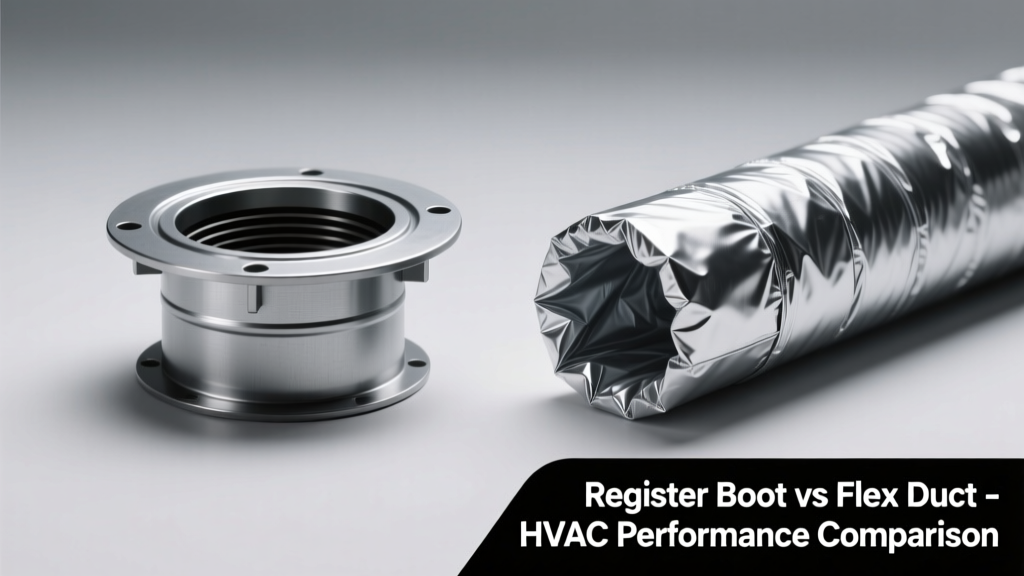
Choosing between a register boot and flex duct isn’t just about fitting something into a tight spot—it’s about balancing airflow efficiency, long-term performance, and how much you’re willing to wrestle with insulation, seams, and static pressure. Contractors often default to one or the other without explaining why—and that silence costs homeowners in energy waste or comfort issues.
Quick Verdict
For rigid, high-efficiency airflow from a main trunk to a wall or floor register, a metal register boot is almost always the better choice—especially in conditioned spaces or new construction. Flex duct shines where routing demands bends, offsets, or quick field adjustments, like connecting a ceiling register to a joist-bay trunk in an attic. Neither is universally superior; the right pick depends on location, system design, and whether you prioritize longevity or install speed.
Side-by-Side Comparison
| Feature | Register Boot | Flex Duct |
|---|---|---|
| Material | Galvanized steel or aluminum (rigid) | Inner plastic/polyester core + insulated fiberglass wrap + outer vapor-barrier jacket |
| Airflow Resistance (per 10 ft) | ~0.02–0.03 in. w.c. (low) | ~0.08–0.15 in. w.c. (moderate to high, worsens with kinks) |
| Installation Time (typical) | 5–10 min (with proper tools & access) | 3–7 min (but sealing adds 5+ min) |
| Code Compliance (IRC 2021) | Always permitted; no sealant required if welded or crimped | Permitted only if UL 181B-FX listed, fully supported, and sealed at both ends |
| Lifespan | 40–60+ years (non-corroding metal) | 15–25 years (jacket degrades; inner liner sags or separates) |
Deep Dive on Register Boot
Register boots are short, rigid, box- or cone-shaped fittings that connect a duct trunk to a wall, floor, or ceiling register. They’re typically fabricated from 26- or 28-gauge galvanized steel and come in standard sizes (e.g., 4×10, 6×12) with flanged or slip-fit ends.
Pros
- Negligible airflow resistance — maintains design CFM without derating
- No risk of internal collapse, sagging, or insulation compression over time
- Fire-rated and non-combustible per ASTM E84 (critical in commercial or multi-family builds)
- Easy to insulate externally with duct mastic + R-8 wrap if running through unconditioned space
Cons
- Requires precise framing cutouts and alignment—no forgiveness for mislocated studs or joists
- Harder to retrofit into finished walls without drywall removal
- Higher material cost per unit ($12–$28 vs. $8–$15/ft for flex)
According to the Air Conditioning Contractors of America’s 2022 Technical Bulletin, improperly installed flex duct accounts for 22% of residential duct leakage—while register boots contribute less than 2% when mechanically fastened and mastic-sealed.
Deep Dive on Flex Duct
Flex duct is a pliable, insulated duct assembly designed for short runs between trunks and registers—or as branch ducts in hard-to-reach areas. Its performance hinges entirely on proper support, stretching, and sealing. The U.S. Department of Energy warns that undersized or poorly installed flex duct can reduce delivered airflow by up to 40% compared to rigid equivalents.
Pros
- Forgiving in tight or irregular cavities—ideal for attic-to-ceiling or crawlspace-to-floor transitions
- Lightweight and easy to transport; cuts with utility knife or snips
- Insulated by default (R-4 to R-8), reducing condensation risk in humid climates
Cons
- Must be fully stretched (no more than 5% slack) and supported every 4 ft—otherwise, it sags and restricts flow
- Sealing requires mastic + tape at both ends AND all seams; zip ties alone aren’t code-compliant
- Vulnerable to rodent damage, UV degradation (if exposed), and jacket tears during installation
"Flex duct isn’t ‘flexible’ in terms of performance—it’s flexible in geometry, not physics. Every bend over 90° adds resistance equal to 5 linear feet of straight duct." — HVAC Design Guide, ACCA Manual D, 2023 edition
When to Choose Register Boot vs Flex Duct
Use a register boot when:
- You’re building new or doing a full remodel with open walls/floors
- The register connects directly to a rigid trunk inside conditioned space (e.g., basement supply run to first-floor register)
- You’re installing in a high-static-pressure system (e.g., heat pump with ECM blower)
Choose flex duct when:
- You’re adding a register to an existing attic or crawlspace where cutting into framing isn’t feasible
- The path requires multiple directional changes within 6 feet (e.g., around a header beam)
- You need R-value built-in and can guarantee full stretching and support per IRC M1601.4.1
Alternatives to Consider
Neither option works well in every situation. Consider these alternatives before committing:
- Rigid rectangular duct (galvanized or aluminum): Best for long branch runs or high-CFM zones—but overkill for single-register drops.
- Flexible aluminum duct (non-insulated): Lower resistance than insulated flex, but offers zero thermal protection—only suitable for fully conditioned spaces.
- Boot-to-flex hybrid: A short metal boot mounted to the trunk, then 3–4 ft of flex to the register—combines rigidity near the source with flexibility at the endpoint.
Can I use flex duct for a return air drop?
No—most building codes (including IRC 2021 §M1601.4.2) prohibit uninsulated flex duct for return air, and insulated flex must be UL 181A-P rated (not B-FX) for returns. Return drops should use rigid metal boots or sheet metal transitions.
Do register boots need insulation?
Only if they pass through unconditioned or partially conditioned space (e.g., garage ceiling, exterior wall cavity). In conditioned basements or interior chases, bare metal is acceptable—but always seal joints with mastic, not tape.
Why does my flex duct whistle?
Whistling usually means excessive velocity—often due to undersizing (e.g., using 6-inch flex for a 120 CFM zone that needs 8-inch) or kinks restricting flow. Measure static pressure with a manometer; anything above 0.15 in. w.c. at the register suggests duct restriction.
Can I replace a damaged flex duct with a register boot?
Yes—if framing allows. You’ll need to remove drywall or subfloor to install the boot’s flange and secure it to the trunk. It’s labor-intensive but pays off in airflow consistency and lower long-term maintenance.
Is there a hybrid solution that combines both?
Absolutely. Many pros install a 12- to 18-inch metal boot from the trunk, then transition to 3–4 ft of flex duct secured with a band clamp. This avoids flex near the high-velocity trunk while preserving flexibility at the register end—especially useful in tight ceiling cavities.
There’s no universal winner—but there is a right answer for your layout, budget, and performance goals. If airflow precision and decades-long reliability matter most, lean toward register boots. If adaptability and speed define your project, flex duct has its place—provided you treat it with the care (and code compliance) it demands. For deeper guidance, see our guides on dryer duct sizing and duct leakage testing procedures.