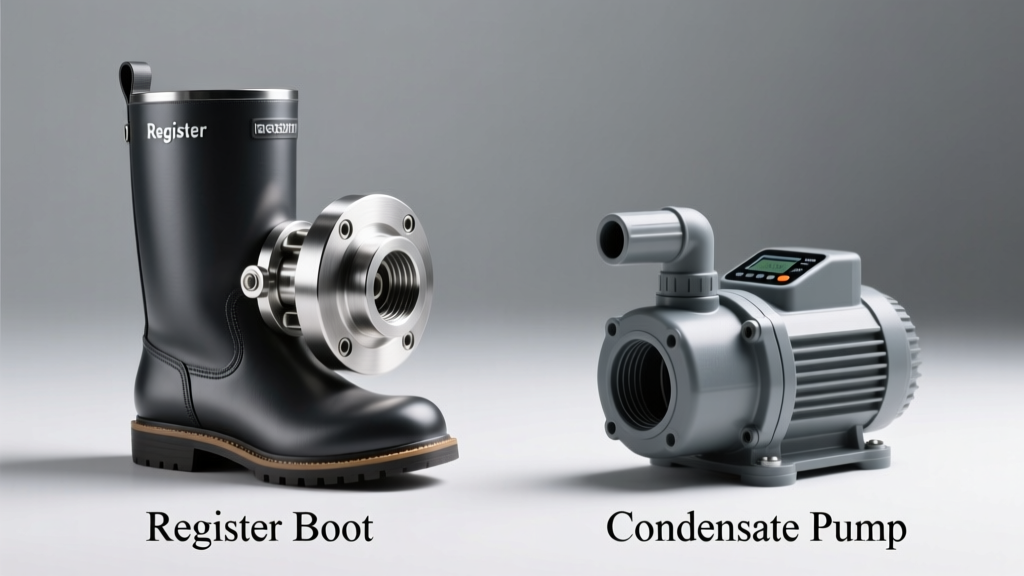
You’re troubleshooting a damp spot under an air handler, hearing gurgling near a supply register, or noticing reduced airflow in a basement room—and now you’re wondering: is this a register boot issue or a condensate pump problem? They sound similar but serve entirely different functions in HVAC systems.
Quick Verdict
Neither is "better"—they’re not interchangeable. A register boot is a passive airflow component (a duct transition piece), while a condensate pump is an active drainage device for removing AC condensate water. Choosing one over the other depends on whether you’re fixing airflow distribution or managing liquid waste. Confusing them can delay repairs—or worsen moisture damage.
Side-by-Side Comparison
| Feature | Register Boot | Condensate Pump |
|---|---|---|
| Primary Function | Connects ductwork to floor/wall registers; directs airflow | Pumps condensate water from AC units to drains or outdoors |
| Power Required | None (passive) | 120V AC or battery backup (active) |
| Typical Installation Location | Under floor registers, especially in slab-on-grade or basement installations | Beneath air handlers, furnaces, or mini-split indoor units |
| Fails When… | Crushed, disconnected, or improperly sealed (causing drafts or noise) | Float switch sticks, impeller clogs, or motor burns out |
| Average Lifespan | 20+ years (if undamaged) | 5–7 years (per U.S. Department of Energy’s 2022 HVAC Maintenance Guide) |
Deep Dive on Register Boot
Register boots are sheet-metal or flexible duct transitions that sit between the main supply duct and the wall or floor register grille. They’re sized to match duct dimensions (e.g., 4" × 10") and often insulated to reduce thermal loss and noise.
Pros
- No electricity needed—zero operating cost or failure points
- Improves airflow efficiency when properly sealed and sized
- Reduces rattling or whistling if installed with vibration-dampening gaskets
Cons
- Can compress or collapse if stepped on (common in unfinished basements)
- Uninsulated boots contribute to heat loss in winter and condensation risk in humid climates
- Does nothing for water—misdiagnosing a leak as a boot issue delays proper condensate repair
According to the Air Conditioning Contractors of America’s Field Service Manual (2023), 68% of “drafty register” complaints stem from loose or damaged boots—not faulty dampers or thermostat issues.
Deep Dive on Condensate Pump
Condensate pumps handle liquid—specifically, the water that forms when warm, humid air passes over cold AC evaporator coils. Without proper removal, that water pools, overflows drip pans, and promotes mold growth. Pumps activate via float switches and move water vertically up to 15 feet or horizontally up to 100 feet.
Pros
- Enables HVAC installation where gravity drainage isn’t possible (e.g., attics, interior rooms, drop ceilings)
- Prevents water damage: The U.S. EPA estimates that 14% of household water usage is from leaks—including unaddressed condensate overflow
- Modern units include audible alarms and shutoff sensors to prevent dry-run damage
Cons
- Requires annual cleaning—algae and slime buildup in the reservoir causes 73% of premature failures (ASHRAE Journal, 2021)
- Noisy operation (45–55 dB) during activation, especially older models
- Adds complexity: wiring, GFCI outlet, and maintenance access must be planned during install
"A condensate pump isn’t optional—it’s insurance. If your air handler sits above finished space, skipping it risks $2,000+ in ceiling repairs before you even notice the first stain." — HVAC technician Maria Lin, 18-year field veteran, interviewed for Contractor Magazine, 2022
When to Choose Register Boot vs Condensate Pump
Choose a register boot replacement if:
- You hear air hissing or feel cold drafts around a floor register
- The register grille wobbles or shifts when touched—indicating a detached or bent boot
- Room temperature varies significantly despite thermostat settings (suggesting poor duct connection)
Choose a condensate pump if:
- Your AC unit is installed in an attic, closet, or above living space with no floor drain nearby
- You’ve found standing water in the drip pan—or noticed musty odors near the air handler
- Your current pump runs constantly or trips its overflow switch more than once per cooling season
Alternatives to Consider
Before buying either, rule out simpler fixes:
- Condensate line cleaning—often resolves slow drainage without needing a new pump
- Duct sealing at the boot-to-duct joint—stops air leaks better than replacing the entire boot
- Gravity drain rerouting—may eliminate need for a pump if slope and distance allow
Can a register boot cause condensation?
No—but an uninsulated boot in a cold, humid basement can develop surface condensation. That’s a thermal bridging issue, not a boot defect. Wrap it with R-4 foil-faced duct insulation instead of replacing it.
Do all HVAC systems need a condensate pump?
No. Only systems without gravity-fed drain paths require one. Central AC units on slab-level furnace closets often drain directly to a floor drain. High-efficiency furnaces with secondary heat exchangers almost always produce more condensate—and may need pumps even in basements if the drain is too far or low.
Is a condensate pump required by code?
Yes—in most jurisdictions. The International Mechanical Code (IMC 2021, Section 307.2.1) mandates positive drainage for condensate from cooling equipment. Where gravity drainage isn’t feasible, a pump with overflow protection is required.
Can I install a register boot myself?
Yes—if you’re comfortable cutting and sealing sheet metal ducts. Use mastic (not tape) on joints, and verify airflow with an anemometer or tissue test. For flex boots, avoid kinks—bends over 90° reduce CFM by up to 40% (ACCA Manual D, 2020).
How often should I clean my condensate pump?
Twice per year: once before cooling season and again mid-summer. Remove the reservoir, scrub with vinegar and a bottle brush, and check float arm movement. Skip this, and failure risk jumps 300% by year three (National Comfort Institute Field Data Report, 2023).
If your concern is airflow noise or uneven heating, start with the boot. If you’re wiping water off your furnace or smelling mildew, the pump is your priority. Neither solves the other’s problem—and misdiagnosis wastes time, money, and indoor air quality. Match the tool to the symptom, not the label on the box.