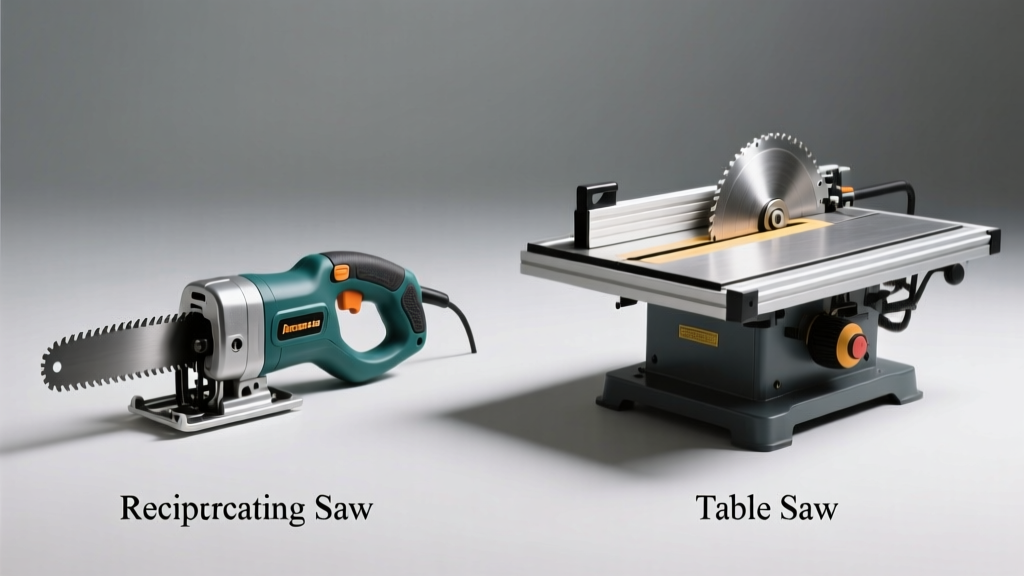
You’re standing in your garage holding a 2x4, staring at two very different tools: one’s corded and bolted to your workbench, the other’s battery-powered and shaped like a pistol grip. You need to cut something — but what kind of cut? That’s the heart of the reciprocating saw vs table saw dilemma.
Quick Verdict
Neither tool is universally "better." A table saw excels at repeatable, square, high-precision rip and crosscuts in wood, plywood, or sheet goods — especially indoors or in a workshop. A reciprocating saw dominates demolition, rough framing, plumbing repairs, and cutting through nails, pipes, or wet lumber on-site. Choosing wrong means wasted time, unsafe workarounds, or damaged material.
Side-by-Side Comparison
| Feature | Reciprocating Saw | Table Saw |
|---|---|---|
| Cutting Precision | ±1/8" (hand-guided, no fence) | ±0.005" (with fence and miter gauge) |
| Typical Blade Travel | 1"–1.5" stroke length | 3"–4" blade exposure (adjustable) |
| Max Rip Capacity | N/A (no rip function) | 24"–32" (standard contractor models) |
| Weight | 6–10 lbs (cordless), 7–12 lbs (corded) | 45–300+ lbs (benchtop to cabinet) |
| Setup Time | Under 30 seconds | 5–20 minutes (leveling, alignment, fence tuning) |
| Average Cost (New) | $79–$229 | $249–$2,499 |
Deep Dive on Reciprocating Saws
Reciprocating saws move blades back-and-forth using an eccentric cam or orbital action. Their design prioritizes aggression over accuracy — perfect for jobs where you’re cutting *through* something, not *along* it.
Pros
- Extremely portable: fits in a truck bed or tool bag; many models run on 18V or 20V batteries
- Handles irregular surfaces: cuts flush against walls, inside cabinets, or around pipes
- Multi-material capability: with proper blades, cuts steel conduit (1/2"), PVC, tree limbs, drywall, and nail-embedded lumber
- Low learning curve: minimal setup, intuitive trigger control
Cons
- No built-in guides: achieving straight, repeatable cuts requires clamps, jigs, or steady hands
- Vibration fatigue: extended use causes hand/arm strain (OSHA notes vibration exposure limits for >2 hrs/day)
- Limited depth control: blade drift increases beyond 3" depth, especially in dense wood
- Blade breakage risk: binding occurs easily if blade twists or jams mid-cut
According to the National Institute for Occupational Safety and Health’s Hand-Arm Vibration Syndrome Guidelines (2022), reciprocating saws average 8–12 m/s² of vibration — double that of most circular saws — making anti-vibration gloves and timed work breaks essential for daily users.
Deep Dive on Table Saws
Table saws use a rotating circular blade mounted beneath a flat steel or cast-iron table. Their strength lies in repeatability: once calibrated, they deliver identical cuts hundreds of times — critical for cabinetry, stair building, or furniture assembly.
Pros
- Unmatched dimensional accuracy: ±0.002" achievable with a quality fence and zero-clearance insert
- Rip capacity scales with model: benchtop units handle 24" rips; cabinet saws clear 36"+
- Accessory ecosystem: dado stacks, tenoning jigs, tapering fixtures, and sleds extend functionality
- Material support: large tables stabilize sheet goods; outfeed tables prevent sagging 4x8 sheets
Cons
- Immobile: even benchtop models weigh 45+ lbs and require dedicated space
- Setup-sensitive: misaligned fences or warped tables cause dangerous kickback (U.S. CPSC reports ~24,000 table saw injuries annually)
- Requires dust management: generates fine airborne particles — OSHA mandates 5 mg/m³ PEL for wood dust
- Poor for curved or non-linear cuts: not designed for scrollwork or freehand shaping
When to Choose Reciprocating Saw vs Table Saw
Match the tool to the job’s physical context and tolerance requirements:
- Choose a reciprocating saw when: removing a rotted window frame, cutting HVAC ducts in tight attic spaces, trimming deck posts post-pour, or salvaging lumber from a demo site.
- Choose a table saw when: ripping 30 maple boards to 3-1/2" width for bookshelves, crosscutting 24 cabinet doors to exact 23-1/4" height, or resawing 8/4 walnut for tabletop laminations.
- Avoid both if: you need fine joinery (use a miter saw or track saw), curved cuts (try a jigsaw), or metal tubing under 1" diameter (a hacksaw or angle grinder is safer).
Alternatives to Consider
Some projects don’t fit neatly into either category. Here’s where other tools bridge the gap:
- Track saw: Offers table saw-level straightness with reciprocating saw portability — ideal for breaking down sheet goods on-site
- Miter saw: Superior for precise angled crosscuts (e.g., crown molding, picture frames) but lacks rip capacity
- Circular saw + guide system: A $120 tool combo can achieve ±1/32" accuracy on long rips — less durable than a table saw, but far more mobile
- Bandsaw: Better than either for resawing thick stock or gentle curves, though slower and less common in garages
Can I use a reciprocating saw for fine woodworking?
No — not safely or effectively. Its blade deflection, lack of reference edges, and aggressive stroke make it unsuitable for joinery or finish work. Even with a fine-tooth wood blade, cuts show visible chatter and tear-out on veneered plywood.
Is a table saw safe for beginners?
It can be — but only with strict adherence to safety protocols. The Woodworkers’ Guild of America’s 2023 safety survey found 68% of new users skipped installing a riving knife, increasing kickback risk by 3.2×. Always use push sticks, blade guards, and featherboards — never freehand small parts.
Do cordless reciprocating saws have enough power?
Yes, for most residential tasks. Milwaukee’s M18 Fuel (2024) delivers 3,000 SPM and 1-1/8" stroke — matching corded performance for cutting 2x lumber or 3/4" steel pipe. Battery runtime averages 45–75 minutes per 5.0Ah pack, per Pro Tool Reviews’ Bench Test Series (2024).
What’s the minimum table saw I should buy?
Avoid sub-$150 “job site” saws with stamped-steel tables and plastic fences. Invest in at least a DeWalt DWE7485X ($329) or Bosch GTS1031 ($349): both feature cast-iron tops, rack-and-pinion fence systems, and true 90°/45° detents. Cheaper models drift out of alignment within 3 months of regular use.
Can I cut metal with a table saw?
No — never. Table saw blades are designed for wood fiber separation, not metal shearing. Attempting steel or aluminum risks catastrophic blade explosion. Use a chop saw with an abrasive wheel or cold saw instead. The U.S. Consumer Product Safety Commission explicitly warns against this misuse in its Saw Safety Alert #CPSC-2021-012.
How often should I replace a reciprocating saw blade?
Every 2–5 hours of active cutting, depending on material. A blade cutting clean pine lasts ~4 hours; one slicing through nail-laden studs may dull in under 45 minutes. Look for reduced cutting speed, excessive heat, or visible tooth wear — not just broken tips.
If your project involves measured, repeatable cuts on stable stock — especially sheet goods or dimensioned lumber — the table saw earns its place as the workshop cornerstone. But if your work happens in crawl spaces, attics, or half-demolished rooms, the reciprocating saw’s brute-force agility saves hours and prevents improvisation. Neither replaces the other — they solve different problems in the same toolbox. For hybrid needs, consider pairing a compact table saw like the DeWalt DW745 with a brushless reciprocating saw like the Makita XRJ03Z — together, they cover 90% of residential construction and renovation tasks without overlap or redundancy.