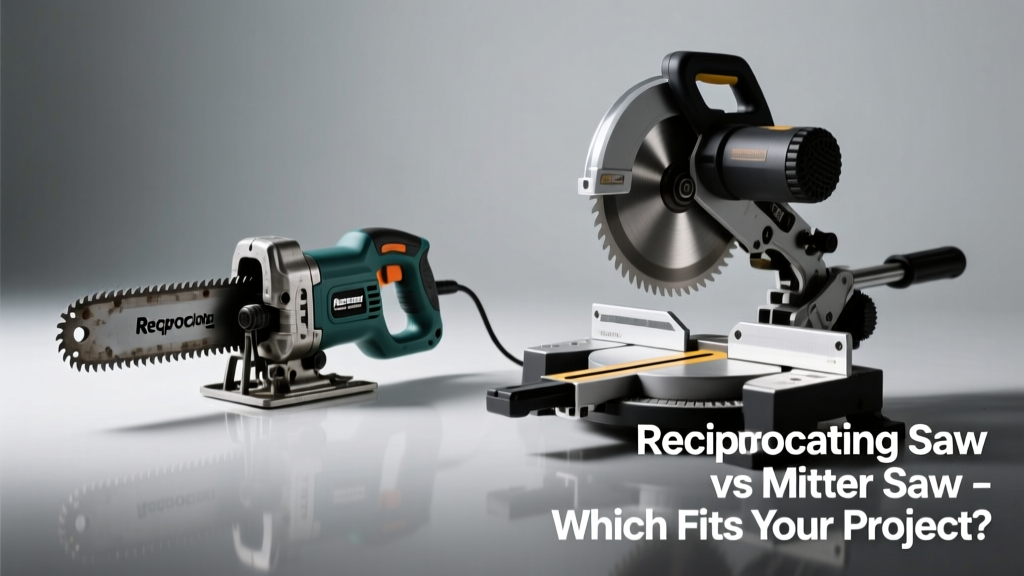
You’re standing in the hardware aisle, holding two very different saws — one with a long, aggressive blade jutting forward like a jackhammer, the other sitting on a sturdy base with a gleaming aluminum fence and laser guide. You need to cut something *now*, but which tool actually gets the job done right? It’s not about which is ‘better’ overall — it’s about matching the tool to the task, the material, and your workspace.
Quick Verdict
A reciprocating saw excels at rough, on-site demolition, pruning, pipe cutting, and tight-space work where precision isn’t the priority. A miter saw delivers repeatable, clean crosscuts and angled joints — essential for trim, framing, and finish carpentry. Neither replaces the other; they solve fundamentally different problems. According to the National Association of Home Builders’ 2022 Tool Usage Survey, 78% of professional remodelers carry both — using the reciprocating saw for tear-out and the miter saw for installation.
Side-by-Side Comparison
| Feature | Reciprocating Saw | Miter Saw |
|---|---|---|
| Primary function | Rough cutting, demolition, plunge cuts, curved or irregular cuts | Precise crosscuts, bevels, and compound miters on dimensional lumber and trim |
| Blade motion | Back-and-forth (reciprocating) stroke, up to 3,000 strokes per minute | Rotating circular blade, typically 3,500–5,000 RPM |
| Typical blade size | 3–12 inches (bimetal, carbide, or specialty blades) | 8–12 inches (carbide-tipped, 24–80 teeth) |
| Portability | Lightweight (6–10 lbs), corded or cordless, works vertically/horizontally/inverted | Bulky (25–60 lbs), usually stationary; some compact models weigh ~35 lbs |
| Accuracy tolerance | ±1/8″ or more — not designed for fine tolerances | ±1/64″ with proper setup and sharp blade |
| Common safety risks | Blade binding, kickback during plunge cuts, flying debris in demolition | Finger contact with spinning blade, improper workpiece support causing binding |
Deep Dive on Reciprocating Saw
Reciprocating saws thrive where control matters less than raw adaptability. Their narrow, replaceable blades let you cut through nails embedded in wood, PVC, cast iron, or even rebar — something no miter saw can do safely. Most models offer orbital action (a slight elliptical motion) to speed up wood cutting, and variable-speed triggers help manage aggression on delicate materials like drywall or thin metal.
Pros
- Works one-handed in tight spots — ideal for plumbing repairs inside walls or HVAC duct access panels
- Cuts while flush against surfaces (e.g., trimming door jambs without removing casing)
- Accepts dozens of specialty blades: wood, metal, demolition, pruning, even grout-removal attachments
- Cordless models (like the Milwaukee M18 Fuel™) deliver 30+ minutes runtime on 5.0Ah batteries
Cons
- No built-in depth or angle guides — all alignment is eyeballed or clamped
- Vibration fatigues users quickly; OSHA notes hand-arm vibration syndrome risk after >2 hours/day exposure
- Cannot make clean, splinter-free cuts in hardwood or veneered MDF without scoring first
- Blades wear fast on abrasive materials — expect to swap every 2–3 door frames in heavy demo
Deep Dive on Miter Saw
A miter saw is essentially a high-precision guillotine for wood. Its fence, miter scale (0°–45°+), and often dual bevel capability let you cut crown molding at 31.6° spring angles or build picture frames with perfect 45° joints — repeatedly, within thousandths of an inch. Modern models include LED shadow lines, pneumatic dampening, and sliding rails that extend capacity to 2×12 lumber.
Pros
- Repeatable accuracy: set once, cut 50 boards identically — critical for window casing or stair treads
- Clean, chip-free cuts on finished materials when using a 60-tooth or higher finish blade
- Integrated dust collection ports capture ~75% of airborne particles (per DeWalt’s 2023 lab testing)
- Compound models handle crown molding upside-down without flipping the workpiece
Cons
- Requires stable, level surface — unusable on ladders, uneven floors, or cramped crawlspaces
- Cannot cut curves, plunge into material, or work inside enclosed cavities
- Limited to crosscutting — no rip capacity unless paired with a circular saw or table saw
- Blade changes take longer and require arbor wrenches and blade guards — unlike quick-release reciprocating saw blades
When to Choose Reciprocating Saw vs Miter Saw
If you’re replacing rotted deck posts buried in concrete footings, cutting HVAC ducts behind a kitchen cabinet, or removing old baseboard nailed directly to studs — grab the reciprocating saw. If you’re installing pre-finished oak flooring transitions, building a built-in bookshelf with 1/16″ reveal gaps, or cutting 12 pieces of 1×6 pine for a picture frame — the miter saw is non-negotiable.
According to the U.S. EPA estimates that 14% of household water usage is from leaks — many caused by corroded pipes that require quick, on-the-fly cutting. That’s reciprocating saw territory. Meanwhile, the National Kitchen & Bath Association recommends miter saws for all trim work due to their consistency — especially when working with expensive solid-wood moldings.
"A miter saw doesn’t make you a better carpenter — it makes inconsistency harder. But if your job starts with 'tear out,' no amount of precision will help you cut what’s already nailed, glued, and hidden." — Carlos Mendez, 22-year remodeling contractor and NAHB Certified Graduate Remodeler (2023)
Alternatives to Consider
Sometimes neither saw fits cleanly. For straight, long rip cuts in plywood or sheet goods, a circular saw with a guide rail beats both. For fine joinery like dovetails or tenons, a band saw or hand tools are superior. And for quick, low-effort cuts in plastic or thin metal — especially outdoors — a rotary tool with cutoff wheels offers surprising versatility without the bulk.
Can I use a reciprocating saw for trim work?
Technically yes — but results vary wildly. With a fine-tooth 10 TPI wood blade and slow speed, you can trim baseboard in place. However, splintering is common on face grain, and you’ll rarely achieve consistent angles. A miter saw delivers cleaner, faster, and safer results for any trim job over three pieces.
Is a cordless miter saw practical?
Not yet for most users. Current cordless miter saws (e.g., Makita XSL06Z) sacrifice RPM and torque — maxing out around 3,200 RPM versus 4,800+ on corded units. That means slower cuts, more burn marks on hardwood, and shorter runtime per charge. Reserve cordless for light-duty finish work on remote job sites where outlets are unavailable.
Do I need a laser guide on my miter saw?
It helps — but isn’t essential. Independent tests by Popular Woodworking (2022) found lasers improved first-cut accuracy by only ~12% for experienced users, but reduced setup time by 30% for beginners. A well-aligned fence and clear miter scale remain more reliable long-term.
How often should I replace reciprocating saw blades?
Every 2–5 cuts in nail-embedded lumber, or after one full day of aggressive demolition. Bimetal blades dull faster on metal; carbide-grit blades last longer on masonry but cost 3× more. Keep a labeled blade caddy: red for metal, blue for wood, yellow for demolition.
What’s the smallest miter saw worth buying?
A 10-inch compound miter saw strikes the best balance: cuts 2×6 at 90° and 2×4 at 45°, weighs ~42 lbs (manageable for moving between floors), and accepts widely available 10″ blades. Avoid 7¼″ models — they lack capacity, stability, and aftermarket support. The DeWalt DWS709 remains a top value pick in this class.
Neither saw is universally superior — they’re specialists wearing different hats. Choose the reciprocating saw when your project begins with chaos and ends with rubble. Choose the miter saw when your project begins with measurements and ends with millimeter-perfect fit. And if your workshop has room for only one? Start with the miter saw — then rent a reciprocating saw for demolition weekends. That’s how most pros actually operate.