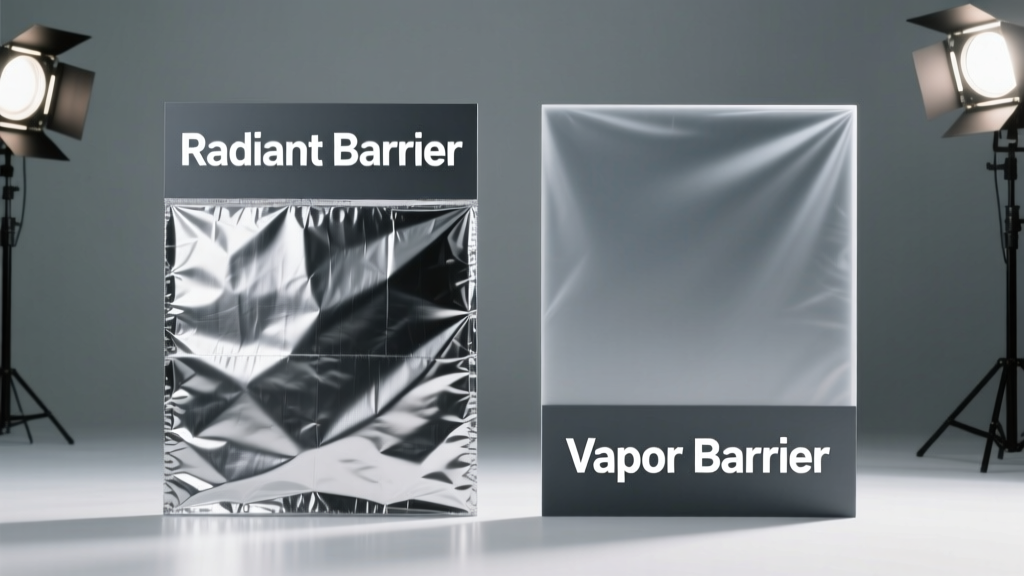
Choosing between a radiant barrier and a vapor barrier feels like comparing apples to insulation—except both are critical, often confused, and frequently installed in the wrong place. They serve fundamentally different physics-based functions, yet homeowners and contractors alike mix them up—or worse, install one thinking it solves both heat transfer and moisture problems.
Quick Verdict
Neither is "better" universally: radiant barriers reduce summer heat gain by reflecting infrared radiation (most effective in hot, sunny climates), while vapor barriers control moisture diffusion (essential in cold or humid climates to prevent condensation inside walls and roofs). Installing the wrong type—or layering them incorrectly—can trap moisture, accelerate rot, or even void warranties. According to the U.S. Department of Energy’s 2022 Building Technologies Office report, misapplied radiant barriers in humid climates increased attic moisture levels by up to 18% due to unintended condensation on foil surfaces.
Side-by-Side Comparison
| Feature | Radiant Barrier | Vapor Barrier |
|---|---|---|
| Primary Function | Reflects radiant heat (infrared energy) | Resists water vapor diffusion (perm rating ≤ 0.1 perms) |
| Typical Materials | Aluminized polyethylene film, foil-faced OSB, reflective roof deck coatings | Polyethylene sheeting (6-mil), asphalt-coated kraft paper, foil-faced polyiso, smart membranes |
| Permeability (Perm Rating) | 0.02–0.1 perms (often vapor-closed, but not designed for that role) | ≤ 0.1 perms (Class I vapor retarder) or 0.1–1.0 perms (Class II) |
| Best Installed In | Attic roofs (under rafters), cathedral ceilings, radiant-heated floors | Exterior sheathing (cold climates), interior drywall face (heating-dominated zones), crawlspaces |
| Climate Sweet Spot | Hot-dominant (ASHRAE Zones 1–3), especially with unconditioned attics | Cold-dominant (Zones 5–8) or mixed-humid (Zones 3–4) with high indoor humidity |
Deep Dive on Radiant Barrier
Radiant barriers work by reflecting up to 97% of incoming radiant heat—think sunlight hitting your roof, heating the decking, and re-radiating downward into the attic space. Their effectiveness hinges on an air gap (minimum 3/4") adjacent to the reflective surface; without it, conduction nullifies the benefit. They do almost nothing against conductive or convective heat flow.
Pros
- Reduces attic temperatures by 20–30°F in summer (Florida Solar Energy Center, 2021 field study)
- Lowers HVAC cooling loads by 5–10% in properly vented, unconditioned attics
- Thin, lightweight, and easy to retrofit under rafters or over attic floor joists
Cons
- Ineffective in winter or cloudy climates—no radiant heat source to reflect
- Dust accumulation on foil surfaces cuts reflectivity by up to 50% within 5 years (Oak Ridge National Lab, 2019)
- Can trap moisture if installed directly against wet sheathing or without ventilation
Use radiant barriers when: you live in Phoenix or Dallas, have an unvented attic with dark shingles, and run AC heavily June–September. Avoid them in Minneapolis, Portland, or anywhere with frequent fog or low winter sun angles.
Deep Dive on Vapor Barrier
Vapor barriers slow the movement of water vapor through building assemblies via diffusion—not air leakage (that’s an air barrier’s job). Their placement depends on climate-driven vapor drive direction: in cold winters, vapor moves inward, so the barrier belongs on the warm-in-winter side (interior); in hot-humid summers, it may go on the exterior—but only with careful hygrothermal modeling.
Pros
- Prevents interstitial condensation in walls and roofs—reducing mold, rot, and insulation degradation
- Required by IRC Section R702.7 for framed walls in Climate Zones 5–8
- Smart vapor retarders (e.g., MemBrain) adapt permeance based on humidity (0.02–12 perms)
Cons
- Misplaced barriers cause more moisture problems than they solve—especially in double-vapor-closed assemblies
- Does not stop air-transported moisture (a separate air sealing strategy is mandatory)
- 6-mil poly can tear during framing, wrinkle behind drywall, or create condensation traps if not perfectly sealed
Use vapor barriers when: you’re building new construction in Chicago, insulating a basement in Nashville, or finishing a bathroom wall in Seattle. Skip them in Santa Fe unless paired with exterior rigid foam and expert detailing.
When to Choose Radiant Barrier vs Vapor Barrier
Choose a radiant barrier if your top priority is cutting summer attic heat gain—and you’re in a hot-dry or hot-humid zone with adequate attic ventilation. Choose a vapor barrier if your main concern is preventing wintertime condensation in walls or roofs—and you’re in a heating-dominated climate with indoor relative humidity above 40% in winter.
Here’s what not to do: don’t staple foil-faced bubble wrap to the underside of roof sheathing as a 'dual-purpose' layer. It’s neither a reliable radiant barrier (no air gap) nor a proper vapor barrier (seams unsealed, perm rating inconsistent). According to the Building Science Corporation’s 2020 case studies, this hybrid approach caused premature roof deck decay in 7 out of 12 monitored homes in central Texas.
"A radiant barrier addresses 30% of heat flow in attics—radiation. A vapor barrier addresses 5%—diffusion. Confusing the two is like using a raincoat to fix a broken heater." — Dr. Joseph Lstiburek, Building Science Corporation, 2022
Alternatives to Consider
Sometimes the best solution isn’t choosing between these two—it’s using neither, or combining them correctly with other strategies:
- Spray foam insulation (closed-cell) acts as both an air barrier and moderate vapor retarder (1.0–1.5 perms), reducing need for separate layers
- Air barriers (like ZIP System sheathing or fluid-applied membranes) tackle the 95% of moisture transport that occurs via air leakage—not diffusion
- Cool roof coatings lower surface temps more reliably than radiant barriers in low-slope or flat roofs
Can I install both in the same assembly?
Yes—but only with meticulous sequencing and climate-specific placement. Example: In Houston, a radiant barrier goes under roof decking (with vent channel), while a Class II vapor retarder (e.g., kraft-faced batts) faces interior drywall. Never sandwich a vapor barrier between two impermeable layers.
Does attic radiant barrier help in winter?
Minimally. It reflects interior heat upward—but only if there’s a temperature differential *and* an air gap. In practice, most homes lose far more heat via conduction and air leakage than radiant loss. The DOE estimates winter energy savings from radiant barriers average less than 1%.
Is plastic sheeting a good vapor barrier under concrete slabs?
Yes—6-mil polyethylene is standard and code-compliant per ASTM E1745 when lapped 6" and sealed at seams. But it must be covered before pouring; exposed plastic degrades under UV and foot traffic.
What happens if I skip the vapor barrier in a cold climate?
Water vapor from showers, cooking, and breathing migrates into walls, condenses on cold sheathing, and saturates insulation. The U.S. EPA estimates that unchecked vapor diffusion contributes to 30% of premature wood-frame wall failures in Zone 6+.
Do radiant barriers need to be grounded?
No—but if installed near electrical wiring or fixtures, follow NEC Article 320.12: foil must be non-conductive or properly bonded to avoid arcing. Most residential-grade radiant barriers use laminated polyester film, not bare aluminum.
Can I use housewrap as a vapor barrier?
No. Tyvek and similar WRBs are water-resistive but highly permeable (≥50 perms)—they’re designed to let walls dry outward, not block vapor. Using them as vapor barriers invites trapped moisture and mold growth.
If your project involves a cathedral ceiling in Atlanta or a basement remodel in Cleveland, start with a hygrothermal analysis—not a product catalog. Both radiant and vapor barriers are tools, not magic fixes. Get the fundamentals right first: air sealing, insulation depth, and ventilation. Then choose the right tool for the specific job—and location—in your wall or roof assembly.