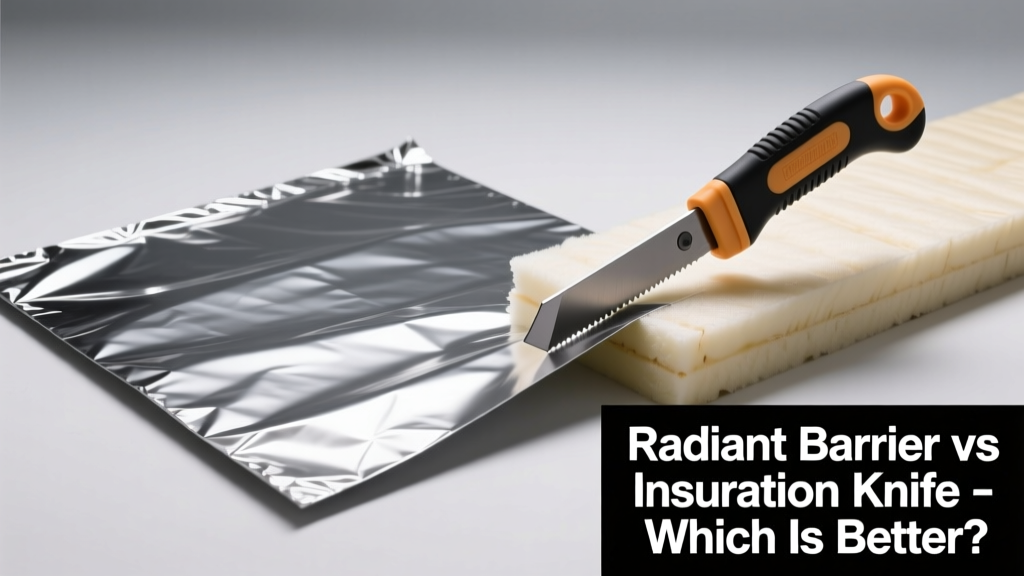
You’re standing in your attic, holding a roll of reflective foil and a utility knife labeled 'insulation cutter'—and suddenly realize you’ve mixed up two entirely different tools. One blocks heat transfer; the other cuts batts. Confusion here isn’t just awkward—it can lead to under-insulated ceilings or wasted budget.
Quick Verdict
Neither is ‘better’—they serve fundamentally different functions. A radiant barrier reflects radiant heat (like summer sun baking your roof), while an insulation knife is a precision cutting tool for fiberglass, mineral wool, or foam board. Using one in place of the other solves nothing. The real question isn’t ‘which is better?’ but ‘which do I actually need right now?’
Side-by-Side Comparison
| Feature | Radiant Barrier | Insulation Knife |
|---|---|---|
| Primary function | Reduces radiant heat gain/loss via reflectivity (≥90% emissivity reduction) | Cuts insulation materials cleanly without compressing or fraying edges |
| Material composition | Aluminized polyethylene or reinforced foil-faced kraft paper | Stainless steel blade + ergonomic handle (often with depth stop) |
| Installation location | Attic rafters, roof decking underside, or behind wall sheathing | Used manually during installation—never installed permanently |
| Lifespan | 20–30 years if not punctured or dust-coated | Blade lasts 6–12 months with regular use; handle lasts indefinitely |
| Code compliance | Must meet ASTM C1313; requires air gap for effectiveness | No code requirements—tool safety standards only (ANSI/ISEA 105-2016) |
Deep Dive on Radiant Barrier
A radiant barrier is a passive thermal control layer—typically foil-faced material installed with an air gap to reflect up to 97% of incoming radiant heat (U.S. Department of Energy, 2022). It works best in hot climates where attic temperatures exceed 120°F, like Phoenix or Dallas.
Pros
- Slows heat transfer without adding R-value—ideal when space is tight (e.g., cathedral ceilings)
- Reduces HVAC runtime by up to 5–10% in attics with insufficient mass insulation (Florida Solar Energy Center, 2021)
- Non-toxic, mold-resistant, and unaffected by moisture if properly vented
Cons
- Zero effect in cold, cloudy, or humid conditions where conduction dominates
- Loses >40% effectiveness if dust accumulates or air gap is compromised (IBHS 2023 report)
- Can’t replace bulk insulation—R-value remains unchanged without added fiberglass or cellulose
Best used as a supplement—not a substitute—for traditional insulation. For example, pairing it with R-38 blown cellulose in a vented attic delivers measurable summer cooling gains. See our guide on attic insulation options for layered strategies.
Deep Dive on Insulation Knife
An insulation knife isn’t a building material—it’s a trade tool designed for clean, consistent cuts through soft insulation. Unlike box cutters or serrated knives, it features a spring-loaded blade retraction, adjustable depth stop, and often a hooked tip for scoring faced batts.
Pros
- Prevents over-compression—critical for maintaining stated R-value (e.g., compressing R-13 fiberglass to 3.5" drops effective R to ~R-10)
- Reduces airborne fibers: sharper blades = cleaner cuts = less fiberglass dust inhalation
- Compatible with most common insulation types: fiberglass, rock wool, EPS, XPS, and even spray foam skins
Cons
- Useless without insulation to cut—no thermal benefit on its own
- Poorly maintained blades cause jagged edges that create air gaps and reduce performance
- Not suitable for cutting metal-faced polyiso or rigid PIR boards without carbide-tipped variants
If you're installing fiberglass batts yourself, this tool prevents common errors that undermine insulation performance. According to the North American Insulation Manufacturers Association (NAIMA, 2022), improper cutting accounts for nearly 22% of field-reported R-value shortfalls.
When to Choose Radiant Barrier vs Insulation Knife
Choose a radiant barrier if you’re retrofitting a hot-climate attic and already have R-30+ insulation—but still face high cooling bills and surface temps above 140°F. Choose an insulation knife if you’re actively installing or trimming insulation and want precision, speed, and safety.
- Go radiant barrier when: Attic floor is insulated to code, roof assembly allows air gap, and local summer temps average >90°F
- Go insulation knife when: You’re cutting 15+ batts per day, working with faced insulation, or aiming for IECC 2021 compliance on air sealing
- Avoid both if your attic has no vapor barrier, poor ventilation, or less than R-19—fix those first
"Radiant barriers are highly situational—they’re not insulation, and they’re not a tool. Calling them interchangeable with cutting tools reveals a fundamental misunderstanding of heat transfer physics." — Dr. Lena Cho, Building Science Advisor, Oak Ridge National Lab (2023)
Alternatives to Consider
If your goal is improved thermal performance, consider these proven alternatives:
- Reflective insulation systems (e.g., foil-faced bubble wrap): Combine radiant barrier + small air gap + some R-value (R-1 to R-3), but require strict installation discipline
- Smart vapor retarders like Certainteed MemBrain: Adjust permeability with humidity—ideal for mixed-humid climates
- Insulation saws (e.g., Insul-Knife Pro): Motorized versions for large-scale commercial jobs—cut 3x faster than manual knives
- Thermal imaging audits: Before choosing any solution, identify actual heat loss patterns using FLIR E6 or similar (costs $1,200–$2,500, but pays back in 1–2 seasons)
Can I install a radiant barrier myself?
Yes—if you’re comfortable working in attics, can maintain a 3/4" minimum air gap, and avoid covering electrical fixtures or recessed lights. DIY errors include stapling foil directly to rafters (eliminating air gap) or covering HVAC ducts (fire hazard). Always follow manufacturer instructions and local fire codes—some foil products require Class A flame spread rating.
Do insulation knives work on spray foam?
Only on cured, closed-cell spray foam skins—not wet or open-cell foam. Use a hot-wire cutter for precision shaping of uncured foam. For cured foam, carbide-tipped insulation knives (like the Malco T-Tool) cut cleanly without melting edges.
Is a radiant barrier worth it in cold climates?
Rarely. In heating-dominated zones (e.g., Minneapolis, Buffalo), radiant barriers provide negligible benefit—conductive and convective losses dominate. The U.S. EPA estimates less than 1% energy savings in HDD >7,000 zones (Energy Star, 2023). Focus instead on air sealing and higher-R bulk insulation.
How often should I replace my insulation knife blade?
Every 2–3 days during active installation, or immediately after cutting dusty or abrasive materials (e.g., mineral wool). Dull blades compress insulation instead of slicing—reducing effective R-value by up to 15%, per NAIMA field testing (2022).
Can radiant barrier cause moisture problems?
Yes—if installed without proper attic ventilation or on the wrong side of the assembly. Foil facing toward a cool, unvented cavity can trap condensation—especially in mixed-humid climates. Always pair with soffit-to-ridge venting and consult ASHRAE 160 guidelines before installing.
What’s the biggest mistake people make with insulation knives?
Using them like utility knives—applying downward pressure instead of drawing the blade smoothly across the material. This compresses batts, creates uneven edges, and leaves gaps at joist cavities. Proper technique uses light, continuous forward motion with the blade angled slightly upward.
Confusing tools with materials is common—but clarity saves time, money, and performance. If your project involves cutting insulation, reach for the knife. If it involves managing solar heat gain in an attic, evaluate radiant barriers—but only after verifying existing insulation levels and ventilation. For more on integrating both into a whole-house strategy, see our whole-house energy retrofit checklist.