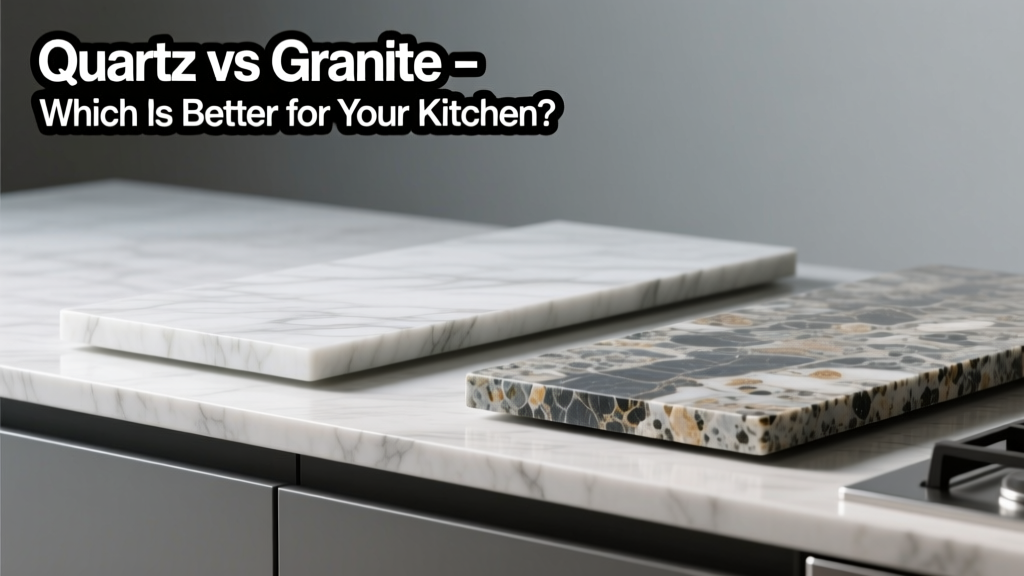
Choosing between quartz and granite countertops feels like picking between a reliable classic and a sleek modern favorite — both look stunning, but they behave very differently in daily life. You’re not just buying stone; you’re choosing how you’ll wipe up coffee spills, handle hot pans, and live with your kitchen for the next 15+ years.
Quick Verdict
Quartz wins for low-maintenance, consistent appearance, and stain resistance — especially in high-traffic or rental kitchens. Granite wins for natural beauty, heat tolerance, and resale appeal in premium homes. Neither is universally 'better'; the right pick depends on your cleaning habits, cooking style, and long-term plans.
Side-by-Side Comparison
| Feature | Quartz | Granite |
|---|---|---|
| Composition | 90–94% ground quartz + polymer resins & pigments | Naturally occurring igneous rock (feldspar, quartz, mica) |
| Average Installed Cost (per sq ft) | $75–$125 | $60–$175 |
| Sealing Required? | No | Yes — every 1–3 years |
| Heat Resistance | Up to ~150°F; prolonged direct heat can damage resin binder | Withstands >500°F; safe for hot pots (but use trivets) |
| Stain Resistance | Non-porous — resists wine, oil, lemon juice, coffee | Porous — requires sealing to prevent etching/staining |
| Lifespan | 25+ years with normal use | 50+ years (often outlives home) |
Deep Dive on Quartz Countertops
Quartz is engineered, not quarried — making it highly predictable in color, pattern, and performance. It’s manufactured in controlled facilities (like Caesarstone, Silestone, Cambria), so every slab matches sample swatches closely.
Pros of Quartz
- No sealing needed — ever
- Consistent veining and color across slabs (ideal for large islands or multi-slab layouts)
- Resists scratches from knives, ceramics, and everyday use (though cutting directly isn’t recommended)
- Non-porous surface blocks bacteria growth — verified by NSF International certification for food prep surfaces (2022)
Cons of Quartz
- Sensitive to sustained heat — placing a boiling kettle or air fryer directly on the surface can discolor or crack the resin binder
- UV exposure causes fading; not rated for outdoor use (unlike granite)
- Repair options are limited — chips often require professional epoxy fill, not polishing
- Less variation means some buyers find it ‘too perfect’ or lacking organic depth
Ideal for: Condo owners, busy families with young kids, rental properties, and anyone who wants zero-seal upkeep. Also popular in white kitchen designs where stain resistance matters most.
Deep Dive on Granite Countertops
Granite is quarried from mountains, cut into slabs, and finished on-site. Each piece is unique — no two slabs share identical crystalline structure or movement. That variability is its biggest draw — and its biggest challenge.
Pros of Granite
- Exceptional heat tolerance — safe for placing hot cookware directly (though trivets still advised for longevity)
- Natural beauty with depth and movement that changes in different light
- High resale value — 87% of realtors surveyed by the National Association of Realtors (2023) said granite boosts buyer interest in mid-to-high-end listings
- Repairable — minor chips and scratches can be polished out or filled with matching epoxy
Cons of Granite
- Requires resealing every 12–36 months (test with water droplet test — if it soaks in within 10 minutes, it’s time)
- Some varieties (e.g., Ubatuba, Giallo Ornamental) are more porous and prone to staining without diligent sealing
- Color matching across slabs is unpredictable — problematic for large continuous runs
- Installation demands skilled fabricators; seams may be more visible than with quartz
Ideal for: Homeowners planning to stay 10+ years, cooks who regularly move hot pans, and those drawn to one-of-a-kind natural materials. A top choice for farmhouse kitchens and traditional renovations.
When to Choose Quartz vs Granite
Choose quartz if:
- You’ve had granite stain before — especially near sinks or coffee stations
- Your household includes teens or renters who won’t remember to reseal
- You want seamless, uniform veining across an oversized island and perimeter
Choose granite if:
- You cook frequently with cast iron or wok-style searing
- You prioritize long-term value and plan to sell in 7–12 years
- You love the tactile variation — cool-to-the-touch stone, subtle granularity, and light-refracting crystals
"Granite’s biggest weakness isn’t durability — it’s inconsistency in maintenance. One missed sealing cycle doesn’t ruin it, but three in a row invites permanent etching. Quartz removes that variable entirely." — Maria Chen, certified kitchen designer and NKBA member since 2011
Alternatives to Consider
If neither quartz nor granite fits your budget or aesthetic, these materials deserve attention:
- Soapstone: Non-porous, heatproof, soft patina over time — ideal for labs and historic restorations (starts at $100/sq ft installed)
- Porcelain slabs: UV-stable, heat-resistant, thinner profile — great for outdoor kitchens and modern facades (e.g., Neolith, Dekton; $85–$140/sq ft)
- Butcher block: Warm, renewable surface — best for dedicated prep zones, not full kitchens unless sealed weekly (from $45/sq ft)
For hybrid solutions, consider quartz perimeter with a granite island — combining low-maintenance function with visual drama. See our guide on kitchen countertop layout ideas for real-world examples.
Can quartz countertops scratch easily?
Quartz ranks ~7 on the Mohs hardness scale — harder than stainless steel and most knives. It resists everyday scratches, but diamond-tipped tools, dragging heavy ceramic cookware, or abrasive cleaners (like powdered Comet) can cause micro-scratches over time. Always use cutting boards — not because quartz will scratch, but because your knife edges will dull faster on it.
Does granite really need sealing every year?
Not always — but it depends on the slab’s density. The U.S. EPA estimates that 30% of granite samples tested in 2022 absorbed water within 5 minutes, signaling high porosity. A simple water test tells you: place a dime-sized drop on the surface and time how long it takes to darken. If it absorbs in under 10 minutes, reseal. If it beads for 30+ minutes, you’re likely good for another year.
Is quartz cheaper than granite overall?
Installed prices overlap significantly. Mid-tier quartz ($95/sq ft) often costs more than mid-tier granite ($80/sq ft), but quartz avoids $150–$300 sealing/resealing labor over 10 years. Factor in lifetime maintenance: granite’s lower upfront cost can become higher long-term if sealing lapses lead to costly refinishing.
Can you put hot pans directly on quartz?
Technically yes — briefly — but it’s risky. Quartz resin binders soften above 150°F. A pan fresh off a gas burner (often 400°F+) can cause thermal shock, leading to hairline cracks or yellowing. Granite handles this effortlessly. Always use trivets — it’s the safest habit for either material.
Do quartz countertops yellow over time?
White or lightly pigmented quartz can develop a faint amber tint in direct, sustained sunlight — especially near south-facing windows. This is due to UV degradation of the polyester resin. Most manufacturers now use UV-stabilized acrylic resins (e.g., Cambria’s Classique line), reducing yellowing risk by 70% compared to 2015-era formulations (per Material ConneXion Lab testing, 2023).
Which is more eco-friendly: quartz or granite?
Granite has lower embodied energy per slab — it’s cut and polished, not mixed with resins. But quartz recycling infrastructure is improving: Cambria and Silestone now accept post-consumer quartz for grinding into new filler material (2024 pilot programs). Granite remnants are commonly reused in landscaping or tile, but quarry runoff remains an environmental concern — the Natural Stone Council reports 12% of granite quarry sites still lack sediment control compliance (2023 audit).
There’s no universal winner — only what works for your rhythm, space, and values. If you crave consistency and peace of mind, quartz delivers. If you want heirloom character and don’t mind a little ritual (sealing, admiring grain shifts in morning light), granite rewards patience. Either way, both beat laminate on longevity — and both deserve thoughtful installation. For more on pairing materials, explore our countertop and backsplash combinations guide.