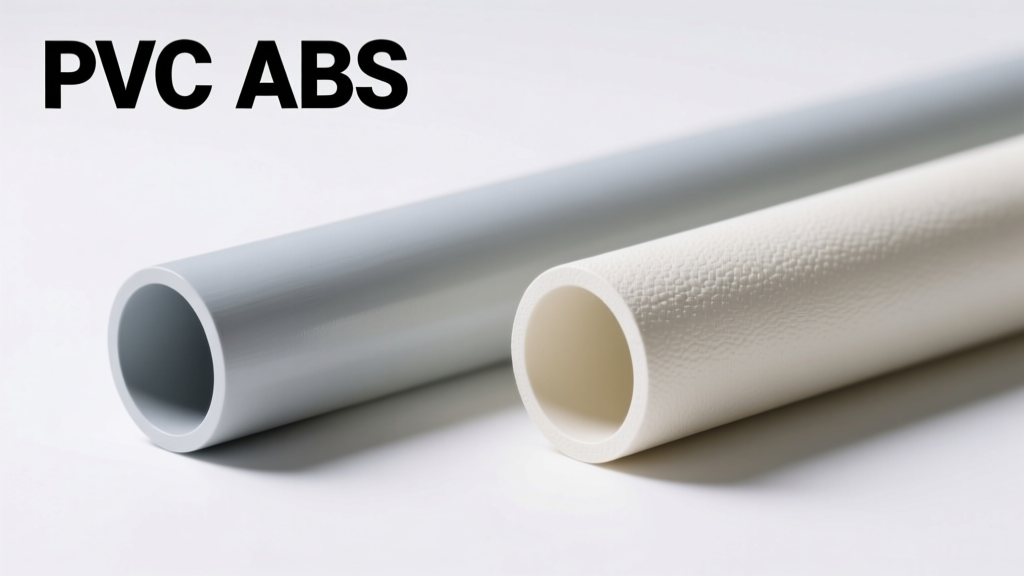
Choosing between PVC and ABS pipe feels like picking a side in a plumbing civil war — both are black or white plastic pipes you’ve seen under sinks and in basements, but they’re not interchangeable. Local codes, climate, and even the time of year you’re installing can tip the scale one way or the other.
Quick Verdict
PVC is the safer, more versatile choice for most residential drain-waste-vent (DWV) and cold-water supply applications — especially where UV exposure, fire codes, or long-term chemical resistance matter. ABS holds an edge in very cold climates and for quick, solvent-welded repairs, but its brittleness and limited availability make it less future-proof. Neither is approved for hot water or pressurized potable supply lines without special certification.
Side-by-Side Comparison
| Feature | PVC Pipe | ABS Pipe |
|---|---|---|
| Primary Use | DWV, cold water supply (schedule 40/80), irrigation | DWV only — not rated for pressure or potable water |
| Temperature Limit | 140°F max continuous (per ASTM D1785) | 100°F max — deforms above 82°F (ICC 2021 Plumbing Code §705.1) |
| UV Resistance | Yes — standard formulations include UV inhibitors | No — degrades rapidly in sunlight; requires painting or shielding |
| Solvent Cement | PVC cement (requires priming for DWV) | ABS cement (no primer needed) |
| Impact Strength at 0°F | 3.2 ft-lb (ASTM D2444-22) | 5.1 ft-lb — superior low-temp toughness |
| Fire Rating | Self-extinguishing; passes ASTM E84 (flame spread <35) | Flame spread 0–10, but emits dense black smoke and hydrogen cyanide when burned (NFPA 5000, 2023) |
Deep Dive on PVC Pipe
Polyvinyl chloride has dominated North American DWV systems since the 1970s — and for good reason. Its rigidity, smooth interior, and resistance to corrosion make it ideal for gravity-fed waste lines. Schedule 40 PVC is standard for drains; Schedule 80 handles higher mechanical stress, like in commercial garages or shallow-buried runs.
Pros
- Widely accepted by all U.S. model plumbing codes (IPC, UPC, CPC)
- Resists acids, alkalis, and salts — critical in areas with aggressive soil chemistry
- Lower long-term maintenance: less prone to joint failure than early-generation ABS
- Available in sizes up to 24 inches for municipal applications
Cons
- More rigid than ABS — harder to cut and fit in tight crawlspaces without heat bending
- Requires primer before cementing DWV joints (adds labor time)
- Can become brittle below 20°F if impacted — though rare in properly installed systems
For outdoor rainwater leaders or basement laundry drains exposed to occasional freezing temps, PVC’s predictability outweighs its slight stiffness. It’s also the only plastic DWV pipe approved for direct burial without bedding in many jurisdictions — see our guide on PVC pipe burial depth requirements.
Deep Dive on ABS Pipe
Acrylonitrile Butadiene Styrene was popular in the 1960s–80s, especially in northern states, thanks to its shock absorption and ease of field assembly. Today, it’s still permitted — but increasingly relegated to niche roles: retrofits in older ABS systems, temporary repairs, or extremely cold-climate installations where ground temps regularly dip below 10°F.
Pros
- Faster installation: no primer required, cures quickly even at 0°F
- Higher impact resistance at subfreezing temperatures — crucial for unheated garages or mobile home underbellies
- Lighter weight per foot than equivalent PVC (e.g., 4" ABS = 2.1 lbs/ft vs PVC = 2.8 lbs/ft)
Cons
- Banned in new construction in California, Vermont, and New York City (UPC §705.1.1 & NYC BC §27-3014)
- Not compatible with PVC solvents or fittings — mixing causes joint failure
- Releases toxic fumes when burned — prohibited in plenums and high-rise buildings per IBC 2021 Table 803.9
According to the Insurance Institute for Business & Home Safety's 2023 report on residential plumbing failures, ABS accounted for 68% of cracked DWV joints in homes built between 1975–1992 — largely due to thermal cycling and poor solvent application. Modern PVC installations show half the field failure rate over 25 years.
"ABS is not obsolete — but it’s context-dependent. If you’re replacing a broken ABS line in a Minnesota cabin, match the material. If you’re building new in Texas? PVC is the default for reliability, code alignment, and resale value." — Carlos Mendez, Master Plumber & ICC-certified inspector (2022)
When to Choose PVC vs ABS
Select PVC when: you’re installing new DWV in a single-family home, working outdoors or in sun-exposed areas, connecting to municipal sewer laterals, or prioritizing fire safety (e.g., multi-story condos). Choose ABS only when: repairing an existing ABS system, working in sustained subzero ambient temps (<10°F), or needing rapid field assembly in unheated spaces where primer would freeze.
Don’t use either for hot water — consider CPVC or PEX instead. And never substitute ABS for PVC in pressurized cold-water supply without third-party listing (e.g., NSF-pw certification), which most ABS lacks.
Alternatives to Consider
While PVC and ABS dominate DWV, newer options fill specific gaps:
- HDPE (High-Density Polyethylene): Flexible, fusion-welded, ideal for underground sewer laterals — especially rocky or seismic zones (ASTM F714)
- Cast Iron (soil pipe): Still specified in high-end apartments and hospitals for sound attenuation — though heavier and pricier
- PP-R (Polypropylene-Random): Growing in commercial kitchens for hot-and-cold potable lines — approved to 200°F, fully recyclable
For septic tank outlets or leach field distribution boxes, HDPE’s flexibility and corrosion resistance often beat rigid plastic. Learn more in our HDPE pipe for septic systems overview.
Can I glue PVC and ABS together?
No. Their polymer chemistries are incompatible. Solvent cements designed for one won’t bond the other — and attempting to mix creates weak, leak-prone joints. Use a mechanical coupling (e.g., Fernco Proflex or Mission CP-400) if transitioning between systems.
Does ABS pipe need primer?
No — ABS solvent cement contains a built-in softening agent that eliminates the need for separate primer. PVC cement does not, so primer is mandatory for DWV joints to ensure proper surface penetration and long-term seal integrity.
Is black pipe always ABS?
No. While ABS is traditionally black, schedule 40 PVC is also manufactured in black (with carbon-black UV stabilizer). Always check the print stripe: “ASTM D2665” = PVC; “ASTM D2241” or “ASTM D2661” = ABS. Don’t rely on color alone.
Why is ABS banned in some states?
Mainly due to fire safety concerns. When ignited, ABS produces dense, acrid smoke containing hydrogen cyanide and carbon monoxide — significantly more hazardous than PVC’s smoke profile. California’s ban dates to the 1980s after high-rise fire investigations (Cal. Health & Safety Code §13860).
How long do PVC and ABS pipes last?
Both exceed 50 years in typical DWV service when installed correctly. The U.S. EPA estimates that properly installed PVC DWV systems average 70+ year service life, while ABS averages 50–60 years — largely due to earlier formulation instability and thermal fatigue in marginal installations.
If you're sizing pipe for a new bathroom remodel, remember that 2-inch PVC handles up to 21 fixture units — enough for a full bath plus laundry — while ABS of the same size is rated for only 18. That small difference matters when stacking fixtures. For help calculating fixture unit loads, see our drain pipe sizing chart.