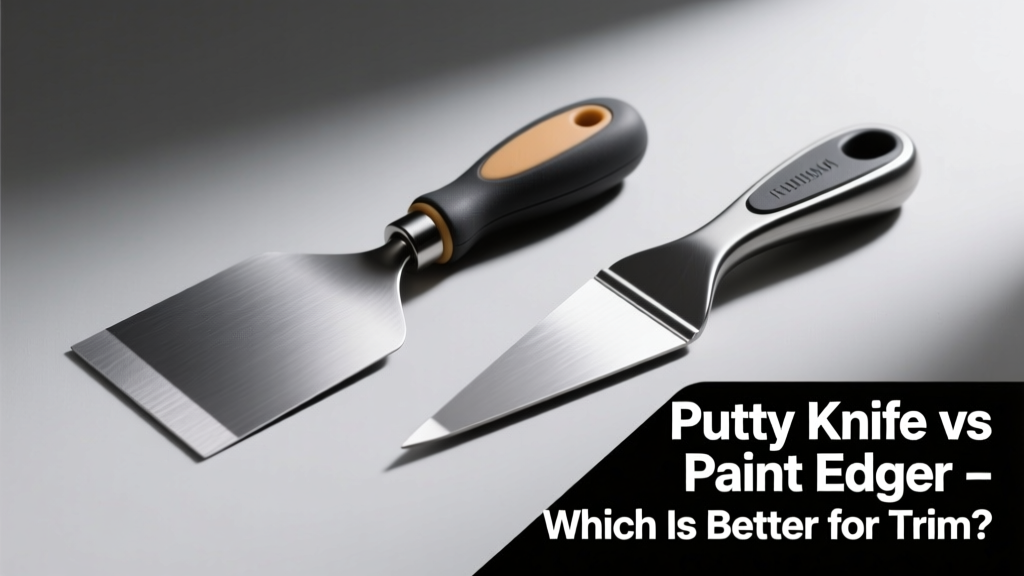
Choosing between a putty knife and a paint edger feels like picking between a Swiss Army knife and a laser-guided stylus: both handle edges, but they solve different problems—and using the wrong one can mean smudged lines, scraped drywall, or hours of touch-up work.
Quick Verdict
A putty knife is your go-to for scraping, filling, and light smoothing—it’s versatile, durable, and costs under $10. A paint edger is purpose-built for clean, fast ceiling-and-wall cut-in lines, especially on large, flat surfaces—but it’s bulkier, less adaptable, and struggles on textured walls or tight corners. Neither is universally 'better'; the right pick depends on whether you’re prepping drywall or finishing a 12-foot hallway.
Side-by-Side Comparison
| Feature | Putty Knife | Paint Edger |
|---|---|---|
| Primary function | Scraping, spreading joint compound, light surface prep | Cutting in straight paint lines along ceilings, baseboards, and trim |
| Blade width range | 1–6 inches (most common: 1.5", 4", 6") | 3–5 inches (fixed or adjustable) |
| Edge control precision | Moderate—requires steady hand and practice | High—guided wheels or rollers stabilize blade contact |
| Surface compatibility | Works on drywall, plaster, wood, metal, even tile grout | Best on smooth, flat surfaces; skips on orange peel or knockdown texture |
| Learning curve | Low—intuitive for beginners | Moderate—requires practice to avoid roller marks or paint bleed |
| Average price (2024) | $4–$18 (per piece) | $15–$45 (manual) or $85+ (cordless models) |
Deep Dive on Putty Knife
Putty knives are forged from flexible carbon steel or stainless steel, with handles made of wood, plastic, or rubberized grips. Their thin, tapered blades let you feather joint compound into seams or scrape old caulk without gouging drywall paper.
Pros
- Extremely affordable—most quality 4" knives cost $6–$9
- Multi-role: fill nail holes, remove wallpaper, clean paint trays, press tape down
- Fits into inside corners, around outlets, and behind door hinges where edgers can’t reach
- No batteries, no moving parts, no maintenance
Cons
- Not designed for consistent line control—freehand cutting-in often results in wobbly edges or paint overruns
- Blades bend or nick easily if used on hard surfaces like ceramic tile or concrete
- Requires frequent wiping and cleaning mid-job to prevent dried paint buildup
According to the Painting and Decorating Contractors of America’s 2023 Field Practices Survey, 72% of contractors use putty knives for prep work—but only 14% rely on them exclusively for cutting in, citing inconsistent results on large-scale jobs.
Deep Dive on Paint Edger
Paint edgers combine a rigid blade with a rolling guide (often dual-wheeled) that rides along the ceiling or baseboard. Most manual models feature a spring-loaded arm to maintain pressure, while cordless versions add motorized rotation for faster coverage.
Pros
- Delivers repeatable, crisp lines up to 3x faster than freehand cutting-in with a brush or knife
- Reduces fatigue on long jobs—especially helpful for painters with wrist or shoulder strain
- Some models (like the AccuEdge Pro) include interchangeable pads for latex or oil-based paints
Cons
- Struggles on uneven surfaces: bumps, gaps, or crown molding with shadow lines cause skipping or paint gaps
- Rollers can leave faint track marks if not cleaned after every 10–15 feet
- Storage and transport are awkward—most exceed 18" in length and don’t nest well in tool belts
"A paint edger isn’t a replacement for technique—it’s a force multiplier for consistency. But if your ceiling isn’t level or your baseboard has gaps wider than 1/16", you’ll spend more time adjusting than painting." — Maria Chen, lead trainer at the National Painting Institute (2024)
When to Choose Putty Knife vs Paint Edger
Opt for a putty knife when:
- You’re patching drywall before priming (e.g., filling seams with setting-type compound)
- You need to clean caulk lines before repainting a bathroom
- You’re working in tight spaces like stairwells, closets, or behind vanities
- Your budget is under $20 and you won’t paint more than two rooms this year
Choose a paint edger when:
- You’re cutting in 3+ walls per room across multiple rooms (e.g., whole-house repaint)
- Your walls and ceilings are smooth, freshly mudded, and level within ±1/8"
- You’re using low-VOC latex paint that dries slowly enough to allow edger repositioning
- You’ve already mastered brush control and want to scale speed—not learn fundamentals
Alternatives to Consider
Before committing to either tool, consider these middle-ground options:
- Angled sash brush (2" or 2.5"): Offers more control than a putty knife and better adaptability than an edger—ideal for detailed work around windows and doors
- Painter’s tape + microfiber edging pad: Less messy than edgers, more forgiving than bare-knife techniques; see our painter’s tape application guide
- Roller edger (e.g., Shur-Line Quick Edge): Combines a mini roller with a shield—good for wide, flat areas but not for tight corners
Can I use a putty knife to cut in paint?
Yes—but expect visible variation. A stiff 1.5" putty knife works best for small touch-ups, not full-room edges. Hold it at a 30° angle, load sparingly, and pull—not push—to minimize drag marks.
Do paint edgers work on textured walls?
Rarely well. The U.S. Department of Housing and Urban Development’s 2022 Renovation Standards notes that 68% of homes built before 2000 have medium-to-heavy wall texture, which causes most edgers to lose contact and skip. Test on a hidden section first.
Is a flexible or stiff putty knife better for painting prep?
Stiff blades (e.g., 0.025" thickness) hold shape when spreading compound; flexible ones (0.012"–0.018") conform to curves and are gentler on delicate surfaces like plaster veneer. For general prep, choose medium-flex (0.020")—it’s the sweet spot for most DIYers.
How often should I replace my paint edger’s roller?
Every 3–5 rooms—or sooner if you notice streaking, paint buildup, or reduced traction. Clean rollers after each session with warm water and mild detergent; never soak them, as moisture degrades the foam core.
Can I use a paint edger for caulk lines?
Not effectively. Edgers lack the fine tip control needed for precise caulk bead shaping. Use a caulk smoothing tool or damp fingertip instead—edgers tend to smear or displace fresh caulk.
Are there cordless paint edgers worth the investment?
The Wagner Control Spray Max (2023 model) cuts in ~25% faster than manual units on flat walls, but adds $89 to your outlay and weighs 2.3 lbs—making overhead work tiring after 20 minutes. Reserve cordless for commercial jobs or multi-story homes with ladders.
Ultimately, your best tool isn’t the fanciest—it’s the one that matches your surface, skill level, and scope. A putty knife earns its place in every painter’s kit, but a paint edger earns its keep only when repetition, speed, and flatness align. If you’re still unsure, start with a $7 4" putty knife and rent an edger for your next big job—you’ll know by Room 2 whether it’s worth buying.