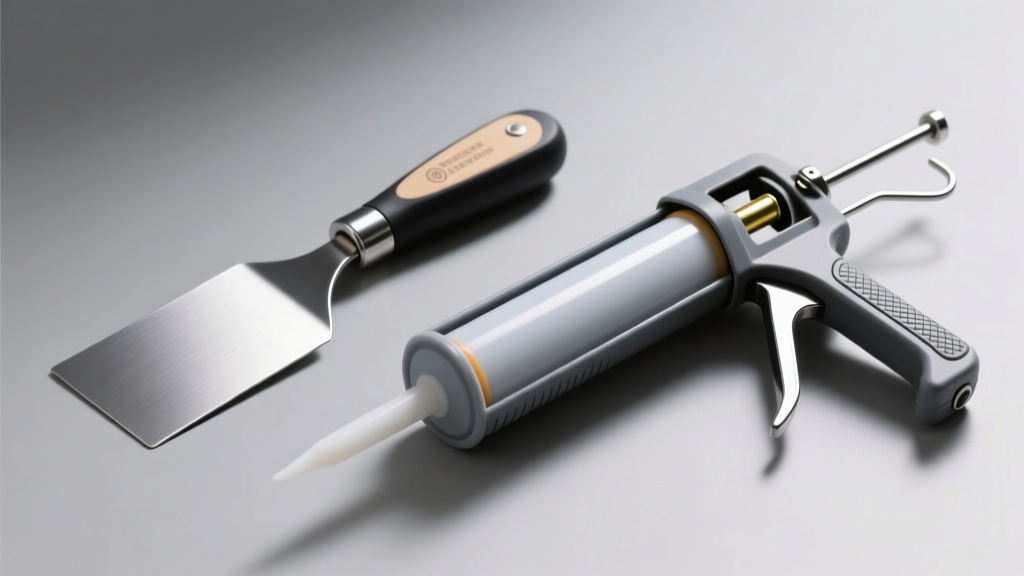
You’re standing in the hardware aisle, holding a putty knife in one hand and eyeing a caulk gun on the shelf—both promise to fix that gap around your bathroom tile or patch that drywall nick. But they serve fundamentally different jobs, and using the wrong one wastes time, material, and patience.
Quick Verdict
Neither tool is universally "better"—they’re built for distinct tasks. A putty knife excels at spreading, scraping, and smoothing thin, stiff compounds like spackle or joint compound. A caulk gun delivers controlled, pressurized flow of viscous sealants like silicone or acrylic latex into narrow gaps and joints. Choose based on material viscosity and application geometry—not habit or convenience.
Side-by-Side Comparison
| Feature | Putty Knife | Caulk Gun |
|---|---|---|
| Primary function | Spreading, scraping, smoothing | Dispensing, metering, and injecting sealant |
| Typical materials used | Spackle, joint compound, wood filler, plaster | Silicone, polyurethane, acrylic latex, butyl rubber |
| Minimum gap width handled well | 1/8 inch or wider (flat surface work) | 1/16 inch up to 3/4 inch (linear joints) |
| Cleanup effort | Wipeable with damp cloth; minimal residue | Requires mineral spirits (for silicone) or soap/water (for latex); nozzle clogs easily |
| Learning curve | Low—intuitive pressure control | Moderate—requires trigger rhythm, cut-angle control, and back-rolling technique |
Deep Dive on Putty Knife
A putty knife is a simple, rigid or flexible metal blade mounted on a handle—common widths range from 1.5 inches (detail work) to 12 inches (broad skim coats). Its strength lies in manual control and surface interaction.
- Pros: Inexpensive ($3–$15), durable, zero setup or loading time, ideal for feathering edges and removing dried compound
- Cons: Cannot dispense sealant; ineffective on deep, narrow seams; struggles with highly adhesive or stringy materials like uncured silicone
- Ideal use cases: Patching drywall holes, embedding drywall tape, smoothing spackle over nail pops, cleaning old caulk before resealing, applying wood filler to gouges
According to the National Association of Home Builders’ 2022 Remodeling Cost Report, 78% of minor interior repairs involving surface-level imperfections are completed faster with a putty knife than with dispensing tools—largely due to immediate tactile feedback and no waiting for sealant cure before sanding.
Deep Dive on Caulk Gun
A caulk gun is a lever-actuated device that pushes a plunger through a sealed tube of sealant. Trigger pressure controls flow rate, while tip size and cut angle determine bead width and penetration depth.
- Pros: Delivers consistent, metered output; handles high-viscosity sealants that won’t spread by hand; essential for watertight, flexible joints (e.g., tub-to-tile, window frames)
- Cons: Requires tube loading, tip cutting, and post-application tooling; higher upfront cost ($8–$45); poor performance with non-extrudable compounds like setting-type joint compound
- Ideal use cases: Sealing bathroom showers, kitchen backsplashes, exterior window/door perimeters, HVAC duct seams, and any joint requiring movement accommodation or moisture resistance
"A caulk gun isn’t about speed—it’s about containment. If you can’t hold the bead where it needs to be without oozing or voids, you’ve already failed the seal—even if it looks smooth." — Mike R., licensed general contractor with 22 years of residential waterproofing experience
When to Choose Putty Knife vs Caulk Gun
Select the tool based on what you’re installing—and where it goes:
- Fixing a 2-inch crack in drywall? → putty knife
- Sealing the 1/4-inch gap between your shower base and tile wall? → caulk gun
- Smoothing a thick layer of epoxy wood filler into a split stair tread? → putty knife (flexible 2-inch blade)
- Applying fire-rated intumescent sealant around an electrical box penetration? → caulk gun (with notched tip for precise depth control)
- Removing decades-old cracked silicone from a sink rim? → putty knife first, then caulk gun for replacement
Alternatives to Consider
Sometimes neither tool fits the job—or both are needed together. Consider these complementary options:
- Roller applicators: For large-area sealant coverage (e.g., concrete expansion joints); rarely used in residential interiors
- Cartridge dispensers with pneumatic triggers: Used in commercial flooring for urethane seam sealers—overkill for DIY
- Flexible silicone scrapers: Rubber-blade tools that smooth caulk beads *after* extrusion—often paired with a caulk gun
- Auto-feed drywall knives: Motorized tools for professional skim-coating; not interchangeable with putty knives
For hybrid jobs—like applying acoustical sealant behind baseboards—you’ll often load the caulk gun first, then finish with a putty knife to press and smooth the bead into tight corners.
Can I use a putty knife to apply caulk?
You can—but it’s inefficient and rarely effective. Most caulks are too sticky and stringy to spread evenly with a blade, and you’ll waste 30–40% more material trying to force adhesion into narrow gaps. The U.S. EPA estimates that improper caulk application accounts for nearly 12% of premature sealant failure in homes built since 2015.
Do I need multiple putty knife sizes?
Yes—for precision and efficiency. Keep a 1.5-inch stiff blade for corners and small patches, a 6-inch flexible blade for broad smoothing, and a 10-inch rigid blade for drywall taping. Narrower blades offer better control; wider ones reduce streaks on flat surfaces.
Why does my caulk gun drip after releasing the trigger?
This usually means the plunger isn’t locking properly or the tube’s inner seal wasn’t fully punctured. Cheaper guns lack a positive-lock mechanism—look for models with a “release lock” lever (e.g., Red Devil 0845 or TapeTech CAULK-PRO). Also check that the nozzle is cut at a 45° angle—not straight across.
Is a cordless caulk gun worth it?
Only for contractors doing 10+ tubes per week. Battery-powered models (like the Dewalt DC608KB) reduce hand fatigue during marathon sealing jobs—but add $60–$120 to your budget and require charging logistics. For weekend DIYers, a ratcheting manual gun delivers equal precision at 1/3 the cost.
Can I reuse a caulk tube with a caulk gun?
Yes—if you use a caulk saver cap and store it tip-down in a cool, dry place. Tubes with butyl or polyurethane sealants harden faster once exposed to air, so expect usable life of 2–4 weeks max. Acrylic latex lasts longer: up to 8 weeks if capped tightly.
What’s the best tool for removing old caulk?
A putty knife works for loose, brittle caulk—but for cured silicone or polyurethane, use a dedicated caulk removal tool (e.g., Dremel 570) or a utility knife with a hooked blade. Always wear gloves and eye protection: old caulk can snap unpredictably under tension.
Bottom line: Your toolbox doesn’t need a winner—it needs the right tool for the job’s physics, not its label. A putty knife moves material *across* surfaces; a caulk gun moves it *into* them. Match the motion to the mission, and you’ll spend less time fixing mistakes—and more time enjoying results.