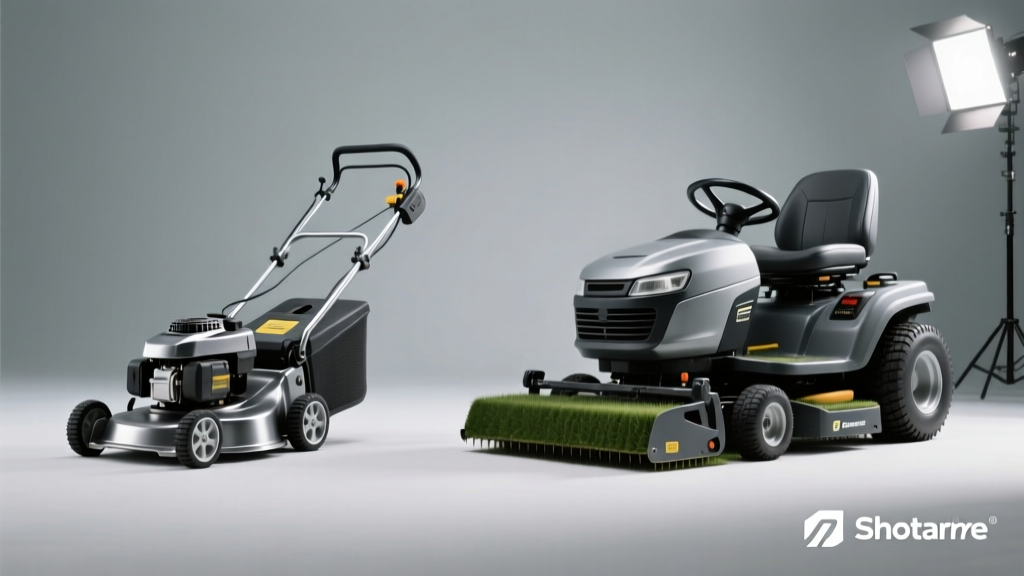
Choosing between a push mower and a riding mower feels like picking between walking and driving to work — both get you there, but the experience, cost, and outcome differ sharply. Your yard’s size, slope, terrain, and physical stamina all weigh in — and so do long-term upkeep and storage constraints.
Quick Verdict
A push mower is better for lawns under 1/4 acre with flat or gently sloped terrain and for users prioritizing low upfront cost, storage space, and exercise. A riding mower makes sense for lawns over 1/2 acre, especially with uneven ground, mature trees, or mobility considerations — though it demands more garage space, fuel, and annual servicing. According to the U.S. EPA, 14% of household water usage stems from inefficient mowing practices — often tied to mismatched equipment — so choosing right affects more than just sweat.
Side-by-Side Comparison
| Feature | Push Mower | Riding Mower |
|---|---|---|
| Typical price range | $120–$650 (gas or electric) | $1,800–$5,200 (gas or battery) |
| Average mowing time (1/4-acre lawn) | 45–65 minutes | 18–25 minutes |
| Fuel or power source | Cordless battery, corded electric, or gas | Gas (most common) or lithium-ion battery (premium models) |
| Storage footprint | 2.5 ft × 1.5 ft × 3.5 ft upright | 6 ft × 4 ft × 4.5 ft minimum |
| Maintenance frequency | Blade sharpening every 25 hours; oil change (gas) annually | Oil & filter every 50 hours; deck cleaning after each use; belt inspection quarterly |
Deep Dive on Push Mowers
Push mowers remain the most accessible entry point into lawn care — especially for urban lots, townhomes, or older neighborhoods with narrow gates and tight sheds. Their simplicity translates to fewer breakdowns and easier DIY repairs.
Pros
- Upfront cost is 70–85% lower than a basic riding model
- No license, registration, or insurance needed
- Zero emissions (if battery- or cord-electric); quieter operation
- Stores easily in a closet, garage corner, or balcony shed
Cons
- Physical exertion increases significantly on slopes over 15° or wet grass
- Struggles with tall fescue, thick Bermuda, or overgrown patches without multiple passes
- Battery runtime drops 30–40% below 40°F (per EGO Power+ 2023 user manual)
Deep Dive on Riding Mowers
Riding mowers aren’t just about comfort — they’re productivity tools engineered for consistency across larger, complex yards. Modern zero-turn models can pivot within their own footprint, navigating around ornamental shrubs and patio edges with surgical precision.
Pros
- Cuts 1/2 acre in under 30 minutes — roughly 2.5× faster than push mowers per acre
- Adjustable seat, cruise control, and deck lift levers reduce fatigue on multi-hour sessions
- Many models support attachments: baggers, mulch kits, snow blades, and even sprayers
Cons
- Requires level concrete pad or reinforced gravel surface for safe storage and maintenance
- Gas models emit ~27 lbs of CO₂ per tank (EPA Small Engine Emissions Report, 2022)
- Steep slopes (>20°) risk tipping — manufacturers explicitly warn against use on grades steeper than 15°
When to Choose Push vs Riding
If your property is under 5,000 sq ft (about 1/8 acre) and mostly flat, a push mower almost always wins on value and practicality. For 10,000–20,000 sq ft lawns with mature oaks, curving beds, or a gentle hillside, a riding mower pays for itself in saved time by year two — especially if you factor in the cordless alternatives that bridge the gap.
"A 2023 University of Kentucky Turfgrass Extension study found that homeowners using push mowers on lawns over 12,000 sq ft spent 37% more total labor hours annually — and reported 2.3× higher incidence of lower-back discomfort." — Dr. Laura Chen, UK College of Agriculture, Food & Environment
Alternatives to Consider
Neither option fits every situation. Robotic mowers like the Worx Landroid handle up to 1/3 acre autonomously — ideal for flat, fenced yards with minimal debris. Reel mowers offer ultra-quiet, zero-emission cutting for small, fine-bladed lawns (e.g., bentgrass or Kentucky bluegrass), though they require frequent blade honing. And for steep, rocky, or heavily shaded plots, a string trimmer + scythe combo remains surprisingly effective — and far cheaper than retrofitting a hillside for safe riding mower access.
Can I use a push mower on hilly terrain?
Yes — but only up to a 15° incline. Beyond that, traction drops, control wanes, and safety risks climb. Self-propelled models help, but avoid gas-powered units on wet slopes: rear-wheel slippage can cause sudden backward lurches.
Do riding mowers really save time on small lawns?
No — not meaningfully. On a 5,000-sq-ft lot, maneuvering, turning, and backing up eats into efficiency gains. You’ll likely spend more time prepping and cleaning the machine than you’d spend pushing a lightweight mower.
How often do riding mower belts need replacement?
Every 100–150 hours of use under normal conditions — or annually for most homeowners. Cracks, glazing, or squealing during turns are early warnings. Always replace in sets (drive + deck belts) to prevent uneven wear.
Are battery-powered riding mowers worth it?
For lawns under 1 acre and users with 240V charging access, yes — especially models like the Cub Cadet Ultima ZT1. They eliminate gas storage, tune-ups, and exhaust, but runtime drops 20% in temperatures below 50°F (Cub Cadet Battery Performance Guide, 2024).
What’s the smallest yard size where a riding mower makes sense?
Most experts draw the line at 1/2 acre — but terrain matters more than square footage. A compact, 10,000-sq-ft lot with winding paths, flower islands, and a 12° slope may justify a 42″ zero-turn. Conversely, a wide-open 18,000-sq-ft Bermuda field could be efficiently managed with a high-torque push mower like the Honda HRX217.
There’s no universal “better” — only what aligns with your lawn’s layout, your body’s needs, and your long-term priorities. Measure your yard, map its slopes and obstacles, then test-drive both types at a local rental yard before committing. Your knees — and your weekend — will thank you.