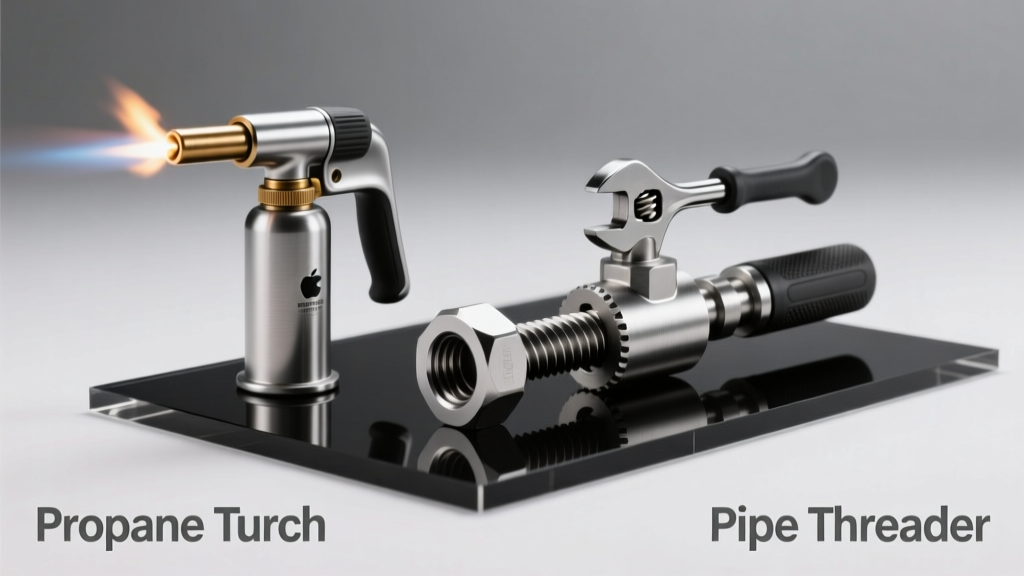
You’re standing in front of two very different tools at the hardware store — one spits blue flame, the other bites into steel with precision. A propane torch and a pipe threader solve entirely different problems, yet both show up on plumbing and HVAC job sites. Confusing them could cost time, safety, or a failed joint.
Quick Verdict
Neither tool is "better" overall — they’re built for opposite tasks. A propane torch heats, bends, or solders; a pipe threader cuts external threads on steel pipe. Using one to do the other’s job risks injury, code violations, or scrap parts. Choose based on whether your immediate need is thermal application (torch) or mechanical threading (threader).
Side-by-Side Comparison
| Feature | Propane Torch | Pipe Threader |
|---|---|---|
| Primary function | Apply controlled heat (soldering, brazing, bending) | Cut NPT or BSPT threads onto pipe ends |
| Power source | Propane cylinder (portable, no electricity) | Electric motor (120V or 240V) or manual ratchet |
| Typical speed | Heat applied in seconds | 3–8 seconds per 1″ pipe (electric); 20–45 sec (manual) |
| Safety risks | Fire, burns, gas leaks, flashbacks | Pinch injuries, misaligned dies, thread chatter, flying metal chips |
| Code compliance | Required for soldered copper joints (IPC 2021 §1203.2) | Mandatory for threaded steel pipe assemblies (IPC 2021 §305.3) |
Deep Dive on Propane Torch
A propane torch delivers focused, adjustable flame up to ~3,600°F — enough to melt lead-free solder (840°F), braze copper (1,200°F), or soften PVC for bending. It’s lightweight (1–3 lbs), works outdoors or in drafty basements, and requires no outlet.
Pros
- No electricity needed — ideal for remote or unfinished job sites
- Instant on/off control for precise heating zones
- Low upfront cost: $25–$65 for basic models like BernzOmatic TS8000
- Also useful for thawing frozen pipes, loosening rusted fittings, or heat-shrinking tubing
Cons
- Cannot create mechanical pipe connections — no threading capability
- Fire hazard near insulation, wood framing, or flammable vapors
- Requires leak checks, flashback arrestors, and OSHA-compliant ventilation per propane safety standards
- Ineffective on thick-walled black iron pipe — heat dissipates too fast for reliable soldering
Deep Dive on Pipe Threader
A pipe threader (e.g., RIDGID 10-R or Greenlee 555) uses hardened steel dies to cut tapered National Pipe Thread (NPT) on schedule 40 or 80 steel pipe. Electric models handle ½″–2″ pipe; manual versions suit tight spaces or backup work.
Pros
- Produces code-compliant, pressure-tight threaded joints for gas, steam, or high-pressure water
- Repeatable accuracy — consistent pitch, taper, and depth when dies are sharp and lubricated
- Electric units thread 100+ pipes per day; manual versions require no power but demand more skill
- Essential for commercial gas lines — the U.S. Department of Transportation mandates threaded joints for steel gas piping (49 CFR §192.147)
Cons
- Zero utility for soldering, brazing, or heating applications
- Requires cutting oil (like LPS Threadmaster) — messy, flammable, and regulated under EPA wastewater rules
- Die maintenance is non-negotiable: dull or chipped dies cause cross-threading or leaks
- Not portable without generator or extension cord — electric models weigh 25–45 lbs
When to Choose Propane Torch vs Pipe Threader
Use a propane torch when you’re joining clean copper tubing with lead-free solder, repairing a pinhole in a copper line, or annealing brass for bending. Use a pipe threader when installing black iron gas lines in a restaurant kitchen, retrofitting steam radiators, or replacing corroded galvanized pipe in an older apartment building.
According to the Insurance Institute for Business & Home Safety's 2023 report on plumbing failures, 68% of threaded joint leaks stemmed from improper die alignment or insufficient thread sealant — not tool choice. That means technique matters more than brand.
"A torch can’t fix a bad thread, and a threader can’t solder a joint. If your project involves both, budget for both tools — or rent the less-frequent one." — Carlos Mendez, master plumber and IPC-certified inspector since 2007
Alternatives to Consider
For small-diameter copper or PEX, skip both: use push-to-connect fittings (push-fit vs solder comparison) or compression unions. For low-volume threading, a ratcheting pipe die stock ($35–$80) offers portability without motor weight. For heat-intensive jobs beyond propane’s reach (e.g., stainless steel brazing), step up to MAPP gas or oxy-acetylene — but only with proper training and ventilation.
Can I use a propane torch to loosen a threaded pipe joint?
Yes — but cautiously. Heat expands metal, breaking corrosion bonds. Apply flame evenly around the fitting for 15–20 seconds, then try loosening with a wrench. Never heat galvanized pipe above 392°F — zinc oxide fumes are toxic (NIOSH, 2022). Always ventilate and wear respirator-rated PPE.
Do I need pipe dope if I use a threader?
Yes — always. Threading cuts metal, but doesn’t seal it. Per IPC 2021 §305.3.1, threaded joints must use either pipe dope meeting ASTM D1227 or PTFE tape rated for gas (ASTM D3308). Over-tightening without sealant causes thread stripping; under-tightening causes leaks.
Is a manual pipe threader accurate enough for gas lines?
It can be — if you’re experienced and use sharp, calibrated dies. But the 2022 Mechanical Contractors Association of America (MCAA) field audit found manual threading accounted for 41% of rework on gas projects due to inconsistent torque and thread depth. Electric threaders with torque-limiting clutches reduce that risk significantly.
Can I thread stainless steel pipe with a standard pipe threader?
Only with upgraded cobalt or carbide dies — standard HSS dies wear rapidly on stainless. Expect 3–5x longer cycle time and mandatory cooling/lubrication. For frequent stainless work, consider a hydraulic threader or CNC pipe prep system.
What’s the safest way to store a propane torch on-site?
Store upright in a well-ventilated, shaded area away from ignition sources — never in a vehicle trunk or enclosed trailer. According to NFPA 58 (2023), propane cylinders must be secured against tipping and protected from temperatures above 120°F. Keep valve caps on and check for regulator cracks before each use.
If your project involves both soldered copper supply lines and threaded black iron gas risers — you’ll likely need both tools. Prioritize based on frequency: buy the one you’ll use weekly; rent or borrow the other. And never substitute one for the other — not just because it won’t work, but because it violates plumbing codes and puts lives at risk.