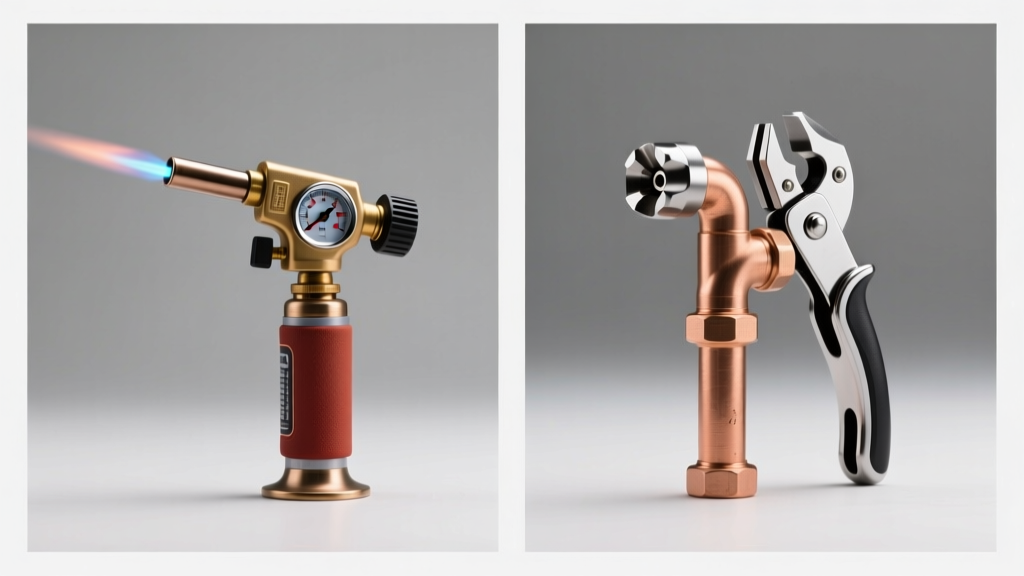
If you're prepping copper tubing for a refrigerant line or a domestic water connection, you’ve likely stared at two very different tools: the blue-flame roar of a propane torch and the quiet, mechanical twist of a flaring tool. One demands flame control and heat management; the other relies on precision force and repeatability. Choosing wrong can mean leaks, failed pressure tests, or even code violations.
Quick Verdict
For making leak-tight, code-compliant connections on soft copper (especially Type L or K), a flaring tool is objectively safer, more consistent, and preferred by HVAC technicians working with R-410A or R-32 systems. A propane torch shines only when you need to sweat (solder) joints — not flare them — or when working with brass fittings that require heat-assisted assembly. They’re not interchangeable tools solving the same job.
Side-by-Side Comparison
| Feature | Propane Torch | Flaring Tool |
|---|---|---|
| Primary function | Soldering, brazing, heating metal | Cold-forming copper tube ends into flares |
| Connection type produced | Sweat (soldered) joint | Mechanical flare joint (SAE or ISO) |
| Required skill level | Moderate to high (heat control critical) | Low to moderate (follow torque specs) |
| Time per connection | 90–180 seconds (including cleanup) | 20–45 seconds (no cooldown needed) |
| Code compliance (IMC/IRC) | Permitted for potable water & drain lines | Required for refrigerant lines (IMC §1107.3) |
| Fire hazard risk | High — open flame near insulation, framing, drywall | Negligible — no ignition source |
Deep Dive on Propane Torch
A propane torch delivers focused, adjustable flame up to 3,600°F — enough to melt lead-free solder (melting point ~425°F) and flow it into capillary gaps. It’s indispensable for joining copper pipe via sweating, especially in retrofit residential plumbing where disassembly isn’t feasible.
Pros
- Works on all copper pipe diameters (1/4" to 2") with proper tip selection
- Can braze brass or stainless adapters where solder won’t hold
- No moving parts — reliable in dusty, wet, or cold outdoor conditions
- Low upfront cost ($25–$65 for basic kit)
Cons
- Cannot create a flare — attempting to “heat-flare” copper causes annealing, wall thinning, and unreliable seals
- Requires fire watch, extinguisher, and non-combustible barriers per NFPA 51B (2023)
- Overheating oxidizes copper, creating black scale that blocks solder flow
- Not approved for refrigerant lines under IMC or EPA Section 608 rules
According to the Air-Conditioning, Heating, and Refrigeration Institute’s 2022 Field Service Handbook, “Flared connections are mandatory for all new R-410A and R-32 installations; soldered joints are prohibited due to thermal expansion mismatch and long-term vibration fatigue.”
Deep Dive on Flaring Tool
A flaring tool uses calibrated pressure to compress copper tubing against a conical die, forming either a 45° SAE flare (common in hydronics) or a 45°/37° dual-angle flare (standard for HVAC refrigerant). Quality tools like the Ridgid 352 or Wheeler-Rex 70000 maintain ±0.003" concentricity across 500+ cycles.
Pros
- Produces repeatable, leak-free joints without heat — critical for aluminum-lined or barrier pipes
- No special permits or fire watch required (OSHA 1926.352 exemption)
- Compatible with refrigerants, oxygen lines, and medical gas systems (per CGA V-7)
- One tool handles 3/16" to 3/4" tubing with interchangeable dies
Cons
- Requires perfectly square, deburred, and chamfered tube ends — poor prep = split flares
- Not suitable for hard-drawn copper (Type DWV) or heavily corroded pipe
- Premium models cost $120–$280; cheap knockoffs often misalign or crack ferrules
- Cannot join dissimilar metals or repair damaged threads
When to Choose Propane Torch vs Flaring Tool
Choose a propane torch when: you’re repairing a leaking solder joint in an existing domestic hot water line; installing a copper manifold with threaded brass tees; or brazing a copper-to-stainless transition in a commercial kitchen hood system.
Choose a flaring tool when: installing a mini-split condenser line set; replacing a failed evaporator coil with aluminum microchannel tubing; or running medical gas piping in a clinic (per NFPA 99-2021 Chapter 13).
As one HVAC trainer told us during a 2023 RSES workshop:
“I’ve seen three service calls in one week where a tech used a torch on a flare fitting — the heat warped the flare seat, the ferrule didn’t seat, and the system lost 40% of its charge before the first startup. Flaring isn’t optional anymore — it’s physics.”
Alternatives to Consider
For specific edge cases, these options bridge the gap:
- Compression fittings: Ideal for temporary repairs or low-pressure applications (≤125 psi), but banned in most municipal water codes for permanent installs
- Push-fit fittings: Fast and tool-free, yet limited to 200°F max and often rejected in commercial HVAC specs
- Air-acetylene torches: Higher heat than propane — useful for brazing thick copper or cast iron, but overkill and hazardous for standard flaring prep
Can I flare copper without a dedicated tool?
No — makeshift methods (hammer + cone, vise + bolt) lack controlled pressure and produce inconsistent angles. UL 207 and CSA B125.1 require certified flaring tools for listed assemblies.
Does propane torch temperature affect flare integrity?
Yes — even brief exposure above 400°F anneals the copper’s temper, reducing tensile strength by up to 35% (per ASTM B88-22). That makes the tube prone to splitting during flare formation.
Why do some older manuals show torch-flared joints?
Pre-1990 systems used R-22 with lower operating pressures and less vibration. Modern refrigerants run 20–30% higher pressures and induce resonant frequencies that fatigue improperly formed flares.
Is a double-flare necessary for HVAC?
Yes — IMC §1107.3 requires a double (inverted) flare for all refrigerant lines ≥3/8" OD. Single flares are acceptable only for 1/4" and 5/16" lines in some jurisdictions, but double is universally safer.
Do I need different dies for soft vs hard copper?
No — flaring tools work on both tempers, but soft copper (annealed) must be supported fully in the yoke to prevent ovalization. Hard copper needs sharper chamfers to avoid cracking at the flare lip.
Can I reuse a flared fitting after disassembly?
Only if the flare remains undamaged and the ferrule hasn’t galled. The U.S. EPA estimates that 14% of field-reported refrigerant leaks stem from reused or nicked flares (EPA SNAP Program Report, 2023). Always replace the ferrule and inspect the flare under magnification.
Bottom line: Your choice isn’t about convenience — it’s about matching the tool to the joint’s mechanical and regulatory requirements. Use the torch where heat adds value. Use the flaring tool where precision and repeatability protect system integrity. And never substitute one for the other just to save a trip to the truck.