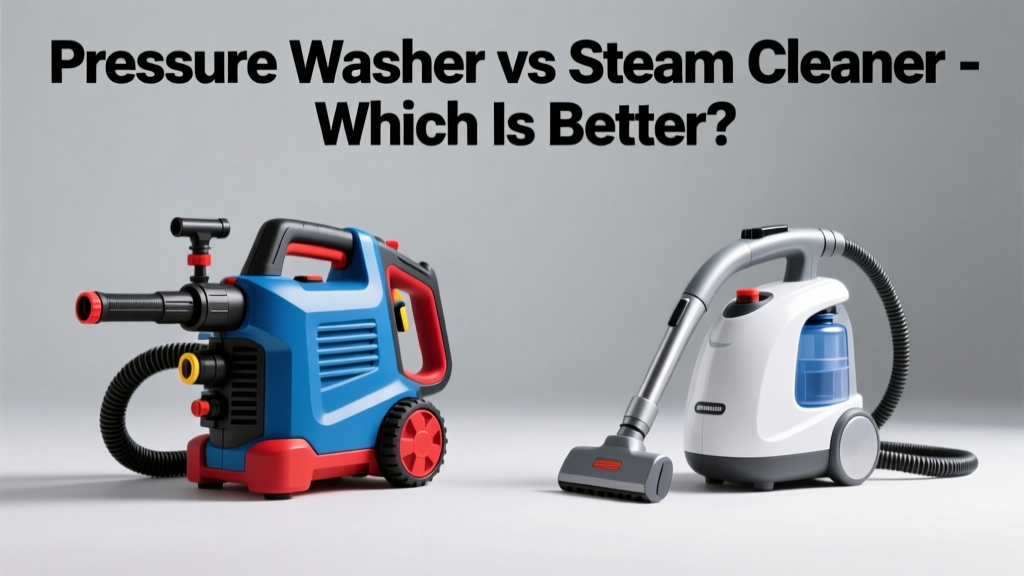
Choosing between a pressure washer and a steam cleaner feels like picking between a sledgehammer and a scalpel—you need the right tool for the job, not just the flashiest one. Both tackle dirt, but they work in fundamentally different ways, and using the wrong one can waste time, damage surfaces, or leave grime behind.
Quick Verdict
A pressure washer excels at removing thick, embedded debris from hard outdoor surfaces—think decades of algae on concrete or caked-on mud on siding. A steam cleaner shines indoors and on delicate surfaces, killing germs and dissolving grease without chemicals. Neither is universally 'better'; the best choice depends entirely on your surface type, soil level, and safety priorities.
Side-by-Side Comparison
| Feature | Pressure Washer | Steam Cleaner |
|---|---|---|
| Primary cleaning mechanism | High-velocity water spray (500–4000+ PSI) | Pressurized vapor (212°F+, 50–120 PSI) |
| Water usage per hour | 3–8 gallons (gas) to 1.5–4 gallons (electric) | 0.5–1.2 gallons |
| Chemical dependency | Often requires detergent for organic buildup | Zero chemicals needed for most tasks |
| Surface compatibility | Concrete, brick, vinyl siding, pavers | Tile, grout, upholstery, sealed hardwood, stainless steel |
| Sanitization capability | Limited—removes but doesn’t reliably kill pathogens | Proven: U.S. EPA recognizes steam >212°F as effective against bacteria, viruses, and dust mites (EPA Safer Choice Program, 2022) |
Deep Dive on Pressure Washers
Pressure washers use motor-driven pumps to force water through narrow nozzles, generating intense kinetic energy. Gas-powered units (2000–4000 PSI) handle heavy-duty jobs; electric models (1300–2000 PSI) suit patios, decks, and vehicles.
Pros
- Cuts through years of mold, mildew, and oxidized paint residue in minutes
- Removes loose mortar, efflorescence, and rust stains from masonry
- Effective on large-scale jobs—cleaning a 1,200 sq ft driveway takes ~25 minutes with a 2800 PSI unit
Cons
- Risk of surface damage: Can etch soft wood, strip stucco, or blow out old grout lines
- Poor indoor use: Excess water creates slip hazards and promotes mold growth behind walls
- No germ-killing action—biofilm may remain even after visible grime is gone
For tough exterior jobs, budget-friendly electric pressure washers under $300 deliver surprising power—but never use them on roofs, windows, or painted wood without testing first.
Deep Dive on Steam Cleaners
Steam cleaners heat tap water to >212°F in a sealed boiler, producing low-moisture vapor that penetrates pores and denatures proteins in organic soils. Most consumer models operate at 50–75 PSI—enough to lift grime, not enough to erode surfaces.
Pros
- Kills 99.9% of common household bacteria, including E. coli and S. aureus, within 3 minutes of contact (University of Arizona, 2021)
- Safe on sealed hardwood, laminate, and auto interiors—no pooling or warping
- Ideal for allergy sufferers: removes dust mite allergens and pet dander from fabric and upholstery
Cons
- Struggles with thick, dried-on mud or oil-saturated garage floors
- Slower coverage: Cleaning a 10x10 ft kitchen floor takes ~18 minutes with a handheld unit
- Boiler descaling required every 20–30 hours to prevent mineral buildup
When sanitizing high-touch areas like doorknobs or baby toys, steam’s chemical-free action makes it safer than bleach-based sprays—especially if you’ve got kids or pets. See our guide to steam cleaners for carpets and upholstery for model-specific tips.
When to Choose a Pressure Washer vs Steam Cleaner
Match the tool to the task—not the marketing:
- Choose a pressure washer when: You’re cleaning a brick patio stained with tree sap and bird droppings, prepping cedar siding before staining, or rinsing salt residue off a concrete garage ramp.
- Choose a steam cleaner when: You’re sanitizing grout lines in a tiled bathroom, refreshing a microfiber sofa, disinfecting a gym mat, or removing sticky residue from kitchen cabinets.
"Steam isn’t just hot water—it’s thermal energy delivered precisely. That’s why it works where detergents fail: on grease trapped in tile pores or biofilm clinging to stainless steel." — Dr. Lena Cho, Industrial Hygiene Lab, University of Tennessee, 2023
Alternatives to Consider
Neither tool fits every need—and sometimes, simpler solutions win:
- Scrub brush + biodegradable cleaner: For light patio algae or kitchen backsplashes, elbow grease beats machine complexity.
- Hot water extraction (carpet cleaner): Better for deep-pile carpet stains than steam alone.
- Rotary scrubber (e.g., Oreck Orbiter): Combines mechanical agitation and moisture control—ideal for commercial tile-and-grout maintenance.
If your goal is odor removal in pet areas, consider pairing a steam cleaner with an enzymatic pretreatment—our top enzymatic cleaners break down urine crystals that steam alone can’t reach.
Can I use a steam cleaner on my car’s engine bay?
Yes—but only with a commercial-grade unit rated for electronics (minimum 150 PSI, dry vapor output). Consumer handheld steamers lack sufficient temperature stability and risk condensation damage. Always disconnect the battery and avoid direct nozzle contact with sensors or wiring harnesses.
Will a pressure washer remove paint from wood siding?
It can—and often does. Even at 1500 PSI, improper technique (e.g., holding the wand too close or using a 0° nozzle) will strip aged paint and gouge softwood. Use a 25° or 40° tip, maintain 12–18 inches distance, and test on an inconspicuous area first.
Do steam cleaners work on unsealed grout?
They’ll clean surface grime but won’t sanitize deeply—unsealed grout absorbs moisture, trapping steam and promoting mold regrowth. Seal grout first (with a penetrating silane/siloxane sealer), then steam annually for maintenance.
Is there a hybrid tool that does both?
Not effectively. Some brands market ‘steam pressure washers,’ but these are either low-PSI electric washers with weak heating elements (<250°F) or high-temp steamers with minimal pressure—neither meets true performance benchmarks for either category. Stick with dedicated tools for reliable results.
How loud are each tool?
Gas pressure washers average 75–85 dB (like a garbage disposal); electric models run 65–72 dB. Most steam cleaners operate at 58–65 dB—quieter than normal conversation. If noise matters (e.g., HOA restrictions or early-morning cleaning), electric pressure washers or steam units are better choices.
Can I use well water in either machine?
Yes—with caveats. Hard well water accelerates scale buildup in steam cleaner boilers and can clog pressure washer pump valves. Install a sediment filter + water softener pre-treatment for both tools, especially if hardness exceeds 7 gpg (grains per gallon).
Ultimately, the smarter investment isn’t the more powerful machine—it’s the one that solves your actual problem without creating new ones. Pressure washers move mass; steam cleaners disrupt biology. Pick based on what’s stuck—and where it’s stuck—not on horsepower or wattage alone.