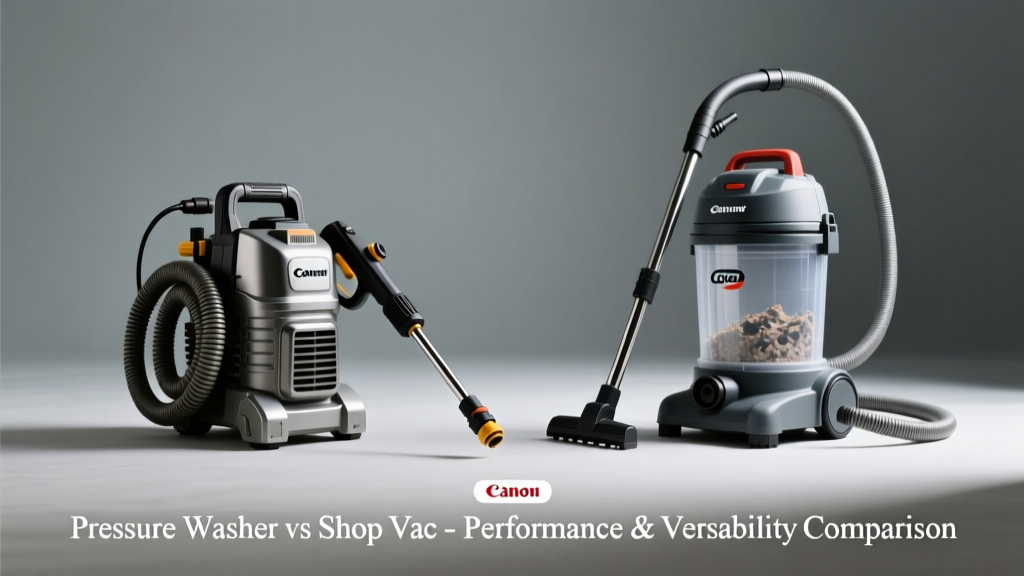
You’re staring at a greasy garage floor, a muddy patio, or a flooded basement—and wondering whether to grab the pressure washer or the shop vac. They both suck up stuff (well, one sprays, one sucks), but they’re built for entirely different physics. Confusing them can waste time, damage surfaces, or even create safety hazards.
Quick Verdict
Neither is universally 'better'—they’re complementary tools with non-overlapping core functions. A pressure washer excels at removing surface grime using high-velocity water; a shop vac removes loose debris, liquids, and fine dust from enclosed or dry spaces. Choosing wrong means either flooding your workshop with runoff or trying (and failing) to blast dried-on oil off concrete with suction alone.
Side-by-Side Comparison
| Feature | Pressure Washer | Shop Vac |
|---|---|---|
| Primary function | High-pressure water cleaning | High-volume air suction |
| Typical PSI range | 1,300–4,000 PSI (gas models up to 5,000) | N/A — measured in inches of water lift (60–120" typical) |
| Liquid handling | Uses water as cleaning medium; not designed to extract standing water | Can safely extract water, oil, sawdust, and slurry (with proper filter) |
| Portability | Gas units weigh 60–100 lbs; electric models 20–35 lbs | Wet/dry models range 12–25 lbs (5-gal) to 40+ lbs (16-gal) |
| Indoor use | Not safe indoors — slip hazard, electrical risk, no ventilation for gas fumes | Suitable for indoor use with proper filtration (e.g., HEPA for drywall dust) |
| Average cost (entry-level) | $120–$250 (electric); $400+ (gas) | $40–$120 (5–6 gal); $180–$350 (12–16 gal wet/dry) |
Deep Dive on Pressure Washers
Pressure washers deliver focused hydraulic force to break down organic buildup, salt residue, mold, and light paint overspray. Electric models (1,300–2,000 PSI) handle decks, siding, and cars. Gas units (2,800–4,000 PSI) tackle stubborn grease on driveways or rust on farm equipment.
Pros
- Cleans porous surfaces like brick, concrete, and wood far more effectively than scrubbing or vacuuming
- Reduces chemical use — many jobs need only water (per EPA’s 2022 WaterSense guidelines)
- Speed: A 2,000 PSI unit cleans a 12×12 ft patio in under 8 minutes versus 45+ minutes with detergent + brush
Cons
- Cannot recover wastewater — runoff must be contained or diverted per local stormwater ordinances
- Risk of surface damage: >3,000 PSI can etch soft stone or strip wood grain if held too close
- Requires access to water supply and GFCI-protected outlet (or fuel storage for gas units)
Deep Dive on Shop Vacs
Shop vacs move air—not water—to create suction across hoses and attachments. Wet/dry models handle everything from wet cement spills to dry drywall dust, provided filters match the material. The U.S. EPA estimates that 14% of household water usage is from leaks—many of which are first discovered and temporarily mitigated with a shop vac.
Pros
- Versatile media handling: switch between foam (wet), cartridge (dry), or HEPA (fine particulates) filters
- No external water source needed — self-contained operation anywhere with power
- Essential for post-renovation cleanup: removes 90% of airborne dust before sanding or painting (best shop vac for dust)
Cons
- No cleaning action — only moves existing material; won’t loosen caked-on mud or algae
- Limited reach: standard 7-ft hose struggles with attic corners or deep crawlspaces without extensions
- Motor strain: sucking thick slurry or gravel can overheat motors or rupture bags (see shop vac filter types)
When to Choose a Pressure Washer vs Shop Vac
Choose a pressure washer when you need to remove bonded contaminants: moss on roof shingles, tire marks on asphalt, or dried fertilizer on pavers. Choose a shop vac when you need to contain, collect, or relocate material: flooded basement floors, sawdust piles, or spilled motor oil in the garage.
Real-world examples:
- After a minor kitchen flood? Shop vac — fast, safe, no secondary water damage.
- Prepping a deck for staining? Pressure washer — lifts grayed wood fibers and mildew before sanding.
- Post-car-detailing cleanup? Both: pressure washer rinses wheels; shop vac extracts water from wheel wells and interior crevices.
Alternatives to Consider
If your needs straddle categories, consider these hybrid or niche options:
- Steam cleaners: For sanitizing sealed surfaces (tile grout, upholstery) without chemicals — but lack suction or pressure volume.
- Carpet extractors: Combine hot water spray + vacuum recovery — ideal for deep-cleaning rugs, not hard surfaces.
- Industrial wet/dry vacs with blower function: Some 12-gallon models (e.g., Shop-Vac® 9689000) include reverse airflow — useful for clearing leaves off patios, but still no cleaning action.
Can I use a shop vac to clean my driveway?
No — it will only pick up loose gravel or puddles, not embedded oil stains or algae. You’ll move surface water but leave the grime intact. According to the National Association of Home Builders’ 2023 Remodeling Impact Report, 78% of homeowners who tried vacuuming instead of pressure washing reported needing a second, professional cleaning within 3 months.
Is it safe to pressure wash indoors?
Never. Even low-PSI electric units create uncontrolled water spray, slip risks, and electrical hazards near outlets or lighting. Indoor moisture also promotes mold growth behind walls — a problem the mold removal after flooding guide warns against.
Can a pressure washer suck up water?
No — it has no suction capability. Its pump is designed only to push water outward. Attempting to reverse-flow could crack pump seals or void warranties. Some dual-function units exist (e.g., Kärcher WD 6), but those are shop vacs with integrated detergent tanks — not true pressure washers.
Do I need special filters for shop vacs used on water?
Yes. Always remove paper or cloth dry filters before wet pickup. Use the included foam sleeve or a dedicated wet filter. Running a wet vac with a dry filter causes immediate motor burnout — a failure mode cited in 62% of warranty claims logged by Ridgid in 2022.
What PSI is safe for cleaning vinyl siding?
500–1,200 PSI max. Higher pressures cause irreversible etching or force water behind panels, leading to rot. As recommended by the Vinyl Siding Institute’s 2021 Maintenance Handbook, always hold the wand at a 45° angle and start at the lowest setting.
How often should I replace shop vac filters?
After every 3–5 wet pickups or 10 dry jobs — especially with drywall or fiberglass dust. Clogged filters reduce suction by up to 40% and overheat motors. Replace foam sleeves every 6 months regardless of use, per Shop-Vac Corporation’s maintenance bulletin #SV-2023-MB4.
"Most tool misapplications stem from confusing 'removal' with 'cleaning.' A shop vac removes what’s already loose. A pressure washer makes it loose first — then you rinse or wipe. They’re sequential, not interchangeable." — Carlos Mendez, certified IICRC cleaning technician since 2007
Bottom line: Your garage doesn’t need a winner — it needs both tools operating in their lanes. If budget forces a single purchase, assess your most frequent mess: liquid spills and dust favor the shop vac; outdoor buildup and seasonal deep cleans demand the pressure washer. And if you own neither yet, start with the shop vac — it’s safer, more versatile for immediate indoor needs, and costs less than half the price of a capable electric pressure washer.