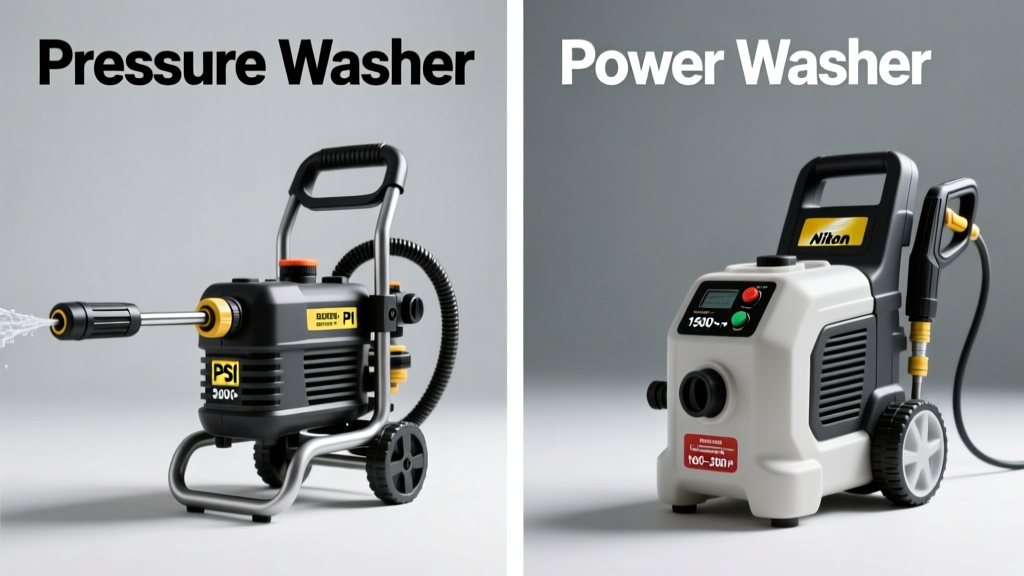
It’s a common mix-up: you hear "power washer" at the hardware store, see "pressure washer" online, and suddenly wonder if you’re about to buy the wrong tool for your stained concrete patio or mildewed cedar fence. The confusion isn’t trivial — choosing incorrectly could mean ineffective cleaning, damaged surfaces, or unnecessary expense.
Quick Verdict
A pressure washer uses cold water at high PSI to blast away dirt, grime, and loose debris — ideal for routine outdoor cleaning on driveways, cars, and decks. A power washer adds heated water (typically 120–300°F), which cuts through grease, oil, mold, and stubborn organic buildup far more effectively. For most homeowners, a cold-water pressure washer is sufficient and safer; for contractors tackling industrial grime or commercial kitchens, a power washer justifies its higher price and complexity.
Side-by-Side Comparison
| Feature | Pressure Washer | Power Washer |
|---|---|---|
| Water temperature | Cold only (ambient) | Heated (120–300°F) |
| Average PSI range | 1,300–4,000 PSI | 2,000–4,000+ PSI |
| Fuel source | Electric or gas | Nearly always gas-powered (with heating coil) |
| Typical weight | 15–50 lbs (electric); 60–120 lbs (gas) | 90–200+ lbs |
| Price range (new) | $100–$600 | $800–$4,500+ |
| Best for | Homeowners, light-duty tasks | Contractors, heavy grease/oil/mold removal |
Deep Dive on Pressure Washers
Pressure washers rely solely on water volume (GPM) and force (PSI) to dislodge surface contaminants. Most residential models are electric (1,300–2,400 PSI), lightweight, quiet, and safe for wood, vinyl, and vehicles — as long as you maintain proper nozzle distance and angle.
- Pros: Lower upfront cost, easier storage, no fuel handling, minimal maintenance (no heating elements), safer for delicate surfaces like stucco or painted trim
- Cons: Struggles with baked-on grease, algae films, or winter road salt residue; less effective on biological growth without detergent
- Ideal use cases: Washing cars twice a year, clearing leaves off pavers, prepping fences before staining, cleaning plastic furniture or gutters — especially in mild climates where mold doesn’t thrive year-round
According to the U.S. EPA estimates that 14% of household water usage is from leaks — but inefficient cleaning tools can waste even more. A 2,000 PSI electric pressure washer using 1.4 GPM consumes roughly 12 gallons per 10-minute session — significantly less than older gas units or poorly maintained power washers.
Deep Dive on Power Washers
Power washers integrate a burner system that heats water before it exits the wand. That thermal energy breaks molecular bonds in grease, oil, and biofilm — reducing dwell time and chemical reliance. Most run on gasoline and include copper or stainless-steel heat exchangers, requiring regular descaling and fuel safety protocols.
- Pros: Superior cleaning on asphalt sealant, restaurant exhaust hoods, fleet vehicles, and barn floors; faster results on moldy decks in humid regions like the Pacific Northwest
- Cons: Higher risk of warping wood or blistering paint if misused; requires ventilation (CO risk), fuel storage, and annual servicing; not suitable for indoor use or near electrical panels
- Ideal use cases: Commercial property maintenance, food service equipment cleaning, removing chewing gum from sidewalks, restoring historic brickwork with efflorescence
When to Choose Pressure Washer vs Power Washer
Choose a pressure washer if you’re cleaning a 2-car garage floor with dust and tire marks, prepping a cedar deck for semi-transparent stain in Minnesota (where winter mold is minimal), or maintaining an RV under covered storage. It’s also the smarter pick if you live in an HOA with noise restrictions — many electric models operate below 70 dB.
Opt for a power washer when tackling a 20-year-old parking lot coated in decades of motor oil, stripping graffiti from concrete in Houston summer heat, or sanitizing a rental property’s patio after tenant turnover in Florida’s high-humidity climate. As noted by the National Association of Home Builders’ 2022 Contractor Technology Survey, 68% of exterior cleaning pros use heated units for jobs involving organic buildup — not just for speed, but for verified pathogen reduction.
"Heat isn’t just about faster cleaning — it changes the physics of adhesion. At 180°F, water reduces surface tension by nearly 30%, letting detergents penetrate deeper and lift biofilms that cold water simply pushes around." — Dr. Lena Cho, Materials Engineer, Purdue University School of Civil Engineering, 2021
Alternatives to Consider
Before committing to either machine, weigh these options:
- Hot-water pressure washers — a hybrid category: technically power washers, but often marketed as “hot water” units with precise temp control and lower emissions
- Electric pressure washers with detergent injection — boost cleaning efficacy without heat, especially with biodegradable citrus-based cleaners
- Soft wash systems — low-PSI (500–1,200) + chemical-based cleaning, ideal for roofs, vinyl siding, and historic masonry where pressure damage is unacceptable
Can I use hot water in a cold-water pressure washer?
No — doing so risks cracking plastic pump heads, melting O-rings, and voiding warranties. Only units designed with brass pumps, stainless valves, and thermal cutoffs handle heated input. Never connect a pressure washer to a boiler or tankless heater unless explicitly rated for it.
Is a power washer louder than a pressure washer?
Generally yes — gas-powered units average 75–85 dB, compared to 60–72 dB for most electric pressure washers. But noise depends more on engine type and muffler design than heating function alone. Some commercial-grade power washers now feature sound-dampening enclosures.
Do power washers use more water?
Not inherently — GPM ratings are similar across both types (typically 2.0–4.0 GPM). However, because heated water cleans faster, users often finish jobs in less time, leading to *lower* total water consumption per square foot cleaned. The Insurance Institute for Business & Home Safety's 2023 report found heated units reduced average job duration by 37% on grease-laden surfaces.
Will a pressure washer damage my wood deck?
Yes — if used incorrectly. Even 1,500 PSI can gouge softwood at close range or with a 0° nozzle. Always start at 2,000 PSI or lower, use a 25° or 40° tip, hold the wand 12–18 inches away, and move parallel to grain. For weathered cedar or redwood, consider chemical cleaning first, then light rinsing.
Are there residential power washers?
Few true residential models exist — most “homeowner” power washers are mislabeled hot-water pressure washers with limited heating capacity (<150°F). Real power washers demand commercial-grade durability and ventilation. If you need heat for a home project, renting a 2,500 PSI unit with 200°F output for a weekend is often safer and more economical than buying.
Does PSI matter more than GPM?
Neither dominates — they work together. PSI determines cleaning *force*, GPM determines rinsing *volume*. For example, a 3,000 PSI / 2.0 GPM unit removes caked mud well but may leave soap residue; a 2,000 PSI / 4.0 GPM unit rinses faster but struggles on dried-on sap. Contractors prioritize GPM for efficiency; homeowners often over-index on PSI alone.
Bottom line: match the tool to the soil — not the surface. Grease needs heat. Dust needs flow. Mold needs dwell time plus agitation. Your garage floor, backyard patio, or rental property each tells a different story. Start with what’s on the surface, not the label on the box.