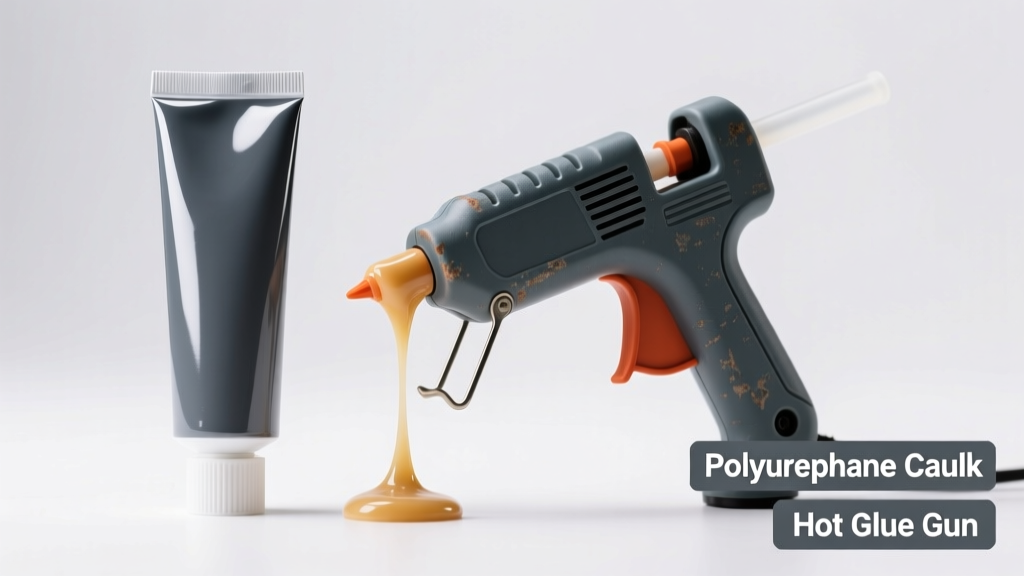
You’re holding a cracked baseboard seam, a drafty window frame, or a loose tile—and you’re wondering: should you reach for the caulk gun or the hot glue gun? It’s not just about convenience; it’s about whether the bond will last through temperature swings, moisture exposure, or minor movement.
Quick Verdict
Polyurethane caulk wins for permanent, weather-resistant seals on building materials like wood, concrete, and metal—especially where expansion, water, or structural integrity matter. Hot glue is faster and more versatile for lightweight, dry, temporary fixes (think craft projects or quick mounting), but it fails under UV, heat above 140°F, or sustained load. Neither replaces mechanical fasteners for structural loads.
Side-by-Side Comparison
| Feature | Polyurethane Caulk | Hot Glue Gun |
|---|---|---|
| Cure Time | 24–72 hours to full cure; skin forms in 15–30 min | Seconds to set; fully hardened in 1–2 minutes |
| Temperature Range | −40°F to 250°F (continuous); remains flexible | −10°F to 140°F; softens above 140°F |
| Water Resistance | 100% waterproof once cured; passes ASTM C920 Class 25 | Not waterproof; degrades with repeated moisture exposure |
| Bond Strength (psi) | 250–400 psi on concrete/wood (per Dow Corning 2022 technical data) | 20–60 psi on porous surfaces; drops sharply with humidity |
| UV Stability | Excellent (when painted or shaded); some formulations include UV inhibitors | Poor—yellowing and brittleness within weeks of direct sun exposure |
Deep Dive on Polyurethane Caulk
Polyurethane caulk is a high-performance elastomeric sealant designed for demanding construction applications. It cures via moisture in the air, forming a durable, flexible, and adhesive bond that accommodates joint movement up to ±25% (per ASTM C717).
Pros
- Exceptional adhesion to masonry, metal, wood, and fiberglass without priming
- Resists mold, mildew, and freeze-thaw cycles—ideal for exterior trim or basement joints
- Paintable within 2–4 hours (with water-based paints) and sands smoothly when cured
Cons
- Cleanup requires mineral spirits—not soap and water
- Strong solvent odor during application; needs ventilation per OSHA guidelines (2023)
- Harder to tool cleanly than silicone; over-application creates messy squeeze-out
Best for: Window and door perimeter sealing, deck-to-house transitions, bathtub surrounds, and any gap >¼" where long-term weather resistance matters. For interior gaps under ⅛", consider silicone vs polyurethane caulk instead.
Deep Dive on Hot Glue Gun
Hot melt adhesive (HMA) delivers instant tack and moderate shear strength using thermoplastic polymers—typically EVA, polyamide, or polyolefin—melted at 250–380°F. Its speed and low cost make it ubiquitous in workshops and classrooms.
Pros
- No cure time: bonds instantly upon cooling
- Low-cost starter kits (<$15) and wide variety of glue stick diameters/formulations
- Works well on foam board, cardboard, fabric, and plastic ornaments
Cons
- Brittle at cold temps; weakens significantly above 120°F (e.g., near HVAC vents)
- Cannot bridge gaps—it only bonds surface contact points
- Not rated for structural or safety-critical applications (UL 94 flammability testing shows rapid flame spread)
Best for: Temporary mounting of holiday decor, assembling lightweight DIY organizers, or securing insulation batts during rough-in—tasks where disassembly is expected. For heavier-duty bonding, see our guide on epoxy vs polyurethane adhesive.
When to Choose Polyurethane Caulk vs Hot Glue Gun
Choose polyurethane caulk if your project involves:
- A gap wider than ⅛" that must resist wind-driven rain (e.g., siding seams)
- Materials exposed to seasonal expansion/contraction (e.g., cedar decking joints)
- Any location requiring code-compliant air sealing (per IECC 2021 Section R402.4.1)
Choose hot glue if you need:
- To hold foam letters in place for a school poster—then remove them intact next week
- A quick fix for a loose drawer liner while waiting for replacement parts
- To assemble a non-load-bearing wooden puzzle box prototype
Alternatives to Consider
Neither option fits every job. For interior-only, paintable, low-odor sealing, acrylic latex caulk works well for gaps under ¼". For high-temp or chemical resistance, consider methyl methacrylate (MMA) adhesives—though they require PPE and strict mixing protocols. And for precision electronics work, cyanoacrylate (super glue) offers stronger initial grab than hot glue—but zero flexibility.
"Hot glue has its place—but calling it 'adhesive' in construction contexts misleads people. It’s a mechanical tack, not a bond. If it’s holding weight or keeping water out, test it first—or don’t use it." — Dr. Lena Torres, Materials Engineer, National Institute of Building Sciences (2023)
Can I use hot glue to seal a leaky faucet joint?
No. Hot glue lacks water pressure resistance and degrades rapidly when wet. Use threaded pipe tape or a two-part epoxy rated for potable water (NSF/ANSI 61 certified) instead.
Will polyurethane caulk stick to PVC pipe?
Yes—but lightly sand and clean the surface with isopropyl alcohol first. Avoid chlorinated solvents (e.g., acetone), which can stress-crack PVC per ASTM D2838.
Is hot glue safe for kids’ crafts?
Low-temp glue guns (200–250°F) reduce burn risk, but supervision is essential. The U.S. CPSC reports ~3,200 hot glue-related ER visits annually (2022 Injury Data), mostly among children under 10.
How long does polyurethane caulk last outdoors?
Properly applied and protected from constant UV, it lasts 15–20 years—matching or exceeding the lifespan of many building substrates. Unpainted, exposed beads may chalk after 5–7 years (per Owens Corning Field Performance Report, 2021).
Can I paint over hot glue?
Technically yes, but adhesion is unreliable. Paint often peels with the glue layer, especially on smooth surfaces. Use acrylic-latex caulk or spackle for paint-ready fills.
Does hot glue work on glass?
It adheres initially, but thermal cycling and humidity cause rapid failure. For glass-to-glass or glass-to-metal, use UV-cured acrylic or silicone-based adhesives rated for transparency and shear strength.
Bottom line: Match the material to the mission—not the speed of application. A five-minute hot glue fix that fails in three weeks costs more in rework than a 20-minute polyurethane caulk job that lasts two decades. When in doubt, ask: "Will this be buried behind drywall—or seen by an inspector?" That question alone eliminates 80% of the guesswork.