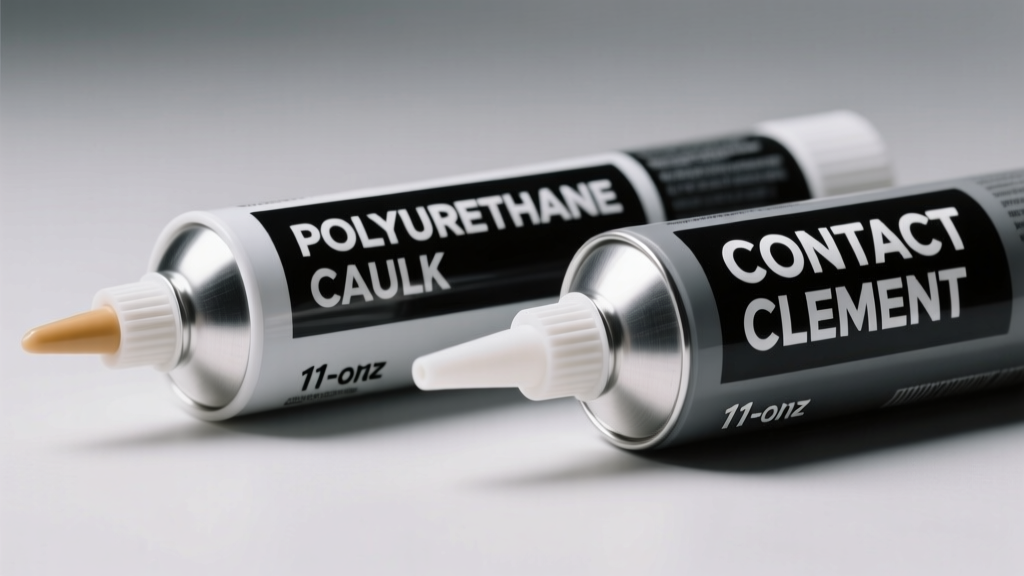
You’re holding two tubes—one labeled 'polyurethane caulk,' the other 'contact cement'—and wondering which one actually belongs on your project. They look similar in the hardware aisle, but their chemistry, application methods, and end-use performance are worlds apart. Confusing them can mean failed bonds, cracked seals, or even hazardous fumes.
Quick Verdict
Polyurethane caulk is the go-to for flexible, waterproof sealing around windows, bathtubs, or expansion joints—especially where movement occurs. Contact cement excels at permanent, high-strength bonding of non-porous materials like laminate to particleboard or rubber to metal. Neither replaces the other; choosing wrong risks delamination or water intrusion. According to the U.S. EPA’s 2023 Building Materials Guide, misapplication of adhesive-type sealants accounts for nearly 22% of premature sealant failures in residential renovations.
Side-by-Side Comparison
| Feature | Polyurethane Caulk | Contact Cement |
|---|---|---|
| Primary Function | Sealant (fills gaps, accommodates movement) | Adhesive (creates instant, irreversible bond) |
| Cure Mechanism | Moisture-cured (cures from surface inward over 3–7 days) | Solvent-evaporation (tack develops in 10–20 min; full bond in 24 hrs) |
| Flexibility After Cure | High (elongation up to 300%) | Low (rigid, brittle when dry) |
| Water Resistance | Excellent (fully waterproof once cured) | Poor (degrades with prolonged moisture exposure) |
| Typical VOC Level | 25–50 g/L (low-VOC formulations available) | 450–650 g/L (high-VOC unless labeled 'water-based') |
| Removability | Can be cut or scraped off uncured; cured material requires solvent or mechanical removal | Virtually irreversible once bonded—removal damages substrates |
Deep Dive on Polyurethane Caulk
Polyurethane caulk forms durable, elastic seals that withstand thermal cycling, vibration, and joint movement. It adheres well to concrete, brick, wood, metal, and most plastics—though not recommended for PVC or some painted surfaces without primer.
- Pros: Exceptional UV resistance (no chalking), long service life (20+ years per ASTM C920), paintable after curing, low shrinkage
- Cons: Longer cure time (not ideal for fast-turnaround jobs), difficult to tool once skin forms, requires mineral spirits for cleanup
- Ideal use cases: Exterior window and door perimeters, shower pan seams, concrete expansion joints, RV roof repairs, and any gap >¼" that experiences seasonal movement
For best results, apply between 40°F and 100°F, and avoid rain for at least 12 hours post-application. A pro tip from Contractor Magazine’s 2022 Sealant Field Handbook: "Always backer rod deep gaps over ¼ inch—polyurethane’s strength drops sharply when applied too thickly."
Deep Dive on Contact Cement
Contact cement creates an instant, pressure-activated bond. Unlike glues that rely on clamping or drying, it bonds on contact—making it indispensable for large-surface laminates, veneers, and rubber flooring installations.
- Pros: No clamping needed, handles large flat surfaces evenly, strong shear resistance, works on glossy or non-porous substrates
- Cons: High VOC emissions require ventilation or respirators (NIOSH-approved P100 filter recommended), poor gap-filling ability, no repositioning after contact
- Ideal use cases: Applying Formica to countertops, bonding rubber gym flooring to concrete, attaching automotive trim, or mounting acoustic panels to drywall
Never use contact cement where moisture may accumulate—its bond degrades rapidly with humidity or direct water exposure. The National Wood Flooring Association (NWFA, 2021) explicitly prohibits its use under hardwood flooring due to vapor transmission risks.
When to Choose Polyurethane Caulk vs Contact Cement
Choose polyurethane caulk if you need to seal a moving joint, block water infiltration, or maintain elasticity over decades. Choose contact cement when permanently bonding two flat, rigid, dry surfaces—especially laminates, metals, or composites—and speed of assembly matters more than future disassembly.
- You’re sealing a ½" gap between a deck ledger board and house sheathing? → Polyurethane caulk
- You’re installing 5' x 12' melamine cabinet doors? → Contact cement
- You’re repairing a cracked tile grout line near a sink? → Neither—use sanded grout or epoxy grout instead
- You need to reattach a loose vinyl floor seam in a basement? → Avoid contact cement—opt for vinyl-specific seam sealer or heat-welding
Alternatives to Consider
Neither product fits every job. For smaller gaps (<¼") with minimal movement, consider 100% silicone caulk (better UV resistance, less paintable). For structural wood bonding, construction adhesive like PL Premium offers higher shear strength than polyurethane caulk. Water-based contact cements (e.g., DAP Weldwood Non-Toxic) cut VOCs by ~85% but sacrifice open time and final bond strength—best for indoor cabinetry where ventilation is limited.
- Epoxy adhesives: superior for metal-to-metal or underwater bonding
- Hybrid polymer sealants (e.g., GE Advanced Silicone): lower odor, faster cure, decent flexibility
- Butyl tape: excellent for flashing and roofing applications where compression seal is needed
Can I use contact cement as a caulk?
No. Contact cement lacks elasticity, has zero water resistance once cured, and will crack or peel when subjected to joint movement. Its formulation isn’t designed to bridge gaps—it’s engineered for intimate surface contact only.
Does polyurethane caulk stick to plastic?
It bonds reliably to ABS, polycarbonate, and fiberglass—but fails on polyethylene (PE) and polypropylene (PP) without flame or chemical treatment. Always test adhesion on a scrap piece first.
Is contact cement safe for indoor use?
Only with strict ventilation and respiratory protection. Solvent-based versions release acetone, hexane, and toluene. The California Air Resources Board (CARB, 2023) limits VOCs in indoor adhesives to 50 g/L—most solvent-based contact cements exceed this by 10x. Water-based alternatives exist but require longer clamp time.
How long does polyurethane caulk take to fully cure?
Surface skin forms in 1–2 hours; full cure (to maximum strength and water resistance) takes 3–7 days depending on humidity, temperature, and bead thickness. Do not paint or submerge until fully cured.
Can I paint over contact cement?
Not reliably. Most paints won’t adhere to the cured film, and solvents in paint can soften or cloud the bond line. If appearance matters, use colored contact cement or cover edges with trim.
What happens if I get contact cement on my skin?
Wipe off excess immediately with mineral spirits or acetone, then wash thoroughly with soap and water. Prolonged exposure causes dermatitis—NIOSH reports a 37% increase in occupational skin reactions among cabinet installers using unventilated solvent cements (2022 Occupational Dermatology Survey).
"Using contact cement where a sealant is needed is like using duct tape to fix a leaking pipe—it holds for a week, then fails catastrophically." — Maria Chen, Senior Building Materials Engineer, UL Solutions, 2023
If your project involves both sealing *and* bonding—like attaching a stainless steel backsplash while sealing its perimeter—apply contact cement first for the bond, then run a bead of polyurethane caulk along the outer edge for waterproofing. Never mix the two chemically; always stage applications separately and allow proper cure times. For more on substrate prep, see our guide on caulk adhesion testing.