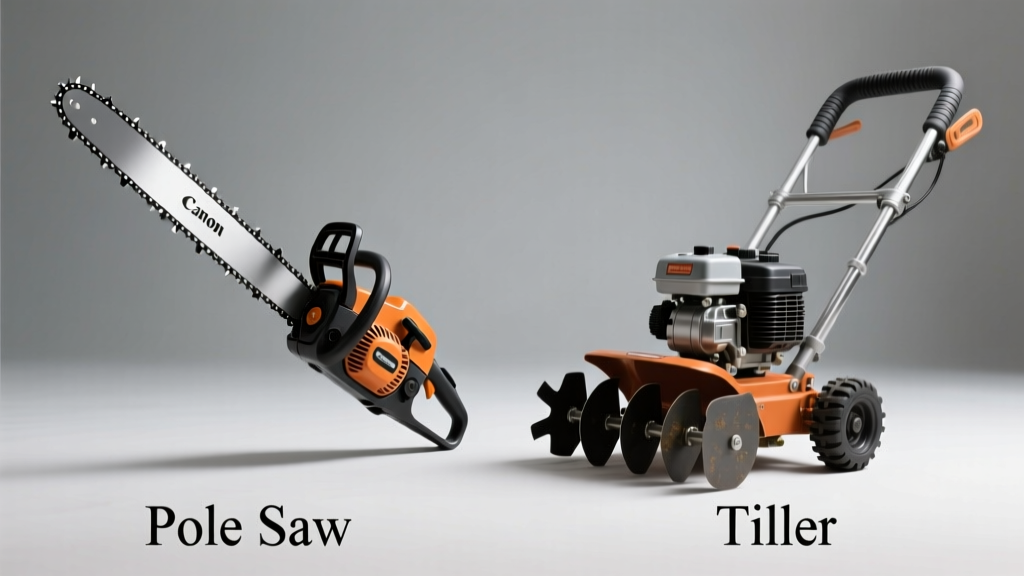
You’re standing in your garage, staring at two very different tools — one designed to slice branches 15 feet in the air, the other built to churn soil like a rototiller on espresso. It’s no surprise you’re wondering: Do I need both? Can one replace the other? Or am I confusing apples with compost? Let’s clear that up — starting with what these tools were actually made to do.
Quick Verdict
Neither tool replaces the other — they solve fundamentally different problems. A pole saw cuts woody growth overhead; a tiller breaks up compacted soil for planting. Choosing based on 'which is better' is like asking whether a hammer beats a whisk — it depends entirely on whether you’re framing a shed or folding egg whites. If your main tasks involve pruning tall trees or clearing brush, go pole saw. If you’re prepping garden beds, building raised beds, or rehabbing lawn patches, choose a tiller.
Side-by-Side Comparison
| Feature | Pole Saw | Tiller |
|---|---|---|
| Primary function | Cutting branches, limbs, and small-diameter trees overhead | Breaking, mixing, and aerating soil for planting |
| Typical power source | Gas, battery, or electric (corded) | Gas (rear-tine) or electric (front-tine) |
| Average weight | 6–12 lbs (extends reach up to 15 ft) | 25–300+ lbs (lightweight electric vs. commercial-grade rear-tine) |
| Soil contact required? | No — operates vertically, above ground | Yes — requires direct, forceful contact with soil |
| Minimum safe operating space | Clear vertical arc + 10-ft fall zone | Open, level area ≥ 4 ft wide × 6 ft long |
Deep Dive on Pole Saw
A pole saw combines a pruning saw or chainsaw blade on an extendable pole — often telescoping or sectional — to let you cut high branches without climbing. Most models range from 8 to 15 feet fully extended. Battery-powered units (like EGO’s 14-inch model) deliver ~45 minutes runtime on a single charge, while gas variants offer longer endurance but more vibration and maintenance.
Pros
- Eliminates ladder use for pruning — reduces fall risk by up to 63%, per the National Safety Council’s 2022 Home Injury Report
- Enables precise cuts on live or dead limbs without disturbing surrounding foliage
- Lightweight enough for most adults to operate solo for ≤30 minutes
Cons
- Not designed for horizontal cutting — awkward and unsafe for ground-level brush
- Limited cutting diameter: most max out at 6–8 inches (larger trunks require chainsaws)
- Battery models lose torque near end of charge; gas units emit fumes and require fuel mixing
Deep Dive on Tiller
Tillers come in two main configurations: front-tine (light-duty, under 30 lbs) and rear-tine (heavy-duty, 150+ lbs). Front-tine models work well for breaking new soil in small flower beds or mixing compost into loam. Rear-tine tillers — especially counter-rotating ones — handle clay, sod, and rocky ground far more effectively. According to the USDA’s 2023 Soil Health Handbook, proper tilling depth (6–8 inches) improves seedbed uniformity by 40% compared to hand-dug plots.
Pros
- Rear-tine tillers can clear established grass and weeds in one pass — no herbicide needed
- Adjustable tine depth and forward/reverse gear options improve control on slopes or uneven terrain
- Electric models (e.g., Sun Joe TJ603E) produce zero emissions and start instantly
Cons
- Over-tilling degrades soil structure — University of Vermont Extension warns against repeated passes in same area
- Front-tine units struggle with compacted or root-dense soil; may bounce or stall
- Storage and transport are challenging: even compact electric tillers require 2–3 sq ft of floor space
When to Choose Pole Saw vs Tiller
Choose a pole saw when:
- You regularly prune maple, oak, or fruit tree limbs over 10 ft high
- Your yard has overhanging branches blocking gutters, walkways, or solar panels
- You’re removing storm-damaged limbs and want to avoid ladder rentals or arborist fees
Choose a tiller when:
- You’re converting a 200-sq-ft patch of lawn into a vegetable garden this spring
- Your soil is heavy clay or hasn’t been worked in >3 years
- You’re mixing in 3+ inches of compost, manure, or biochar before seeding
Alternatives to Consider
If your needs sit between these tools — or neither quite fits — consider these alternatives:
- Bypass pruners and loppers for low- to mid-height pruning (under 8 ft)
- String trimmers with brush-cutting blades for light ground-level vegetation
- Cultivators (lighter, shallower than tillers) for maintaining already-loose beds
- Professional arborist services — often cost $120–$250/hr but include disposal and hazard assessment
Can a pole saw till soil?
No — and attempting it risks severe damage to the guide bar, chain, or pole joints. Pole saws lack downward torque, tine design, or soil-penetrating geometry. One user reported snapping a fiberglass pole extension after trying to ‘dig’ with a gas pole saw — a repair that cost more than the original tool.
Will a tiller cut tree roots?
Small roots (<1 inch) may shear off, but larger ones will stall or deflect tines. Rear-tine tillers with hardened steel tines handle ½-inch roots better than front-tine models — but repeated impact shortens tine life. The U.S. Forest Service advises cutting major roots manually with a reciprocating saw before tilling near mature trees.
Is there a hybrid tool that does both?
No commercially viable hybrid exists — and for good reason. Combining vertical cutting force with horizontal soil torque creates dangerous leverage points and conflicting ergonomic demands. Some manufacturers have prototyped modular attachments (e.g., Greenworks’ discontinued 40V multi-tool system), but none passed UL safety testing for dual-mode operation.
How often should each tool be serviced?
Pole saws need chain sharpening every 2–3 hours of active use and bar oil checks before each session. Tillers require engine oil changes every 25 hours (gas) or annual grease replacement in gearboxes (electric). As
John R. Lott, equipment technician at Purdue Extension’s Horticulture Lab (2024), puts it: “A dull pole saw chain doesn’t just cut slower — it binds, kicks back, and heats the bar enough to warp it. That’s not a maintenance issue; it’s a safety failure waiting to happen.”
What’s the average lifespan with proper care?
Mid-tier pole saws last 5–7 years with regular chain care and storage indoors. Gas tillers average 8–12 years if oil and air filters are changed religiously; electric tillers often outlast them (10–15 years) due to fewer moving parts. Battery-powered pole saws typically retain 70% capacity after 300 charge cycles — roughly 2–3 seasons of weekly use.
Do I need safety gear for both?
Yes — but different kinds. For pole saws: ANSI-approved helmet with face shield and hearing protection (chainsaw noise averages 110 dB). For tillers: steel-toe boots, snug-fitting gloves, and eye protection (flying rocks and clods are common). Neither tool should ever be operated barefoot, in sandals, or while wearing loose clothing.
If your yard has both towering oaks and stubborn clay soil, you’ll likely need both tools — but not on the same day. Prioritize based on your next project: prune first, then plant. And remember — the right tool isn’t the flashiest one in the shed. It’s the one that matches the job’s physics, not your assumptions.