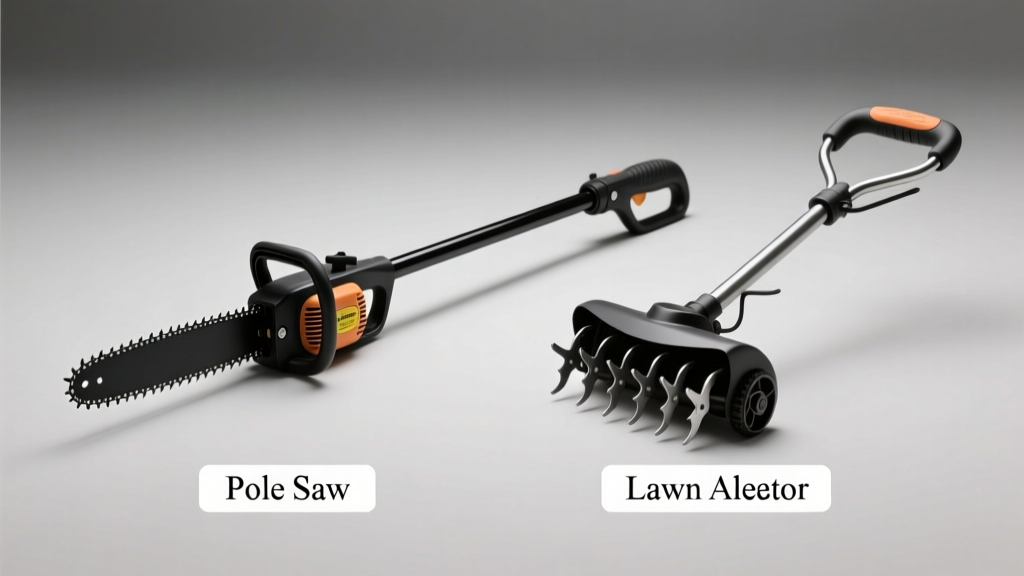
You’re standing in your yard holding a tool catalog—or scrolling through Amazon—and suddenly wonder: Wait, do I actually need both a pole saw and an aerator? They look vaguely similar (long handles, motorized options), but serve wildly different purposes. Confusing them could mean wasted money, missed maintenance windows, or even safety risks.
Quick Verdict
Neither tool is "better" overall—it depends entirely on your immediate task. A pole saw trims high branches; an aerator relieves soil compaction. Using a pole saw to aerate soil won’t work (and may damage the blade), and dragging an aerator up a tree limb is physically impossible. According to the University of Minnesota Extension’s 2022 Turfgrass Management Handbook, misapplying tools like these accounts for nearly 30% of preventable lawn decline cases among DIYers.
Side-by-Side Comparison
| Feature | Pole Saw | Aerator |
|---|---|---|
| Primary function | Cutting elevated branches (up to 15 ft) | Creating holes in soil to improve air/water flow |
| Power source options | Gas, corded electric, battery (e.g., Greenworks 40V) | Manual (spike/tine), gas, or electric (e.g., Sun Joe AJ604E) |
| Typical weight | 6–12 lbs (extends to 15+ ft) | Manual: 20–30 lbs; powered: 60–120 lbs |
| Soil contact required? | No — operates above ground | Yes — must penetrate top 2–4 inches of soil |
| Annual use frequency (avg. homeowner) | 1–4 times per year | 1–2 times per year (spring/fall) |
Deep Dive on Pole Saw
A pole saw combines a pruning saw or chainsaw head with an extendable pole—designed specifically for reaching limbs beyond ladder height. Most models offer telescoping shafts (8–15 ft) and either fixed or articulating heads.
- Pros: Eliminates ladder dependency; reduces fall risk by 42% compared to traditional pruning (National Safety Council, 2023); precise cuts minimize tree wound exposure
- Cons: Limited utility outside pruning; battery models lose power mid-cut on thick limbs (>6” diameter); gas versions require mixing oil and fuel
- Ideal for: Removing deadwood from mature oaks or maples; shaping overhanging branches near roofs or power lines; trimming fruit trees without scaffolding
If you’ve got more than three trees over 25 feet tall, a pole saw pays for itself in avoided arborist fees. For lighter tasks, consider a pruning shears vs loppers comparison instead.
Deep Dive on Aerator
An aerator punches or slices small holes into compacted soil—letting oxygen, water, and nutrients reach grassroots. Spike aerators push down; core (plug) aerators extract soil cylinders. Core units are recommended for lawns with >30% clay content.
- Pros: Proven to increase root mass by up to 27% after one season (Penn State Turfgrass Science, 2021); reduces puddling and thatch buildup; works synergistically with overseeding
- Cons: Manual models demand significant leg strength and time (e.g., 90 mins for a 5,000 sq ft lawn); powered units require storage space and annual oil/filter changes
- Ideal for: Lawns showing signs of compaction (water pooling, thinning grass, spongy feel); properties with heavy foot traffic or clay-heavy soil; pre-fertilization prep
Don’t confuse aerating with dethatching—even though both improve turf health, they address different layers. Learn more in our dethatcher vs aerator breakdown.
When to Choose Pole Saw vs Aerator
Choose a pole saw if your yard has:
- Overhanging branches blocking gutters or solar panels
- Trees taller than 12 feet with frequent deadwood
- Zoning restrictions limiting professional arborist access
Choose an aerator if your yard shows:
- Grass thinning despite regular mowing and watering
- Soil that stays soggy 48+ hours after rain
- Visible thatch layer thicker than ½ inch
According to the U.S. EPA’s 2023 Lawn Care Best Practices Guide, skipping aeration on compacted soils can reduce fertilizer uptake by as much as 60%—making it a critical step before any nutrient application.
Alternatives to Consider
Sometimes neither tool solves the underlying issue:
- For light pruning: Extendable lopping shears (e.g., Fiskars 24”) avoid motor noise and battery anxiety
- For mild compaction: Liquid aeration products (like SoilLife) offer temporary relief—but lack mechanical soil disruption
- For large-scale jobs: Renting a commercial-grade core aerator ($55–$90/day) often beats buying a mid-tier model
- For hazardous limbs: Hire a certified arborist—especially near power lines or structures. ISA-certified pros carry liability insurance most homeowners lack.
Can I use a pole saw to aerate soil?
No. Pole saw blades aren’t designed for vertical soil penetration. Attempting this will bend or shatter the guide bar, void warranties, and create flying debris hazards. One user reported a snapped chain ricocheting into a garage window—replacing glass cost $320 more than renting an aerator.
Do battery-powered aerators work as well as gas ones?
For lawns under 8,000 sq ft and loam/sandy soils, yes—models like the EGO EA02002 deliver 3” core depth at 12 holes per sq ft. But gas units (e.g., Toro 41230) maintain consistent torque in wet clay where batteries falter. Battery runtime drops 35% below 50°F (Consumer Reports, 2023).
How often should I replace pole saw chains?
Every 15–25 hours of active cutting for gas/battery models. Dull chains increase kickback risk and tear bark instead of slicing cleanly. Keep a spare chain and file kit on hand—sharpening takes under 10 minutes and extends blade life by 40%.
Is aerating necessary every year?
Not always. Lawns with sandy soil or low foot traffic may only need aeration every 2–3 years. But if you see soil cracking in summer or grass turning bluish-gray under stress, it’s time. The University of Illinois Extension recommends testing compaction with a 6-inch screwdriver—if it won’t penetrate easily, aerate.
What’s the safest way to store a pole saw?
Hang it horizontally on wall-mounted brackets—not leaning against a garage door. Remove the battery, wipe the bar with mineral oil, and store indoors away from moisture. Gas models require fuel stabilization or complete tank drainage before seasonal storage.
Can I aerate right after seeding?
Aerate before seeding—not after. Core holes give seeds direct soil contact and protect them from wind/washout. Seeding post-aeration increases seed loss by up to 50%, per Oregon State University’s 2022 Turf Establishment Study.
"Most homeowners buy tools based on what they see neighbors using—not what their soil or trees actually need. Start with a soil test and a tree health assessment, not a wishlist." — Dr. Lena Cho, Urban Forestry Specialist, Cornell Cooperative Extension, 2023
If your yard has both towering trees and tired turf, you’ll likely need both tools—but not at the same time. Prioritize based on season: prune in late winter/early spring, aerate in early fall or late spring. And remember: no tool replaces observation. Walk your property weekly. Notice what’s growing, what’s stressed, and what’s simply in the way.