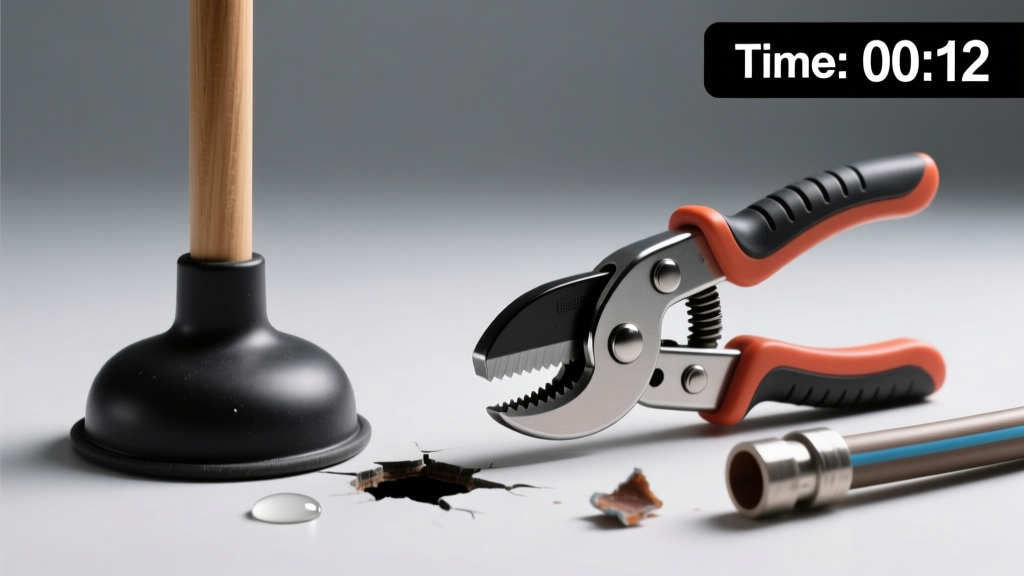
You’re standing in front of a dripping copper pipe under the kitchen sink, water pooling on the cabinet floor. Your toolbox holds a rubber plunger and a shiny tubing cutter — but which tool actually solves this problem? It’s not a silly question; many homeowners assume either tool can handle any leak, and that confusion leads to wasted time or worse, damaged fittings.
Quick Verdict
Neither tool is universally 'better' — they solve entirely different problems. A plunger clears clogged drains (toilets, sinks, showers); a tubing cutter cleanly severs rigid metal or plastic pipe during repairs or installations. Using one for the other’s job won’t work — and may cause injury or flooding. Choose based on whether you’re unclogging (plunger) or cutting pipe (tubing cutter).
Side-by-Side Comparison
| Feature | Plunger | Tubing Cutter |
|---|---|---|
| Primary function | Creates suction and pressure to dislodge blockages in drains | Cuts through copper, PEX, or aluminum tubing with a rotating, scissor-like action |
| Material compatibility | Works on PVC, ABS, cast iron, and ceramic fixtures | Rated for copper (1/8"–1") and PEX (up to 1"), not galvanized steel or cast iron |
| Time to deploy | Under 30 seconds — no setup or calibration needed | Requires pipe stabilization, alignment, and 3–5 full rotations per cut |
| Risk of collateral damage | Low — unless excessive force cracks a porcelain rim | Moderate — improper use causes burrs, ovaling, or incomplete cuts that leak |
| Average lifespan (with care) | 2–5 years (rubber degrades, handles crack) | 8–12 years (replace blade every 200–300 cuts per Home Depot Tool Care Guide, 2022) |
Deep Dive on Plunger
A plunger is the oldest, most accessible drain-clearing tool — and still the fastest solution for soft clogs like hair, soap scum, or food debris in sinks, tubs, and toilets. Its effectiveness hinges on seal integrity and rhythmic pressure pulses, not brute force.
Pros
- No electricity, chemicals, or disassembly required
- Costs $5–$18 — most households already own one
- Effective on 70% of common household clogs (per American Society of Plumbing Engineers, 2021 Drain Survey)
Cons
- Fails on hard obstructions (jewelry, toy parts, tree roots)
- Useless on vented or multi-branch systems without isolating traps
- Flange plungers often slip on flat surfaces like shower drains
Best for: Toilet backups, slow kitchen sinks, and bathtub stoppages where the clog is within 2–4 feet of the drain opening. Pair it with a plumber’s snake if plunging fails twice.
Deep Dive on Tubing Cutter
A tubing cutter isn’t a repair tool — it’s a precision cutting instrument designed for controlled, square cuts on pressurized supply lines. Unlike hacksaws or pipe cutters, its rolling wheel minimizes deformation and eliminates burrs when used correctly.
Pros
- Produces clean, perpendicular cuts critical for compression fittings and solder joints
- Portable and quiet — ideal for tight spaces like behind vanities or under mobile home floors
- Compatible with both amateur and professional-grade PEX crimp rings and push-fit connectors
Cons
- Cannot cut stainless steel, galvanized pipe, or threaded fittings
- Requires practice to avoid ovaling — a common rookie error that causes leaks at the joint
- Blades dull faster on dirty or oxidized copper (e.g., older supply lines)
According to the U.S. EPA, 14% of household water usage is from leaks — many caused by poor cuts during DIY repairs. A quality tubing cutter reduces that risk significantly when paired with proper deburring tools.
"A burr left inside a 1/2-inch copper line can reduce flow by up to 30% and accelerate corrosion," says master plumber Lena Ruiz in Modern Residential Plumbing Systems (2023, p. 89).
When to Choose Plunger vs Tubing Cutter
Reach for the plunger when water backs up *after* running the faucet or flushing — especially if gurgling or slow drainage precedes the backup. Grab the tubing cutter only when replacing a valve, installing a new shutoff, or repairing a pinhole leak in a visible supply line. Never use a tubing cutter on a drain pipe — it’s too narrow, and the cut won’t align with trap geometry.
Other telltale signs: If water pools *around* the base of a toilet, that’s a wax ring failure — neither tool fixes it. If you hear hissing from a copper line under pressure, that’s a rupture requiring immediate cutoff and a tubing cutter — not plunging.
Alternatives to Consider
Sometimes neither tool fits the job. For stubborn clogs beyond plunging range, a drain auger reaches 15–25 feet deeper. For pipe replacement where space is tight, a rotary pipe cutter works faster on larger diameters. And for frozen or corroded supply lines, a flare tool kit may be needed after cutting — especially for gas lines or refrigeration tubing.
Can I use a tubing cutter on PVC drain pipe?
No. Tubing cutters are engineered for thin-walled, round, rigid tubing — not thick-walled, solvent-welded PVC drain pipe. Use a hacksaw or PVC ratchet cutter instead. Attempting a tubing cutter on 2-inch PVC risks blade binding, slippage, and jagged edges that won’t glue properly.
Does plunger type matter for different fixtures?
Yes. A cup plunger works best on flat surfaces (sinks, showers). A flange plunger — with an extended rubber lip — seals tighter around toilet bowls. A collapsible accordion plunger offers more force but requires careful control to avoid cracking porcelain.
How do I know if my tubing cutter blade is dull?
If you need more than five full rotations to cut 1/2-inch copper, or if the cut leaves ridges or requires twisting to complete, the blade is worn. Replace it before your next repair — dull blades deform pipe walls and compromise joint integrity.
Will plunging fix a sewer line clog?
Rarely. Main sewer clogs (often caused by tree roots or collapsed pipe) sit 10–100 feet underground. A plunger’s pressure wave dissipates long before reaching that depth. You’ll need a sewer camera inspection followed by hydro-jetting or excavation — not a rubber cup.
Can I rent a tubing cutter instead of buying one?
Yes — but not advised for one-time use. Rental units are often poorly maintained, with misaligned wheels or rusted adjustment screws. A $22–$38 cutter from brands like Ridgid or Wheeler-Rex pays for itself after two successful repairs and lasts years with basic oiling.
Bottom line: Tools don’t replace diagnosis. Before grabbing either device, confirm the problem’s location and nature. That step alone prevents half the DIY disasters we see in our common plumbing mistakes archive. Match the tool to the task — not the urgency.