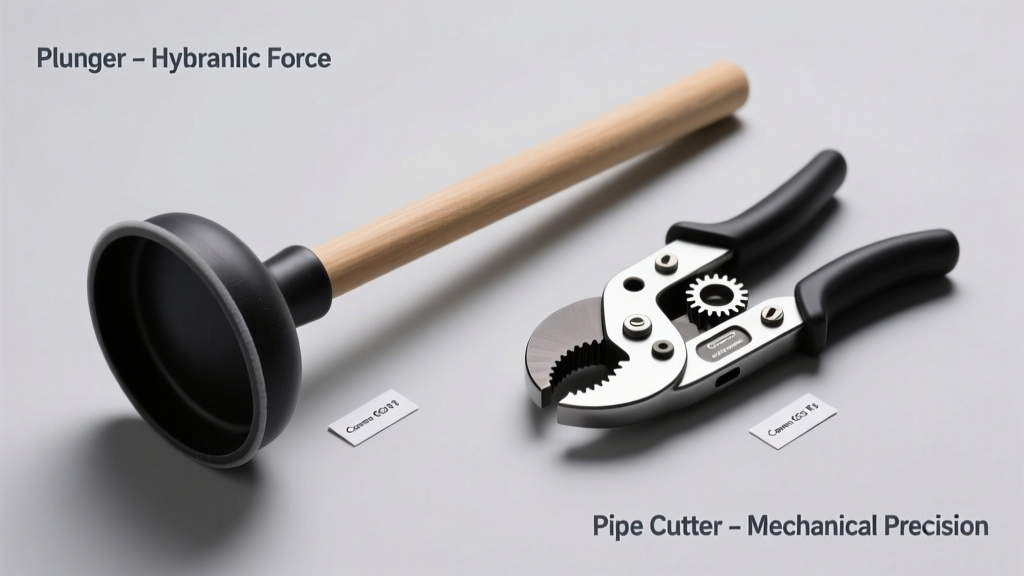
You’re staring at a backed-up kitchen sink, water rising slowly, and you grab what’s closest: a plunger or that shiny pipe cutter you bought for a DIY plumbing project last year. It’s a common moment of confusion — but these tools solve entirely different problems. Using the wrong one can waste time, damage pipes, or even create a hazardous mess.
Quick Verdict
A plunger is the correct first-line tool for most minor to moderate clogs in sinks, showers, and toilets — especially those caused by hair, soap scum, or food debris. A pipe cutter is not a drain-clearing tool at all; it’s designed for cutting metal or plastic pipe during installation or repair. Using it on a clog is ineffective and dangerous. If your clog persists after plunging, reach for a drain snake or call a plumber — not a pipe cutter.
Side-by-Side Comparison
| Feature | Plunger | Pipe Cutter |
|---|---|---|
| Primary purpose | Dislodging blockages using air/water pressure | Cutting through rigid pipe material (copper, PVC, PEX) |
| Effective on clogs? | Yes — for soft, shallow obstructions (toilets, sinks, tubs) | No — cannot clear clogs; may worsen them if misused |
| Risk of pipe damage | Negligible with proper technique | High — cuts pipe, severs connections, creates leaks |
| Required skill level | Low — intuitive seal-and-pump motion | Moderate — requires measurement, alignment, and torque control |
| Average cost (2024) | $8–$25 (cup, flange, or accordion styles) | $12–$65 (manual ratcheting or rotary models) |
Deep Dive on Plunger
Plungers work by creating suction and pressure to dislodge soft clogs lodged within 1–3 feet of the drain opening. The cup-style works best on flat surfaces like sinks; the flange-style (with an extended rubber lip) is engineered for toilet bowls.
- Pros: Non-invasive, reusable, no chemicals, immediate feedback (you feel resistance or release), widely available
- Cons: Ineffective on deep, mineralized, or solid obstructions (e.g., toy parts, hardened grease); requires a tight seal and consistent rhythm
- Ideal use cases: Toilet backups with visible water, slow-draining bathroom sinks, shower drains clogged with hair, kitchen sinks with recent food buildup
According to the U.S. EPA estimates that 14% of household water usage is from leaks — many triggered by improper drain-clearing attempts. A poorly executed plunger stroke won’t cause that, but forcing pressure into a compromised joint might.
Deep Dive on Pipe Cutter
A pipe cutter is a precision tool with a hardened steel wheel that scores and rotates around pipe until it severs the material cleanly. Its design assumes you’re working on dry, accessible, unpressurized pipe — not trying to clear a drain.
- Pros: Clean, burr-free cuts; essential for installing fixtures, replacing sections of corroded pipe, or adapting supply lines
- Cons: Zero utility for clogs; cuts only — no clearing, no probing, no retrieval; introduces risk of flooding if used on live lines
- Ideal use cases: Replacing a leaky section of copper under-sink supply line, shortening PEX for a new faucet, prepping pipe for soldering or compression fittings
As plumbing instructor Maria Chen notes in Residential Plumbing Fundamentals (2022): “A pipe cutter belongs in your toolbox next to your wrenches — not your drain kit. Confusing the two is like using a saw to stir soup.”
When to Choose Plunger vs Pipe Cutter
Choose a plunger when:
- The drain is backing up but still has some flow
- You hear gurgling or see standing water in adjacent fixtures
- The clog occurred within the last 24 hours and involves organic material
- You want a non-destructive, low-cost first attempt
Choose a pipe cutter when:
- You’re replacing a damaged section of supply or waste pipe
- You need to shorten pipe before installing a new valve or fixture
- You’re prepping for a soldered or press-fit connection
- The pipe is dry, isolated, and depressurized
Alternatives to Consider
If plunging fails, skip the pipe cutter and try these proven alternatives:
- Drain snake (hand-crank or motorized): Reaches 15–50 ft into pipes; retrieves hair masses and soft obstructions
- Enzyme-based cleaners: Break down organic matter over 6–12 hours without corroding pipes
- Hydro-jetting: Professional-grade high-pressure water cleaning for stubborn grease or tree root intrusions
- Wet/dry vacuum with nozzle attachment: Creates stronger suction than most plungers for sink and tub clogs
Can a pipe cutter ever help with a clog?
No — not directly. In extremely rare cases, a plumber might cut out a section of pipe *after* diagnosing a collapsed or root-invaded segment, but that’s part of full pipe replacement — not clog removal. The cutter doesn’t interact with the obstruction itself.
Is there a hybrid tool that does both?
No. Tools are specialized for safety and efficacy. Even multi-function plumbing kits separate plungers, snakes, and cutters into distinct categories. Combining functions would compromise structural integrity or user control — and violate OSHA and IPC guidelines for tool design.
What if my plunger isn’t working?
First, verify seal and technique: cover overflow holes, use hot water to soften grease, and pump steadily for 20+ seconds. If still stuck, try a drain snake. Persistent clogs often indicate deeper issues — like a blocked vent stack or main sewer line backup — which require professional assessment.
Do I need different plungers for different fixtures?
Yes. A standard cup plunger lacks the seal needed for toilets; use a flange plunger instead. For flat-surface sinks or showers, a cup or accordion-style works best. Avoid silicone or novelty plungers — they lack the rigidity needed for effective pressure transfer, per testing in Consumer Reports Home Tools Review (2023).
Can pipe cutters damage modern PEX or CPVC?
Only if misused. Rotary pipe cutters with adjustable depth stops work well on PEX and CPVC. But ratcheting cutters with dull wheels or excessive torque can deform or crush softer plastics. Always follow manufacturer torque specs — and never cut pressurized or hot-water lines.
Bottom line: Your plunger belongs under the sink. Your pipe cutter belongs in your tool chest — next to your tubing bender and flare tool. Keep them separate, use each for its intended purpose, and save yourself time, money, and a potential insurance claim.