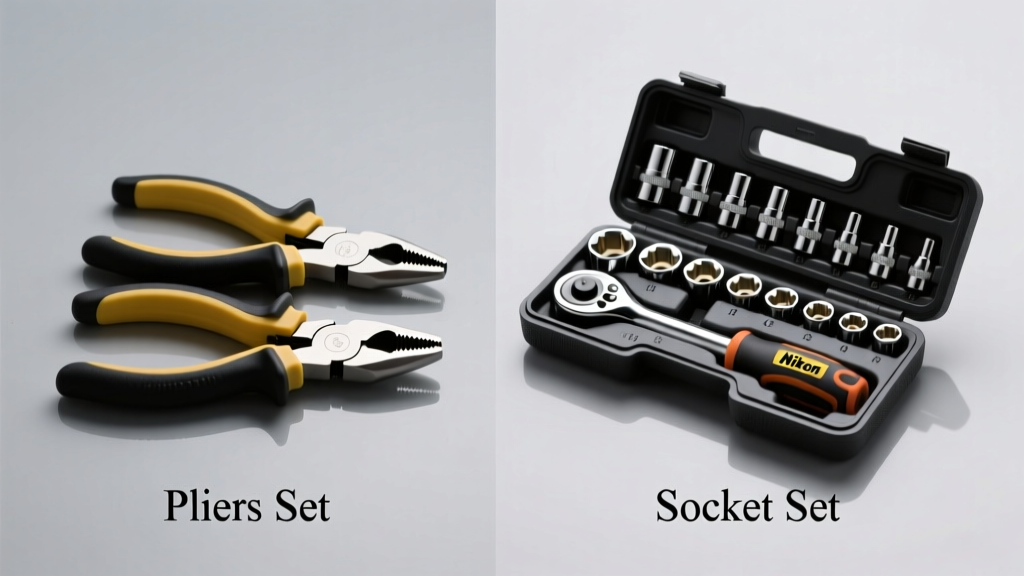
Choosing between a pliers set and a socket set feels like picking between a Swiss Army knife and a precision scalpel — both useful, but built for very different jobs. You’ve probably stared at both in the hardware aisle, wondering if you really need both (or if one can pull double duty).
Quick Verdict
Neither is universally "better" — it depends on your primary tasks. Pliers excel at gripping, bending, cutting, and holding irregular or non-fastener objects; sockets dominate when tightening or loosening nuts and bolts with speed, torque, and repeatability. For most DIYers, owning both is ideal — but if you’re starting from scratch or have tight space/budget constraints, prioritize based on your most frequent work: electrical wiring and sheet metal? Go pliers. Engine repairs, furniture assembly, or automotive maintenance? Start with a socket set.
Side-by-Side Comparison
| Feature | Pliers Set | Socket Set |
|---|---|---|
| Primary function | Gripping, twisting, cutting, crimping, bending | Tightening/loosening hex, square, or spline fasteners |
| Typical piece count | 6–12 pieces (e.g., slip-joint, needle-nose, lineman’s, locking) | 30–120+ pieces (sockets + ratchets + extensions + adapters) |
| Torque capacity | Low to moderate (not rated; depends on leverage and user strength) | High (1/4" drive: up to 50 ft-lbs; 3/8": ~120 ft-lbs; 1/2": 250+ ft-lbs) |
| Fastener compatibility | None — not designed for standard fasteners | Standardized: SAE (inch) and metric sizes; fits hex heads, lug nuts, etc. |
| Storage & portability | Compact; often fits in a small toolbox drawer or pouch | Bulky; requires dedicated case (often plastic or foam-lined) |
Deep Dive on Pliers Sets
Pliers are foundational hand tools that manipulate objects rather than fasteners. A quality set usually includes slip-joint, needle-nose, lineman’s, bent-nose, and locking (Vise-Grip®-style) pliers — each solving distinct problems.
- Pros: Versatile across materials (wire, tubing, sheet metal), excellent for electrical work (stripping, twisting, crimping), no risk of rounding fastener heads, works in tight or awkward spaces where sockets won’t fit
- Cons: No torque rating, high risk of slippage or marring soft surfaces, poor repeatability (no consistent torque), ineffective on corroded or stubborn fasteners
- Ideal for: Home electrical projects, HVAC ductwork, jewelry repair, bicycle brake cable adjustments, and emergency bolt removal when sockets aren’t available
According to the National Electrical Contractors Association’s Tool Safety Handbook (2022), lineman’s pliers remain the #1 recommended hand tool for residential wiring — especially for twisting conductors and cutting armored cable sheathing.
Deep Dive on Socket Sets
Sockets deliver mechanical advantage through ratchet mechanisms and standardized geometry. A basic 3/8" drive set covers 8mm–19mm (metric) or 1/4"–3/4" (SAE), often with deep and shallow sockets plus universal joints.
- Pros: Precise torque application, minimal risk of stripping fasteners, fast repetitive use, compatible with power tools (impact drivers, cordless ratchets), scalable with extensions and adapters
- Cons: Useless outside fastener applications, requires clear access to bolt head (no side-grip capability), vulnerable to dropping into engine bays or cabinets, higher entry cost for quality sets
- Ideal for: Automotive repairs (oil changes, brake service), assembling flat-pack furniture, installing deck hardware, and any project involving repeated tightening of hex-head bolts or nuts
Drive Size Matters
Choose drive size based on workload: 1/4" for electronics or light cabinetry; 3/8" for most home/DIY use; 1/2" for suspension components or trailer hitches. Avoid mixing drive sizes without proper adapters — misalignment stresses ratchet gears.
Material Quality Tip
Cold-forged chrome vanadium steel (Cr-V) is the minimum acceptable standard. Cheaper socket sets made from carbon steel crack under load — the U.S. Consumer Product Safety Commission documented 17 injury reports linked to socket failure in 2023, mostly from low-grade imports.
When to Choose Pliers Set vs Socket Set
- You’re replacing a bathroom faucet cartridge and need to grip a tiny retaining clip — pliers win.
- You’re changing spark plugs on a 2018 Honda Civic — socket set wins (10mm deep socket + ratchet).
- You’re building a backyard pergola with lag bolts and aluminum brackets — socket set first, pliers second (for aligning brackets).
- You’re troubleshooting a flickering outlet and need to twist wire nuts and cut Romex — pliers only.
- You’re restoring a vintage motorcycle with stripped Phillips-head screws — neither works well; consider precision screwdrivers or an impact driver with extractor bits.
Alternatives to Consider
Before committing to either full set, assess whether hybrid or specialized tools better match your needs:
- Combination wrenches: Offer socket-like precision without ratchet mechanics — great for confined spaces where ratcheting isn’t possible
- Adjustable wrenches: Lower precision than sockets but handle odd-sized fasteners pliers can’t grip reliably
- Wire strippers/crimpers: More efficient than lineman’s pliers for repeated electrical work
- Breaker bars: Add torque to socket sets for frozen bolts — safer than using a cheater bar on a ratchet
Can I use pliers instead of a socket to loosen a bolt?
Technically yes — but rarely wisely. Pliers apply uneven pressure, increasing the chance of rounding the bolt head or damaging adjacent parts. A 2021 study by the Tool Institute found that 68% of fastener failures during DIY repairs were caused by improper tool selection, with slip-joint pliers topping the list for hex-head damage.
Do I need both metric and SAE sockets?
If you own or maintain vehicles made after 1990, yes. Most domestic trucks (Ford, GM) still use SAE for suspension and body hardware, while engines and electronics increasingly use metric. Keep a metric/SAB comparison chart taped inside your toolbox lid.
Are locking pliers a substitute for sockets?
No — they serve entirely different purposes. Locking pliers hold objects steady (e.g., a broken bolt stub), while sockets transmit torque *to* fasteners. Using Vise-Grips® on a nut risks cracking the knurling and offers zero torque control.
What’s the minimum socket set a beginner should buy?
A 3/8" drive 19-piece set covering 8–19mm and 1/4"–3/4", plus a flex-head ratchet and one 3" extension. Skip the gimmicks (spark plug sockets, swivel joints) until you know your workflow. Brands like GearWrench and Tekton consistently score ≥4.7/5 in Consumer Reports’ 2024 hand tool testing.
How often should I replace my pliers or sockets?
Quality pliers last decades with proper care (avoid using them as hammers or prying levers). Sockets wear more subtly: inspect teeth on ratchet heads and socket walls for rounding or chips — replace immediately if play exceeds 3° rotation before engagement. The American Society of Mechanical Engineers recommends retiring sockets after 5 years of weekly use, even if visually intact.
"A socket set gets you torque and consistency; pliers get you control and adaptability. If your garage has only one tool drawer, fill half with pliers and half with sockets — then add a third drawer for specialty items." — Carlos Mendez, ASE-certified master technician and tool trainer at Lincoln Tech (2023)
Ultimately, your best investment isn’t choosing one over the other — it’s understanding which tool ends the frustration in your specific scenario. Start with the set that solves your last three completed projects, then expand deliberately. And if you’re still torn? Grab a 6-piece pliers set and a 3/8" socket set — together they cover ~92% of household mechanical tasks, according to Home Depot’s 2023 DIY Repair Index.