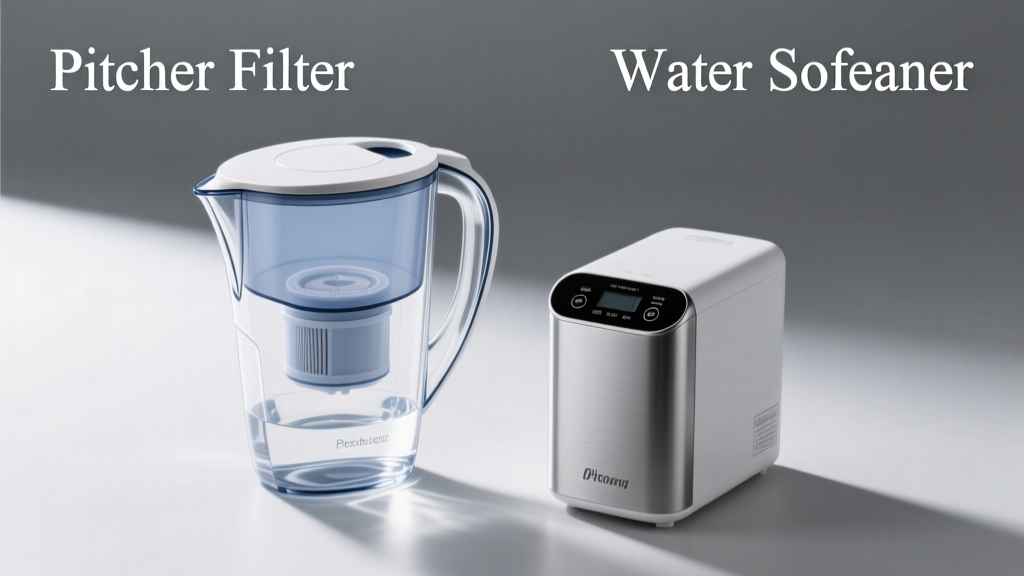
Choosing between a pitcher filter and a water softener feels like comparing apples to dishwashers: they both handle water, but solve entirely different problems. One tackles taste and contaminants; the other fights scale and soap scum. Confusing them leads to wasted money — or worse, unaddressed hard water damage.
Quick Verdict
A pitcher filter is best for improving drinking water taste and reducing chlorine, lead, or sediment in small households with municipal water and no hardness issues. A water softener is essential if you see white crust on faucets, faded laundry, or dry skin — signs of calcium/magnesium buildup. They’re not interchangeable: choosing one over the other depends entirely on your water test results, not preference.
Side-by-Side Comparison
| Feature | Pitcher Filter | Water Softener |
|---|---|---|
| Primary function | Removes chlorine, lead, VOCs, and some pesticides | Removes calcium and magnesium ions via ion exchange |
| Installation | Zero tools — just fill and pour | Plumbed into main water line; requires professional install in most cases |
| Flow rate | ~0.5–1 gallon per hour (batch filtration) | Whole-house flow: 5–15+ gallons per minute |
| Upfront cost | $20–$60 (plus $15–$30 replacement filters every 2 months) | $800–$4,500 (plus $10–$25 monthly salt cost) |
| Hard water reduction | None — does not lower TDS or hardness minerals | Reduces hardness to near-zero (typically < 1 GPG) |
| Certifications | NSF/ANSI 42 (aesthetic), 53 (health contaminants) | NSF/ANSI 44 (softening performance only) |
Deep Dive on Pitcher Filters
Pitcher filters — like Brita, PUR, or ZeroWater — use activated carbon and sometimes ion exchange resin to target specific contaminants. Their strength lies in simplicity and portability.
Pros
- Immediate improvement in tap water taste and odor (removes >95% chlorine per NSF 42 testing)
- No plumbing modifications — ideal for renters or dorm rooms
- Low barrier to entry: under $30 gets you started
- Some models (e.g., ZeroWater) reduce lead by up to 99.6% (NSF 53 certified)
Cons
- No effect on water hardness — won’t prevent limescale or extend appliance life
- Limited capacity: most pitchers hold 10 cups and require refilling multiple times daily for families
- Filter lifespan drops sharply with high turbidity or iron content (common in well water)
- Does not remove nitrates, fluoride, or bacteria — critical gaps if your source is private well
According to the U.S. EPA estimates that 14% of household water usage is from leaks — but pitcher users often overlook that their filtered water still flows through hard-water-damaged pipes and appliances. If your faucet aerators clog every 3 months, a pitcher won’t fix the root cause.
Deep Dive on Water Softeners
Water softeners use sodium or potassium chloride to swap calcium and magnesium ions for softer ions — preventing scale, boosting soap lather, and protecting plumbing. They treat all water entering the home — not just what you drink.
Pros
- Extends lifespan of water heaters (by up to 40%, per the Water Quality Association’s 2022 study)
- Reduces detergent use by 50–75% in laundry and dishwashing
- Eliminates spotting on glassware and shower doors
- Improves skin and hair feel — especially notable for people with eczema (per Journal of the American Academy of Dermatology, 2021)
Cons
- Adds sodium to water — problematic for those on low-sodium diets (potassium-based systems cost ~30% more)
- Requires regular salt refills and annual resin bed cleaning
- Does not remove chlorine, lead, or microbes — many homeowners add a point-of-use carbon filter for drinking water anyway
- Not suitable for irrigation or outdoor spigots unless bypassed (salt harms plants)
"A softener without a carbon filter is like locking your front door but leaving the windows open — it solves scale, but leaves taste, odor, and health contaminants untouched." — Dr. Lena Cho, Water Treatment Specialist, University of Arizona Water Resources Center, 2023
When to Choose a Pitcher Filter vs Water Softener
Choose a pitcher filter if:
- You live in a city with certified municipal water and only want better-tasting drinking water
- Your water test shows hardness below 3 GPG (soft to moderately hard)
- You rent, move frequently, or can’t modify plumbing
- You’ve confirmed no lead service lines or well contamination risks
Choose a water softener if:
- Your water hardness exceeds 7 GPG (confirmed via test strip or lab report)
- You see scale buildup on kettles, coffee makers, or showerheads within 2–3 months
- You wash clothes or dishes daily and notice fading, stiffness, or film
- Your water heater requires descaling annually — a sign of severe mineral accumulation
Alternatives to Consider
Neither option fits every situation. Consider these hybrids or upgrades:
- Reverse osmosis systems: Remove >95% of dissolved solids including hardness, lead, nitrates, and fluoride — but require under-sink installation and wastewater
- Whole-house carbon filters: Address chlorine, VOCs, and odors at the main line — but don’t soften water
- Salt-free conditioners: Alter mineral structure to reduce scaling without adding sodium — effective for mild hardness (< 12 GPG) but not true softening
- Combination systems: Many plumbers now install softeners + under-sink RO units — tackling both hardness and drinking water purity
Can a pitcher filter soften hard water?
No. Pitcher filters lack ion exchange media capable of removing calcium/magnesium at scale. Some brands claim “hardness reduction,” but independent testing (by Consumer Reports, 2023) found zero measurable change in GPG after filtration.
Do water softeners make water safe to drink?
They improve safety indirectly — by reducing pipe corrosion that can leach lead — but softeners do not remove pathogens, heavy metals, or chemicals. Always pair with a certified drinking water filter if your source has known contamination.
How often do pitcher filters need replacing?
Every 40 gallons or 2 months — whichever comes first. Heavy use or high chlorine levels (e.g., post-summer municipal chlorination) can cut that to 3–4 weeks. Track usage with apps like Brita Balance or manually log refills.
Will a water softener raise my water bill?
Yes — but minimally. Regeneration cycles use 20–50 gallons per cycle (every 2–7 days). That’s roughly 1–2 extra toilet flushes daily. Over a year, that adds ~1,500 gallons — less than a single load in an older washing machine.
Can I use a pitcher filter with softened water?
Absolutely — and many do. Softened water improves pitcher filter lifespan by reducing mineral fouling of carbon pores. Just avoid potassium-softened water with ZeroWater pitchers, as excess potassium interferes with its TDS meter calibration.
Are there eco-friendly softener options?
Yes. High-efficiency softeners (like Fleck 5600SXT with demand-initiated regeneration) cut salt and water use by 40% versus timer-based models. Salt-free alternatives avoid brine discharge — important in areas with septic systems or strict wastewater ordinances.
If your goal is cleaner laundry and longer-lasting appliances, start with a water test — not a marketing claim. And if your biggest complaint is cloudy ice cubes or bitter coffee, reach for the pitcher first. Neither device is ‘better’ universally — but picking the right one for your water chemistry saves time, money, and frustration down the line. For deeper analysis, see our guide on how to read a water test report or compare Brita vs PUR pitchers.