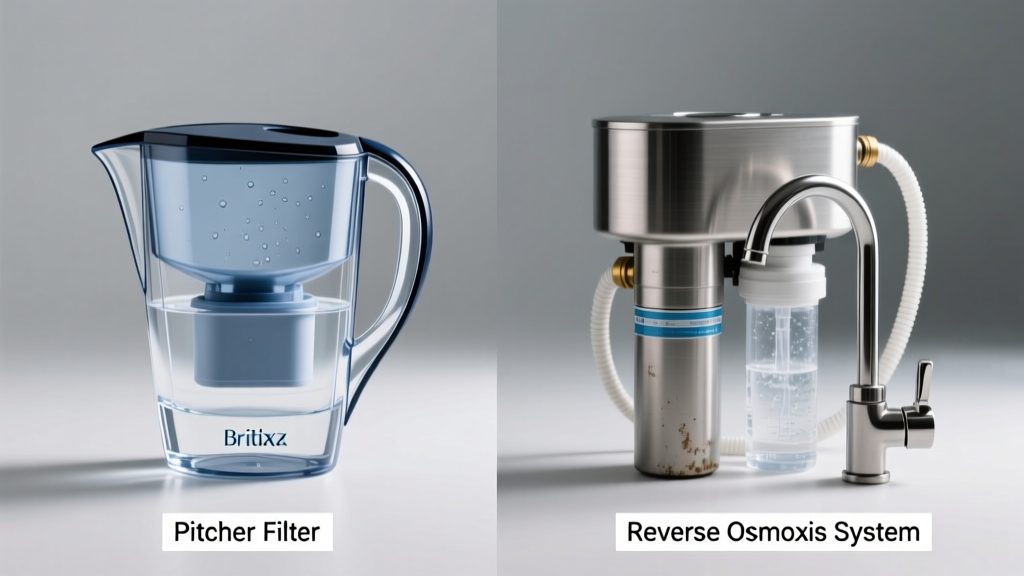
Choosing between a pitcher filter and a reverse osmosis (RO) system feels like picking between a bicycle and a sedan—both get you where you need to go, but they serve very different needs, budgets, and water conditions. If your tap water has visible cloudiness, metallic taste, or known contaminants like lead or nitrates, the decision isn’t just about convenience—it’s about health, long-term cost, and what your local water report actually says.
Quick Verdict
A pitcher filter is ideal for renters, small households, or those needing basic chlorine and sediment reduction on a tight budget. Reverse osmosis delivers lab-grade purification—removing up to 99% of dissolved solids, heavy metals, fluoride, and pharmaceuticals—but requires installation, ongoing maintenance, and produces wastewater. According to the Water Quality Association’s 2022 Consumer Survey, 68% of RO users cited improved taste and confidence in safety as top motivators, while 73% of pitcher users prioritized portability and zero installation.
Side-by-Side Comparison
| Feature | Pitcher Filter | Reverse Osmosis System |
|---|---|---|
| Upfront cost | $25–$45 | $150–$600+ |
| Installation | None — ready in seconds | Under-sink plumbing required; often needs professional help |
| Filtration capacity | 40–120 gallons per filter (2–3 months) | 50–75 gallons per day; membranes last 2–3 years |
| Contaminants removed | Chlorine, zinc, copper, some lead, sediment | Lead, arsenic, fluoride, nitrate, PFAS, bacteria, viruses (with optional UV) |
| Wastewater ratio | None | Typically 3–4 gallons wasted per 1 gallon purified |
| Certifications | NSF/ANSI 42 & 53 (varies by model) | NSF/ANSI 58 (RO-specific); many also certified to NSF 42, 53, and 401 |
Deep Dive on Pitcher Filters
Pitcher filters are the most accessible entry point into home water treatment. They use activated carbon and sometimes ion exchange resin to reduce chlorine, bad tastes, odors, and select heavy metals like lead (e.g., Brita Longlast+ reduces up to 99% of lead per NSF 53 testing). Their simplicity is their strength—and their limitation.
- Pros: No tools, no plumbing, no electricity; easy to store or travel with; replacement filters cost $15–$30 every 2–3 months
- Cons: Limited capacity (most pitchers hold 10 cups max); no removal of fluoride, nitrates, or dissolved minerals like calcium/magnesium; performance drops sharply if filters aren’t changed on schedule
- Ideal for: Apartments without sink access, college dorms, light-use kitchens, or households with municipally treated water that meets EPA standards but has minor taste issues
According to the U.S. EPA estimates that 14% of household water usage is from leaks—but pitcher users rarely track flow rate or pressure changes, making it easy to overlook when filtration efficiency declines. That’s why
"If you’re not changing your pitcher filter every 40 gallons—or roughly every 2 months with average use—you’re likely drinking less-clean water than you assume," says Dr. Lena Cho, environmental engineer and co-author of the AWWA’s 2023 Residential Filtration Review.
Deep Dive on Reverse Osmosis Systems
RO systems force water through a semi-permeable membrane under pressure, removing ions, molecules, and larger particles. Most include pre-filters (sediment + carbon), the RO membrane, and a post-carbon polish. High-end models add remineralization stages or smart monitoring—like the APEC RO-90, which tracks filter life and TDS in real time.
- Pros: Removes >99% of total dissolved solids (TDS); validated against over 50 contaminants including chromium-6, PFOS, and uranium; improves coffee and cooking water clarity significantly
- Cons: Requires under-sink space and drilling; wastes 3–4x more water than it purifies; removes beneficial minerals (calcium, magnesium); slower flow rate (~0.5 gpm typical)
- Ideal for: Homes with well water, high-TDS municipal supplies (e.g., >300 ppm), families with infants or immunocompromised members, or anyone tracking contaminants via third-party lab reports
When to Choose Pitcher Filter vs Reverse Osmosis
Your choice hinges on three things: your water test results, your tolerance for setup and upkeep, and how much you value mineral retention versus purity.
- If your city water report shows only chlorine and low-level lead (<5 ppb), and you drink <2 liters/day, a pitcher is sufficient—and far more sustainable.
- If your well water tests positive for nitrates (>10 mg/L) or arsenic (>10 ppb), RO isn’t optional—it’s medically advised (per CDC 2022 guidelines).
- Renters who can’t modify plumbing should skip RO unless using a countertop RO unit (e.g., Home Master TMULPF), though those still require a dedicated faucet and drain connection.
- Households with hard water (>7 gpg) need a water softener *before* RO—not instead of—to prevent membrane scaling and premature failure.
Alternatives to Consider
Neither option fits every situation. Consider these middle-ground solutions:
- Faucet-mounted filters (e.g., PUR FM-3700B): More effective than pitchers, easier to install than RO, but limited to one tap and require frequent cartridge swaps.
- Under-sink carbon block systems (e.g., Aquasana Claryum): Remove chlorine, VOCs, and lead without wasting water or stripping minerals—certified to NSF 42/53 but not NSF 58.
- Distillation units: Lab-grade purity, zero wastewater, but energy-intensive and slow (1 gallon/hour); best for small-batch lab or medical use, not daily kitchen use.
Do pitcher filters remove microplastics?
Some do—but inconsistently. The ZeroWater pitcher (certified to NSF 42) removes microplastics down to 1 micron, while standard Brita filters don’t claim microplastic reduction. Independent testing by Orb Media found only 2 of 11 popular pitchers reduced >90% of 2.5-micron particles.
Does reverse osmosis remove fluoride—and should it?
Yes—RO typically removes 85–92% of fluoride (per NSF 58 test data). Whether that’s desirable depends on your dental health context. The American Dental Association still recommends community fluoridation at 0.7 ppm, so removing it entirely may increase cavity risk—especially for children. Some RO systems now offer optional remineralization with fluoride-safe blends.
How often do I really need to replace RO membranes?
Every 2–3 years—if pre-filters are changed religiously every 6 months and feed water TDS stays below 500 ppm. In areas like Phoenix or Las Vegas (TDS >700 ppm), membranes may fail in 12–18 months. Always monitor your system’s TDS meter: a rise of >15% over baseline signals membrane fatigue.
Can I use a pitcher filter with well water?
Not safely—unless you’ve tested for bacteria, iron, hydrogen sulfide, or coliform first. Pitchers lack microbiological protection. Even with “lead-reduction” claims, they won’t stop E. coli or Giardia. For untreated well water, start with a whole-house sediment + UV system, then add RO or carbon as needed.
Why does my RO water taste flat?
Because RO strips nearly all dissolved minerals—including bicarbonates that buffer pH and contribute to mouthfeel. This isn’t harmful, but it can feel “empty.” Try adding a pinch of Himalayan salt or using an RO system with a remineralization cartridge (e.g., iSpring RCC7AK) to restore balanced alkalinity and flavor.
Are pitcher filters recyclable?
Most aren’t—though Brita and PUR now partner with TerraCycle for free mail-back programs (available in 48 states). RO filter housings and membranes are rarely recycled locally; however, some manufacturers like APEC accept used membranes for refurbishment. Always check your brand’s take-back policy before disposal.
There’s no universal “better”—only what’s better *for your water*, *your space*, and *your priorities*. If your goal is simplicity and modest improvement, a pitcher earns its place on the counter. If your water carries documented risks or you demand maximum contaminant removal, RO is the proven benchmark—even with its trade-offs. Whichever you choose, pair it with a reliable water quality report interpretation and regular retesting every 12–24 months to stay ahead of changing conditions.