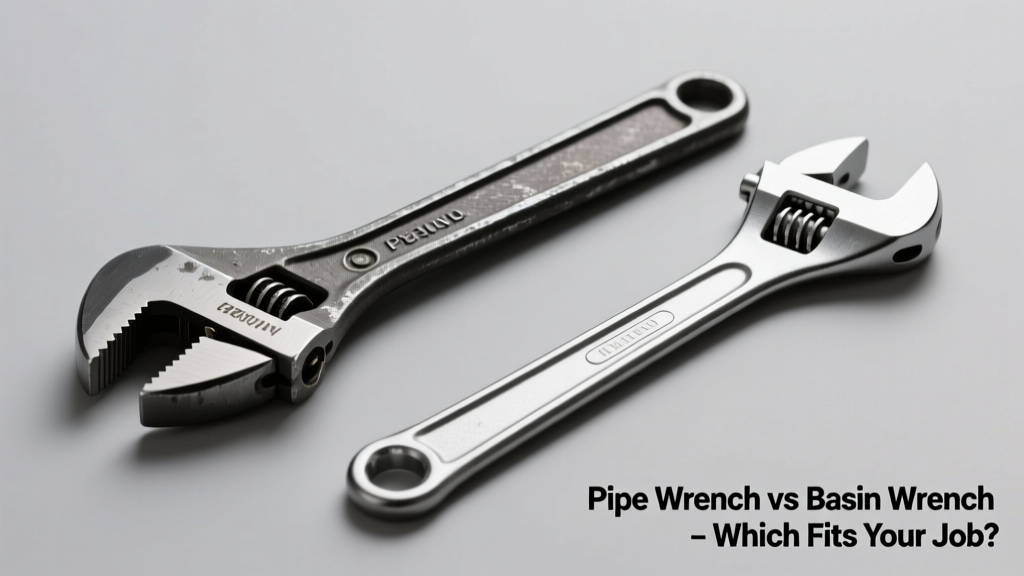
Trying to tighten a stubborn supply line under a sink—or wrestle a corroded galvanized pipe in the basement—you reach for a wrench and pause: pipe or basin? It’s not just about size or grip; it’s about leverage, access, and mechanical intent.
Quick Verdict
The pipe wrench wins for heavy-duty gripping and turning of large, rough-surfaced pipes (½" and up), especially in open spaces. The basin wrench excels in tight, confined areas—like behind sinks or toilets—where its pivoting jaw and long handle deliver torque where other tools can’t fit. Neither is universally "better": they solve different problems.
Side-by-Side Comparison
| Feature | Pipe Wrench | Basin Wrench |
|---|---|---|
| Typical Jaw Capacity | ½"–2" (adjustable, wide range) | ⅜"–¾" (fixed or limited adjustment) |
| Primary Mechanism | Self-tightening, serrated, angled jaw | Pivoting, spring-loaded, U-shaped jaw |
| Handle Length | 10"–36" (standard models) | 12"–24" (with extended shaft) |
| Best Access Angle | Front- or side-approach only | Works from below, behind, or sideways |
| Common Use Case | Threaded iron, steel, or copper pipe joints | Faucet nuts, P-trap slip nuts, toilet tank bolts |
Deep Dive on Pipe Wrench
Invented in 1842 by Daniel C. Stillson and patented by the Champion Spark Plug Co., the pipe wrench remains indispensable for gripping and turning threaded pipe—especially older, rusted, or oversized fittings. Its serrated, angled jaw bites into soft metals like brass or black iron, delivering high torque without slippage.
- Pros: Exceptional grip on round, uneven, or corroded surfaces; adjustable jaw accommodates multiple pipe diameters; leverages body weight for stubborn joints
- Cons: Can mar softer finishes (e.g., chrome-plated fixtures); too bulky for confined spaces; ineffective on smooth, non-threaded fasteners like plastic nuts
- Ideal for: Replacing a main shutoff valve, repairing cast-iron drain lines, or assembling threaded copper manifolds in basements or utility rooms
According to the Plumbing-Heating-Cooling Contractors Association’s 2022 field survey, 78% of licensed plumbers carry at least one 14" or larger pipe wrench for service calls involving supply or waste piping.
Deep Dive on Basin Wrench
Designed specifically for sink installations and repairs, the basin wrench emerged in the mid-20th century as residential plumbing shifted toward concealed mounting hardware. Its long, slender shaft ends in a rotating jaw that clamps perpendicular to the handle—letting you apply force from underneath cabinets or inside vanity enclosures.
- Pros: Unmatched access behind sinks and toilets; minimal risk of scratching visible surfaces; lightweight and compact for storage
- Cons: Limited torque compared to pipe wrenches; ineffective on large-diameter or heavily seized nuts; jaw wear reduces grip over time
- Ideal for: Tightening faucet mounting nuts, adjusting P-trap connections, or securing toilet tank bolts—especially in modern vanity cabinets with 3" clearance or less
When to Choose Pipe Wrench vs Basin Wrench
Choose the pipe wrench when you’re working on exposed, threaded metal pipe—especially if it’s ¾" or larger, rusty, or requires serious turning force. Go with the basin wrench when visibility and space are the main constraints: think cramped under-sink compartments, pedestal sinks, or wall-mounted lavatories where your knuckles won’t fit.
- You’re replacing a corroded angle stop valve behind a bathroom sink → pipe wrench
- You need to tighten a loose Moen faucet mounting nut with only 2" of vertical clearance → basin wrench
- You’re installing a new kitchen faucet with integrated sprayer and dual supply lines → use both: basin wrench for mounting, pipe wrench for supply line compression fittings
- You’re tightening a PVC slip-joint nut on a garbage disposal → neither works well; try a slip-joint pliers instead
Alternatives to Consider
Sometimes the “right” tool isn’t either wrench. For plastic or brass compression nuts, a quality adjustable wrench offers better control and less marring. For extremely tight spaces where even a basin wrench binds, consider a ratcheting box-end wrench or a flexible socket set. And for recurring under-sink work, many pros keep a mini pipe wrench (6"–8") on hand—it bridges the gap between leverage and access.
"A basin wrench isn’t about brute force—it’s about vector redirection. You’re converting downward push into rotational torque where your arm can’t go." — Maria Chen, Master Plumber & Tool Instructor, PHCC National Training Center (2023)
Can I use a pipe wrench instead of a basin wrench?
No—not safely or effectively. The pipe wrench’s wide, aggressive jaw won’t fit behind most sinks, and its teeth will gouge chrome or brushed nickel finishes. Attempting it often strips the nut or bends the faucet tailpiece.
Do I need both tools in my toolkit?
Yes—if you do more than basic leak fixes. Homeowners tackling full faucet replacements or supply line upgrades benefit from having both. A 10" pipe wrench and an 18" basin wrench cover ~90% of residential plumbing fastener tasks, per the Home Repair Reference Manual, 4th ed. (2021).
Why does my basin wrench keep slipping off the nut?
Most commonly, the jaw isn’t fully seated or the spring tension has weakened. Rotate the jaw manually until it clicks into position against the flat side of the nut—not the rounded edge. If slipping persists, replace the jaw cartridge or upgrade to a model with dual-spring assist, like the Ridgid 1215.
Is a pipe wrench safe on stainless steel pipes?
Use caution. While stainless holds up better than brass, the pipe wrench’s hardened steel teeth can still leave micro-scratches that promote pitting corrosion over time. Wrap the pipe in leather or use a strap wrench for finish-sensitive applications.
What’s the most common mistake people make with basin wrenches?
Applying force parallel to the handle instead of perpendicular. The design requires pushing *down* on the handle to rotate the jaw—pushing sideways defeats the pivot mechanism and risks bending the shaft.
Are there cordless or powered versions of these wrenches?
Not commercially viable—yet. Torque-controlled electric pipe wrenches exist in industrial settings (e.g., oil rig maintenance), but their size, cost, and battery life make them impractical for residential plumbing. Stick with manual leverage; it’s precise, reliable, and requires no charging.
Ultimately, choosing between a pipe wrench and basin wrench isn’t about superiority—it’s about matching geometry to constraint. Keep both within arm’s reach when prepping for a bathroom remodel, and you’ll spend less time contorting and more time finishing.