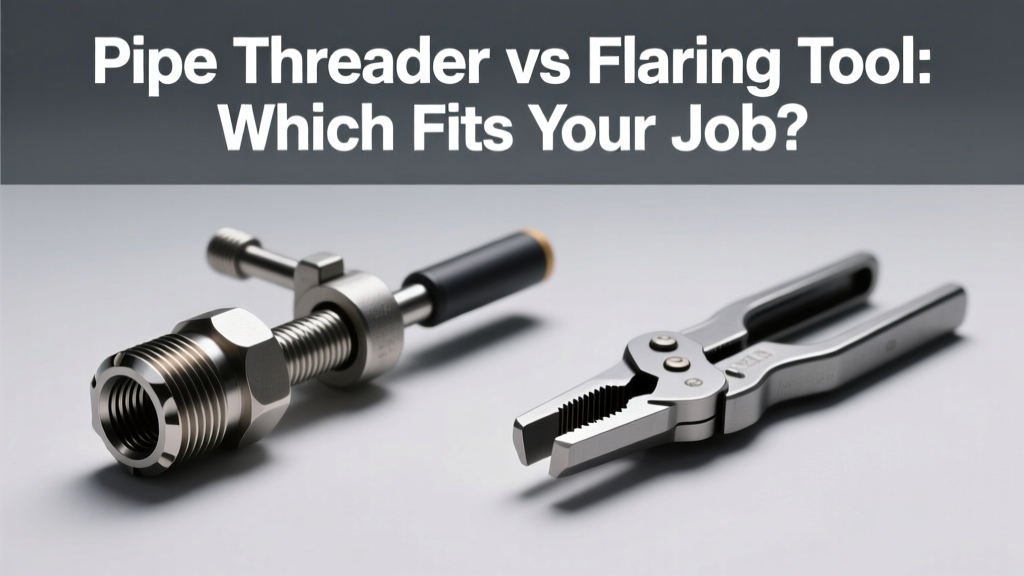
You’re standing in front of a plumbing job—copper tubing for a new bathroom line, or maybe galvanized steel for a gas line retrofit—and you’re stuck: do you cut threads or flare the end? Both tools create secure, leak-free connections, but they serve fundamentally different materials, systems, and skill levels. Choosing wrong means rework, leaks, or scrapped fittings.
Quick Verdict
A pipe threader is essential for rigid metal pipes like black iron or galvanized steel used in gas, water, or steam lines—but it’s overkill and unsafe for soft tubing. A flaring tool is the only safe, reliable option for soft copper or aluminum tubing in refrigeration, fuel lines, or compressed air systems. Neither is ‘better’ universally; the right tool depends entirely on your material, code requirements, and application pressure.
Side-by-Side Comparison
| Feature | Pipe Threader | Flaring Tool |
|---|---|---|
| Primary Use Material | Galvanized steel, black iron, stainless steel pipe (½"–2") | Copper, aluminum, or brass tubing (⅜"–¾") |
| Connection Type | NPT (tapered) threaded joint with sealant or tape | Compression-style flared joint (45° or 37° bevel) |
| Required Skill Level | Moderate to high—requires torque control, alignment, and cleanup of burrs | Low to moderate—consistent results with practice; less risk of cross-threading |
| Typical Pressure Rating | Up to 1,200 psi (per ASTM A53 pipe specs) | Up to 6,000 psi for annealed copper Type L (per ASME B31.5) |
| Code Compliance | Required for gas distribution per NFPA 54 (2023), Section 4.13 | Mandated for refrigerant lines per IMC 2021, Section 1103.2 |
Deep Dive on Pipe Threader
Pipe threaders cut external NPT (National Pipe Taper) threads onto the end of rigid pipe. Manual ratcheting models like the RIDGID 11-R cost $180–$250; electric versions like the RYOBI P310 run $299–$399 and handle up to 2" pipe in under 30 seconds.
- Pros: Creates reusable, code-compliant joints for gas and high-pressure water; works with standard pipe wrenches and die stocks; threads can be inspected visually for completeness.
- Cons: Generates metal shavings that must be flushed from the system—failure causes valve failure (per ASHRAE Guideline 3-2022); not usable on thin-walled or non-ferrous pipe; requires precise alignment to avoid crooked threads.
- Ideal use cases: Installing gas lines to furnaces or water mains; retrofitting old cast-iron drain stacks with threaded adapters; municipal fire sprinkler branch lines.
According to the Insurance Institute for Business & Home Safety's 2023 report on mechanical joint failures, improperly cut or misaligned pipe threads accounted for 22% of field-reported gas leaks in residential retrofits—underscoring why a quality die head and steady hand matter more than speed.
Deep Dive on Flaring Tool
Flaring tools compress tubing ends into conical shapes—either 45° SAE (for automotive fuel/brake lines) or 37° AN (for aerospace and high-vibration applications). Hand-operated kits like the IWISS FLM-100 start at $35; hydraulic flaring presses like the Mastercool 92400 cost $425 and ensure repeatable 0.002" tolerance.
- Pros: No cutting debris; forms a smooth, leak-tight seal without thread sealant; works on annealed copper as thin as 0.035" wall; compatible with compression fittings and flare nuts.
- Cons: Tubing must be perfectly cut square—any deviation causes uneven flares and leaks; over-flaring cracks the tube edge; incompatible with schedule 40 PVC or CPVC.
- Ideal use cases: Installing split-system AC refrigerant lines; connecting propane tanks to RV appliances; building custom brake lines for classic cars.
When to Choose Pipe Threader vs Flaring Tool
Select a pipe threader if you’re working with rigid, thick-walled pipe and need a permanent, field-serviceable joint governed by mechanical piping codes. Choose a flaring tool when you’re handling soft, thin-walled tubing where vibration resistance and zero debris are critical—and especially when working with refrigerants or fuels where sealant contamination is unacceptable.
"Flaring isn’t just about making a connection—it’s about eliminating variables. One burr inside a refrigerant line can clog an expansion valve in under 48 hours." — James Lin, HVAC Field Trainer, Refrigeration Service Engineers Society (RSES), 2022
Also consider: local inspectors often reject threaded joints on copper tubing—even if technically possible—because they violate IMC 2021 Section 1103.1.2, which prohibits threading soft metals unless specifically listed for that use.
Alternatives to Consider
Neither tool fits every scenario. Here are three practical alternatives:
- Compression fittings: Ideal for quick repairs on copper or PEX—no special tools needed, but not approved for gas or buried lines per UPC 608.3.
- Push-to-connect fittings: Great for DIY water shutoffs or under-sink repairs, but limited to 200 psi max and incompatible with chlorine-heavy municipal water per Zurn Technical Bulletin #T-117 (2023).
- Swaging tools: Used for creating bead-type seals on aluminum A/C lines—common in mobile HVAC—but require precise tube wall thickness matching.
Can I flare threaded pipe?
No. Threading and flaring are mutually exclusive processes. Threaded pipe has thick, rigid walls designed for die-cut tapers—not ductile deformation. Attempting to flare it will crack or split the pipe end.
Do I need both tools in my kit?
Only if your work spans both residential gas service (threading) and HVAC installation (flaring). Most licensed plumbers carry both; skilled HVAC techs rarely need a pipe threader unless doing gas meter tie-ins.
Is a flaring tool necessary for PEX tubing?
No—PEX uses crimp, clamp, or push-fit connections. Flaring tools are designed exclusively for metal tubing. Using one on PEX will crush or deform the polymer wall.
Why do some flaring tools have dual-angle dies?
Because 45° SAE flares (used in automotive) and 37° AN flares (used in aircraft and hydraulics) aren’t interchangeable. Mixing them causes incomplete sealing and catastrophic joint failure under pressure—verified in SAE Aerospace Standard AS568A (2021).
Can I rent these tools instead of buying?
Yes—Home Depot rents manual pipe threaders ($22/day) and basic flaring kits ($14/day). But rental units often lack calibration checks; for refrigerant work, EPA 608 certification requires documented tool maintenance logs, making ownership preferable for pros.
What’s the most common beginner mistake with flaring?
Cutting the tube with a hacksaw instead of a tubing cutter. Even slight angles or burrs cause uneven flares. Always deburr both inside and outside edges with a dedicated reamer—never sandpaper or a file.
If your next job involves black iron gas pipe, reach for the die stock. If it’s ⅝" copper refrigerant line snaking through a tight attic chase, grab the flaring tool—and double-check your cutter’s alignment first. Matching tool to material isn’t just best practice—it’s what keeps systems running, inspectors happy, and customers dry.