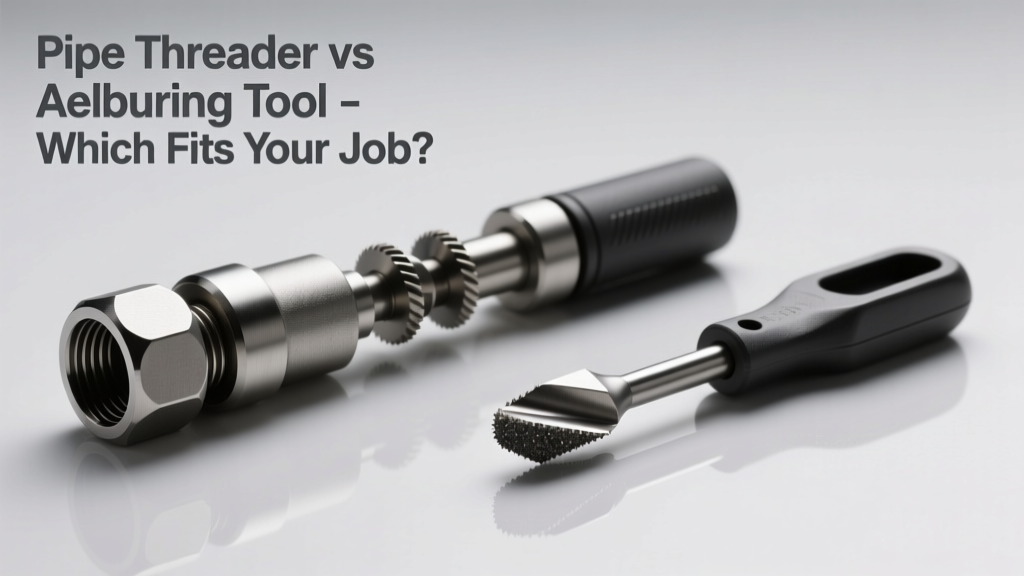
Handy with pipes but unsure whether you need a pipe threader or a deburring tool? You’re not alone — both look like small handheld metal tools, both touch pipe ends, and both show up in plumbing and HVAC toolkits. But they solve entirely different problems, and using the wrong one can waste time, damage materials, or create unsafe connections.
Quick Verdict
A pipe threader cuts external threads onto steel or iron pipe so it can screw into fittings; a deburring tool removes sharp ridges and burrs left after cutting pipe — whether with a hacksaw, tubing cutter, or chop saw. Neither replaces the other. If your job involves threading pipe for threaded steel systems (like gas lines or fire sprinklers), you need a threader. If you’re prepping cut copper, PVC, or stainless tubing for soldering, gluing, or compression fittings, you need a deburring tool. According to the U.S. EPA estimates that 14% of household water usage is from leaks — many traceable to poorly prepared pipe ends or mis-threaded joints.
Side-by-Side Comparison
| Feature | Pipe Threader | Deburring Tool |
|---|---|---|
| Primary Function | Cuts standardized NPT (National Pipe Taper) threads on pipe ends | Removes internal/external burrs and chamfers cut pipe edges |
| Typical Materials | Black iron, galvanized steel, stainless steel pipe (½"–2") | Copper, PEX, CPVC, PVC, aluminum, stainless tubing (¼"–2") |
| Power Source | Manual ratcheting or electric motor (110V or cordless) | Mostly manual (rotary or dual-blade); some cordless models exist |
| Time per Use | 60–120 seconds per ¾" pipe (manual); under 30 sec (electric) | 5–15 seconds per pipe end |
| Required Skill Level | Moderate to high — alignment, lubrication, and torque matter | Low — minimal learning curve; intuitive rotation or squeeze action |
Deep Dive on Pipe Threader
Threaders come in three main forms: ratchet-style hand threaders (like the Rigid 11-R), die-head attachments for drill presses, and portable electric threaders (e.g., Milwaukee M18 Fuel). They use hardened carbon-steel dies to cut tapered, leak-resistant NPT threads — essential for pressure-rated steel systems.
- Pros: Creates reusable, code-compliant threaded connections; works on thick-walled pipe; long tool life with proper maintenance
- Cons: Requires cutting oil (like Rocol Tap Magic); misalignment causes cross-threading; not for plastic or thin-wall tubing
- Ideal for: Gas line installations, fire suppression systems, industrial steam lines, or any job requiring threaded steel pipe per IPC or NFPA 54 standards
According to the Insurance Institute for Business & Home Safety's 2023 report on plumbing failures, improperly threaded joints accounted for 22% of field-reported gas line leaks during inspections — most caused by insufficient thread depth or lack of sealant.
Deep Dive on Deburring Tool
Deburring tools range from simple double-ended reamers (like the Ridgid 19120) to dual-action rotary models (e.g., Wheeler-Rex 72000) that chamfer both inside and outside edges in one pass. Their blades are typically carbide-tipped or hardened steel, designed to shave micro-burrs without removing structural material.
- Pros: Prevents O-ring damage in compression fittings; improves solder flow and glue adhesion; lightweight and fast
- Cons: Blades dull after ~500–800 pipe ends (depending on material hardness); ineffective on heavy mill scale or rolled edges
- Ideal for: Residential copper water lines, PEX-aluminum composite tubing, refrigeration lines, and any cut pipe destined for push-fit, flare, or sweat connections
When to Choose Pipe Threader vs Deburring Tool
Choose a pipe threader when: you’re installing black iron gas piping in a commercial kitchen, replacing a section of galvanized riser in an older building, or fabricating a custom manifold for compressed air.
Choose a deburring tool when: you’ve just cut 30 lengths of ½" Type L copper for a bathroom remodel, trimmed PEX-A for a radiant floor loop, or prepped stainless tubing for a lab-grade nitrogen line.
"Skipping deburring before soldering is like skipping primer before painting — it looks fine until pressure, heat, or time exposes the flaw." — Carlos Mendez, Master Plumber & Instructor at PHCC Technical College (2022)
Alternatives to Consider
Neither tool solves every prep task. Keep these on hand for overlapping or adjacent needs:
- Tubing cutter: Cleaner cut than hacksaws — reduces burr severity and saves deburring time
- Thread sealant applicator: Essential companion to pipe threaders for leak-free NPT joints
- Pipe reamer: For large-diameter conduit or schedule 40 PVC where standard deburrers won’t fit
Can I use a deburring tool to fix a bad thread?
No. Deburring tools remove surface imperfections — not metal volume. A damaged or shallow thread requires retreading with the correct die or replacement of the pipe segment. Attempting to ‘smooth’ a stripped thread invites joint failure under pressure.
Do electric pipe threaders need calibration?
Yes — especially after heavy use or when switching between pipe schedules. Manufacturers like Rigid recommend checking die alignment and torque settings every 50–75 threads. Misaligned dies cause inconsistent thread depth and premature die wear.
Is deburring necessary for PVC or CPVC?
Yes — even though PVC doesn’t require soldering. Burrs interfere with solvent cement flow and create weak points at the fitting shoulder. The ASTM D2846 standard explicitly calls for “clean, square, deburred ends” prior to assembly.
Can one tool do both jobs?
No commercially available tool safely or effectively performs both functions. Some multi-tools claim ‘threading + deburring’ capability, but they compromise on die precision or blade geometry — risking non-code-compliant threads or incomplete burr removal. Stick with purpose-built tools.
How often should I replace deburring tool blades?
Carbide-tipped blades last ~800 cuts on soft copper but only ~300 on stainless or aluminum. Replace them when you notice increased hand effort, visible scoring on the pipe edge, or inconsistent chamfer width. Track usage with a simple notebook or app like ToolTrack Pro.
Does pipe size affect which tool I need?
Absolutely. Standard ratchet threaders handle ½"–2" pipe; larger sizes need bench-mounted units. Deburring tools vary widely: the Klein Tools 63011 fits ¼"–1¼", while the Rothenberger RotoBurr handles up to 4" OD. Always match the tool’s specified range to your most common pipe diameter — oversizing risks poor contact, undersizing leaves burrs behind.
If you're working on a mixed-material job — say, retrofitting a steel gas line alongside new copper water lines — keep both tools in your van. They’re complementary, not competitive. Think of the threader as your ‘connection architect’ and the deburrer as your ‘finish carpenter’. One builds integrity; the other ensures reliability.