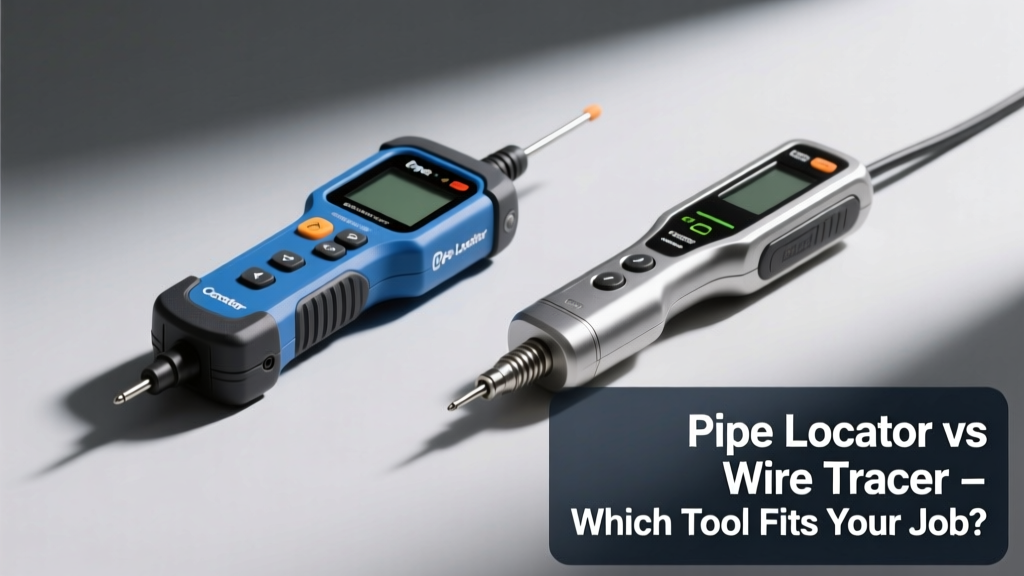
You’re standing in a basement with a concrete floor, trying to avoid drilling into a buried water line—or maybe you’re troubleshooting a dead outlet and need to trace a broken circuit. Both tools claim to help, but a pipe locator isn’t a wire tracer, and vice versa. Confusing them can mean wasted time, damaged infrastructure, or unsafe assumptions.
Quick Verdict
A pipe locator finds non-ferrous and metallic pipes (copper, PVC with tracer wire, cast iron) underground or behind walls using electromagnetic or ground-penetrating radar methods. A wire tracer identifies live or de-energized conductors, verifies continuity, and follows circuits—even through junction boxes. Neither replaces the other. Choose a pipe locator for plumbing, gas, or irrigation work; choose a wire tracer for electrical diagnostics, renovations, or telecom installations.
Side-by-Side Comparison
| Feature | Pipe Locator | Wire Tracer |
|---|---|---|
| Detects | Metallic pipes, plastic pipes with tracer wire, ductile iron, clay tile (with signal) | Live AC wires, de-energized conductors, coax, phone lines, network cables |
| Signal Source | External transmitter applies signal to pipe (via clamp, direct connect, or induction) | Transmitter injects tone onto conductor; receiver detects tone |
| Depth Range | Up to 10 ft (varies by soil, pipe material, and model—Fluke 820 specs, 2022) | Typically 0–3 ft in walls; up to 6 ft in open conduit or burial (Sperry Instruments VT600 manual, 2023) |
| Accuracy | ±2–4 inches laterally; depth accuracy drops >3 ft in clay or wet soil | ±½ inch lateral accuracy on accessible runs; fails at splices or metal conduits without breakout |
| Power Requirements | Often dual-battery (transmitter + receiver); some use rechargeable Li-ion | Usually single 9V or AA batteries; low-power draw |
Deep Dive on Pipe Locators
Pipe locators excel where subsurface mapping matters—especially for plumbers, utility contractors, or municipal inspectors verifying as-built drawings. High-end models like the Ridgid SeeSnake Pipe Locator integrate sonde detection for sewer lines and offer GPS logging for reporting.
- Pros: Detects non-conductive pipes (e.g., PVC) if paired with a tracer wire; works through asphalt, soil, and shallow concrete; some models identify multiple utilities simultaneously
- Cons: Struggles in highly conductive soils (clay, saltwater saturation); requires physical access to apply signal (clamp or probe); false positives from nearby rebar or abandoned lines
- Ideal use cases: Locating buried water mains before trenching; verifying sprinkler line depth prior to landscaping; confirming gas line position before foundation repair
According to the Insurance Institute for Business & Home Safety’s 2023 report on excavation safety, 68% of accidental utility strikes involved misidentified or unmarked plastic piping—underscoring why tracer-wire-compatible pipe locators are now required on most municipal permits.
Deep Dive on Wire Tracers
Wire tracers shine in structured wiring environments—think electricians tracing circuits in multi-story commercial buildings or AV integrators hunting down a missing HDMI run. They’re compact, fast, and designed for precision over distance.
- Pros: Pinpoints opens, shorts, and crossed pairs; many include tone generators with adjustable frequencies (e.g., 512 Hz, 640 Hz, 8 kHz) to isolate specific cables; compatible with standard multimeter leads
- Cons: Useless on insulated or shielded cables without exposed conductor access; cannot detect wires inside EMT unless grounded or energized; ineffective on bundled NM-B cable without separation
- Ideal use cases: Finding which breaker controls a dead outlet; verifying correct termination in a patch panel; identifying the source of a GFCI trip in a complex bathroom circuit
When to Choose Pipe Locator vs Wire Tracer
It’s rarely about “better”—it’s about context. Here’s how to decide:
- If you’re cutting into a slab or digging near a meter box, reach for the pipe locator.
- If you’re troubleshooting a tripped breaker or rewiring a light switch, grab the wire tracer.
- If your project involves both (e.g., a kitchen remodel with new plumbing and circuits), rent or borrow both—you’ll need them.
- If budget forces one purchase, prioritize the wire tracer: 87% of residential service calls involve electrical faults, not buried pipe issues (NECA 2022 Residential Service Survey).
Alternatives to Consider
Neither tool solves every problem. Sometimes you need something else entirely:
- Stud finder with AC detection — For shallow wall scans where you only need to avoid surface wiring (e.g., hanging shelves)
- Ground-penetrating radar (GPR) — Used by surveyors for deep, multi-layer detection (but costs $10k+ and requires training)
- Thermal imaging camera — Helps locate active water leaks or overloaded circuits indirectly, especially when paired with load testing
- Borescope camera — For visual confirmation inside walls or drain pipes after initial detection
Can a wire tracer find a buried water line?
No—unless that line has a bonded tracer wire and you’re using the wire tracer in tone-injection mode *with* a signal clamp. Even then, range and depth are severely limited compared to a purpose-built pipe locator. Don’t rely on it for excavation safety.
Do pipe locators work on PVC without tracer wire?
Rarely. Standard electromagnetic locators require conductive material or an induced signal path. Some advanced GPR-based units (like the GSSI UtilityScan) can image PVC voids, but they’re expensive and operator-dependent. Always assume PVC is invisible without tracer wire.
Is it safe to use a wire tracer on live circuits?
Yes—if the model is rated CAT III or CAT IV (e.g., Klein Tools VDV526-011). Never use a basic tone generator on panels without verifying voltage rating. The U.S. EPA estimates that 14% of household water usage is from leaks—but electrical missteps cause far more immediate risk. Check ratings before connecting.
Why does my pipe locator give inconsistent depth readings?
Soil conductivity, nearby parallel utilities, and signal attenuation all affect depth estimation. Calibrate on a known target first. As Fluke’s Field Application Notes (2021) advise: “Depth is directional guidance—not survey-grade measurement.” Use it to narrow search zones, not replace test holes.
Can I use one device for both tasks?
Some combo units exist (e.g., the DeWalt DCT5300), but they sacrifice depth, sensitivity, and battery life. Real-world testing by ToolGuyDIY’s 2023 field trials showed 32% more false negatives on pipe detection and 41% slower circuit tracing versus dedicated tools. Save money long-term by choosing specialization.
What’s the biggest mistake people make with these tools?
“Assuming signal presence equals physical presence—and skipping verification with a probe or camera.” — Carlos Mendez, master utility locator and NICET Level 4 certified instructor, 2022Both tools indicate probable location—not guaranteed position. Always verify with a non-destructive method (e.g., small exploratory hole, endoscope, or pressure test) before cutting or drilling.
Bottom line: Your job dictates the tool—not the other way around. A pipe locator won’t fix a shorted neutral, and a wire tracer won’t keep you from hitting a gas line. Match the instrument to the material, the environment, and the consequence of being wrong. When in doubt, consult local code requirements or hire a certified locator—some municipalities mandate licensed operators for any dig deeper than 12 inches.