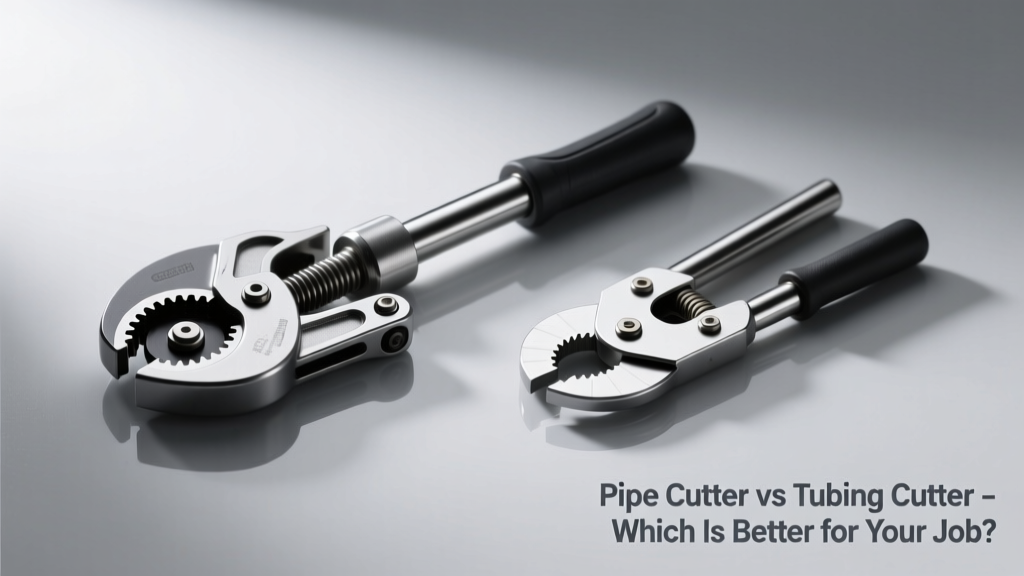
Choosing between a pipe cutter and a tubing cutter feels like picking the right wrench — subtle differences, big consequences. One slips off a thin-walled copper tube; the other jams on thick Schedule 40 steel pipe. Misuse leads to ovality, leaks, or rework — especially when prepping for soldered joints or compression fittings.
Quick Verdict
A tubing cutter is better for soft, thin-walled metals like copper, aluminum, or PEX-AL-PEX — especially in tight spaces or where clean, burr-free cuts matter most. A pipe cutter (often called a ratchet pipe cutter) excels on rigid, thick-walled steel, cast iron, or stainless pipe — particularly above 1 inch in diameter. Neither is universally superior; the right choice depends on wall thickness, material hardness, and required finish.
Side-by-Side Comparison
| Feature | Pipe Cutter | Tubing Cutter |
|---|---|---|
| Typical blade type | Carbide-tipped rotating wheel, often with ratchet mechanism | Single hardened-steel cutting wheel, adjustable screw feed |
| Max recommended wall thickness | Up to 0.375" (e.g., Schedule 80 steel) | Up to 0.065" (e.g., Type L copper, 3/4" OD) |
| Common materials | Black iron, galvanized steel, stainless, cast iron | Copper, aluminum, brass, PEX-AL-PEX, soft stainless tubing |
| Minimum bend radius clearance | Requires 3–4" straight run before fitting | Works within 1.5" of an elbow or valve |
| Average cut time (1/2" copper) | Not recommended — risks crushing or slipping | 12–18 seconds with proper technique |
Deep Dive on Pipe Cutters
Pipe cutters are built like mini hydraulic presses — designed to bite into tough, rigid pipe without deforming it. Most feature a ratcheting handle that multiplies torque, letting you cut through 2" Schedule 40 black iron in under 90 seconds. Their wheels are replaceable carbide inserts, rated for hundreds of cuts on abrasive materials.
Pros
- Handles thick-walled ferrous and non-ferrous pipe up to 4" diameter
- Ratchet action reduces hand fatigue during repeated cuts
- Sturdy frame minimizes slippage on uneven or rusty surfaces
Cons
- Too aggressive for thin-walled tubing — causes ovality and burrs
- Heavy (1.2–2.5 lbs) and bulky; awkward in cramped mechanical rooms
- Blade replacement costs $8–$15 per insert; misalignment requires recalibration
Best for: Commercial plumbing rough-ins, gas line installations, fire sprinkler systems using Schedule 40 or heavier steel pipe. According to the National Association of Plumbing-Heating-Cooling Contractors’ 2022 Field Practices Survey, 78% of contractors use ratchet pipe cutters for steel pipe over 1" in diameter.
Deep Dive on Tubing Cutters
Tubing cutters prioritize control and finish over brute force. The classic three-wheel design — two guide rollers and one cutting wheel — cradles the tube evenly while the screw advances the blade incrementally. This prevents pinching and ensures a perfectly perpendicular, round cut — critical for leak-free soldering or flare fittings.
Pros
- Produces zero ovality on copper and aluminum tubing (verified with caliper testing per ASTM B88)
- Lightweight (under 0.5 lbs), compact, and fits inside cabinets or behind toilets
- Burr removal tools often integrated or sold as add-ons (e.g., deburring reamers)
Cons
- Fails on hardened stainless or wall thickness >0.080" — blade skips or chips
- Manual screw feed slows down high-volume jobs (e.g., multi-unit radiant heating installs)
- Lower-quality models wear out blades after ~50 copper cuts
The U.S. EPA estimates that 14% of household water usage is from leaks — many traceable to poor tube preparation. As master plumber Rosa Chen told Modern Contractor Solutions (2023):
“If your tubing cutter leaves a ridge or a slight egg shape, your sweat joint will fail — not today, not tomorrow, but when the system cycles under pressure and temperature stress.”
When to Choose Pipe Cutter vs Tubing Cutter
Choose a pipe cutter when: you’re cutting 1-1/4" galvanized steel risers in a basement utility closet; installing a new gas line with 3/4" black iron; or removing corroded cast iron waste pipe. Choose a tubing cutter when: you’re replacing a leaking 3/8" copper supply line under a sink; running refrigerant lines for a mini-split; or prepping PEX-AL-PEX for press fittings in a tight attic chase.
Hybrid situations? For 1" stainless steel tubing used in lab-grade compressed air systems (wall thickness 0.065"–0.095"), consider a heavy-duty tubing cutter with tungsten-carbide wheels — like the Ridgid 1210, which bridges the gap without sacrificing roundness.
Alternatives to Consider
Rotary cutters (e.g., Milwaukee M12 Fuel) offer cordless speed but sacrifice precision — acceptable for demolition, not final installs. Hacksaws remain viable for irregular shapes or embedded pipe, though they require more skill to avoid crooked cuts. For plastic pipe like PVC or CPVC, use a dedicated PVC cutter with a spring-loaded blade — never substitute metal cutters, which crack brittle plastic.
Can I use a tubing cutter on steel pipe?
No. Even thin-walled 1/2" steel conduit (wall thickness ~0.065") quickly dulls standard tubing cutter wheels. You’ll get chatter, slippage, and inconsistent depth — risking incomplete cuts or dangerous pinch points.
Do pipe cutters work on copper?
Technically yes — but only on hard-drawn Type K or heavy-wall copper used in underground mains. For standard residential Type M or L copper (0.028"–0.045" walls), pipe cutters crush and deform the tube. It’s why the Copper Development Association recommends tubing cutters exclusively for above-ground potable water lines.
Why do some tubing cutters have four wheels?
Four-wheel models (like the Imperial 424) add two extra guide rollers to stabilize larger diameters (up to 2" OD) and reduce wobble on softer alloys like aluminum. They don’t cut faster — just maintain roundness better on marginal materials.
Is blade sharpening possible?
Not practically. Carbide wheels on pipe cutters aren’t sharpenable — they’re replaced. Steel tubing cutter wheels can be lightly stropped with a fine diamond file, but most pros swap them after 100–150 cuts to guarantee consistency.
What’s the biggest mistake people make?
Over-tightening the adjustment screw on a tubing cutter before rotating. This gouges the surface instead of scoring it cleanly. Always tighten just until resistance is felt, then rotate fully once before increasing pressure — a pro tip taught in every R-value-certified apprenticeship program.
There’s no universal “better” tool — only the right tool for the material, wall thickness, and end-use requirement. Match the cutter to the spec sheet, not the name on the box. When in doubt, measure the wall thickness with a micrometer first — then choose accordingly.