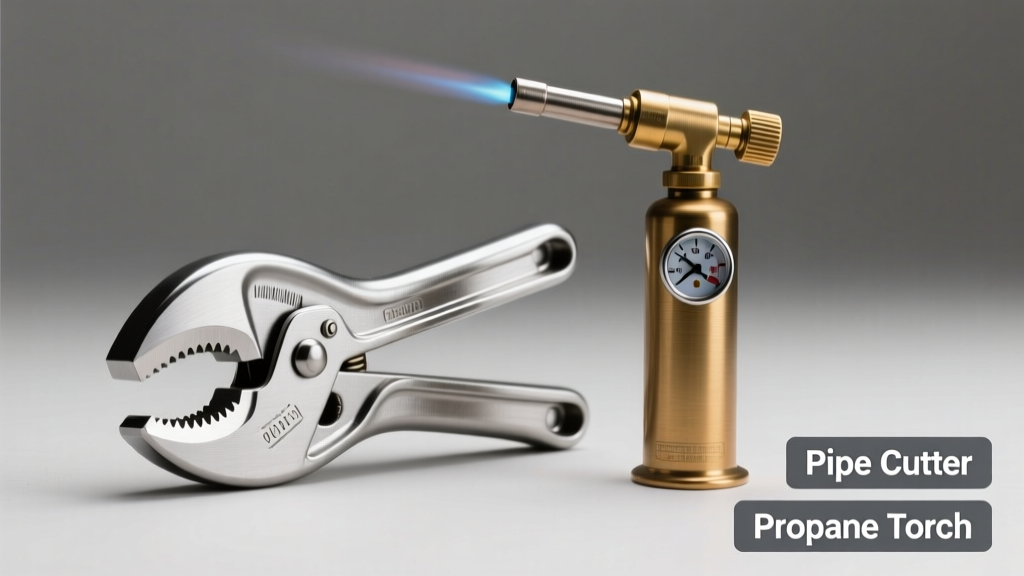
You’re standing in your basement with a leaky copper joint, a stubborn galvanized pipe, or a tight space behind the water heater—and you’re torn: reach for the ratcheting pipe cutter or fire up the propane torch? Both tools get metal pipes cut or joined, but they solve different problems in fundamentally different ways.
Quick Verdict
A pipe cutter is safer, faster, and more precise for clean cuts on accessible copper, PEX, or thin-walled steel pipes—especially indoors or near flammables. A propane torch excels at soldering joints, brazing, or cutting thick ferrous pipe when heat-based removal or fusion is required—but demands ventilation, fire watches, and skill. Neither is universally 'better'; the right tool depends entirely on your material, location, and goal.
Side-by-Side Comparison
| Feature | Pipe Cutter | Propane Torch |
|---|---|---|
| Primary function | Cutting only (mechanical shear) | Cutting, heating, soldering, brazing, bending |
| Typical materials | Copper, PEX, CPVC, thin-walled steel | Copper, steel, cast iron (with proper tip/technique) |
| Time per 1" cut (copper) | 15–25 seconds | 45–90 seconds (plus cooling/safety prep) |
| Indoor-safe (no ventilation needed) | Yes | No — requires active ventilation & fire watch |
| Learning curve | Low — minimal training needed | Moderate to high — technique affects joint integrity & safety |
| Cost (entry-level) | $12–$35 | $25–$80 (torch + regulator + hose + gas) |
Deep Dive on Pipe Cutters
Pipe cutters use a hardened-steel rotating wheel to score and progressively deepen a groove around the pipe circumference until it severs cleanly. Modern ratcheting models (like the Ridgid 10700 or Wheeler-Rex 6000) apply even pressure with each turn—eliminating ovaling or burrs when used correctly.
Pros
- No open flame, no fumes, no fire permits required
- Consistent, square cuts ideal for soldering prep or compression fittings
- Works in confined spaces where torch clearance is impossible (e.g., inside cabinets or stud bays)
- Minimal cleanup — no flux residue, oxide scale, or soot
Cons
- Struggles with heavily corroded, galvanized, or thick-walled black steel pipe
- Cannot join, bend, or flare pipe — strictly a cutting tool
- Blade dulls after ~200–300 cuts on hard copper; replacement wheels cost $4–$8
According to the U.S. EPA estimates that 14% of household water usage is from leaks caused by poor joint prep — often due to uneven cuts from hacksaws or improper torch work. A quality pipe cutter directly reduces that risk by delivering repeatable geometry.
Deep Dive on Propane Torches
A propane torch delivers a focused, adjustable flame (up to 3,600°F) via regulated gas flow. It’s indispensable for capillary soldering of copper joints, brazing steel, annealing brass, or cutting through thick pipe using an oxygen-enriched tip (though standard propane-only tips max out around 1/2" steel).
Pros
- Enables permanent, pressure-rated joints via soldering or brazing
- Can cut, bend, shrink, or loosen seized fasteners with targeted heat
- Effective on rusted or painted pipe where mechanical tools bind
Cons
- Fire hazard: 62% of home fires involving plumbing tools originate from unattended or improperly shielded torches (NFPA Fire Analysis Report, 2022)
- Requires flame-resistant gloves, goggles, and non-combustible shielding — not practical for renters or DIYers without prep space
- Heat can warp nearby PVC, damage drywall paper, or ignite insulation within 18 inches
"A propane torch isn’t a substitute for a pipe cutter—it’s a different category of tool altogether. If your job ends with a cut, use the cutter. If it begins with heat, the torch may be necessary—but never default to flame when shear works." — Carlos M., master plumber and IAPMO instructor since 1998
When to Choose Pipe Cutter vs Propane Torch
Choose a pipe cutter when: replacing a section of accessible 1/2" copper under a sink, installing PEX manifolds, or cutting pipe in an attic with fiberglass insulation nearby. Choose a propane torch when: sweating a new valve into a live 3/4" main line, brazing stainless tubing in a commercial HVAC system, or cutting through a rust-fused 2" cast iron soil stack during a remodel.
For hybrid jobs—like removing a soldered elbow—you’ll often use both: torch to desolder the joint, then cutter to trim back to clean, square ends before reassembly. That workflow appears in how to solder copper pipe and plumbing tools for DIY guides.
Alternatives to Consider
Depending on your pipe type and constraints, these tools may bridge the gap:
- Hacksaw with bi-metal blade: Low-cost, universal, but slow and prone to crooked cuts—still common for galvanized steel in rural installations
- Reciprocating saw with abrasive blade: Fast for demolition cuts on large-diameter pipe, but rough edges require reaming and deburring
- Angle grinder with cutoff wheel: Precise on steel or cast iron, but sparks and noise limit indoor use; requires full PPE
- Tube shear (for PEX/PE-RT): One-handed, no adjustment needed—ideal for radiant floor loops, but useless on metal
For complex multi-material jobs, many pros keep a best plumber tool belt stocked with both a cutter and micro-torch—not as backups, but as purpose-built solutions.
Can I use a pipe cutter on stainless steel?
Yes—but only if it’s thin-walled (e.g., 304 SS tubing under 0.065" wall thickness). Thicker grades quickly dull standard carbon-steel wheels. Use carbide-tipped cutters (like the Rothenberger RotoCut ST) and expect 3–5x longer cut time versus copper.
Is a propane torch safe for PVC or CPVC?
No. Direct flame contact melts or ignites PVC instantly. Even radiant heat from a nearby torch can soften CPVC enough to collapse under pressure. Always cut PVC with a hacksaw or ratchet cutter—and never heat it.
Do I need flux if I’m just cutting with a torch?
No—flux is only required for soldering or brazing to prevent oxidation during heating. Cutting with a torch relies purely on thermal stress fracture or melting, so flux adds zero benefit and creates unnecessary cleanup.
Why does my pipe cutter leave a burr?
Either the cutting wheel is dull (common after 100+ cuts), or you’re over-tightening the knob past the point of clean shear—forcing the wheel to gouge rather than slice. Always deburr with a dedicated reamer (not sandpaper) to avoid embedding grit in the pipe wall.
Can I solder without a torch?
Yes—electric soldering irons work for small-diameter electronics-grade copper, but lack the thermal mass to heat residential 1/2"–1" pipe evenly. Induction soldering tools exist but cost $400+ and remain niche. For standard plumbing, propane or MAPP-gas torches are still the practical standard.
What’s the safest way to store a propane torch?
Store upright in a cool, dry, well-ventilated area away from direct sunlight or ignition sources. Ensure the valve is fully closed and the regulator is detached. NFPA 58 recommends keeping propane cylinders outside or in detached sheds—not garages attached to homes—due to vapor accumulation risk.
At the end of the day, this isn’t about picking a winner—it’s about matching the tool to the physics of the job. A pipe cutter respects geometry; a propane torch commands energy. Use the former when precision and control matter most. Reach for the latter only when heat is the only path forward—and always with respect for what that flame can do.