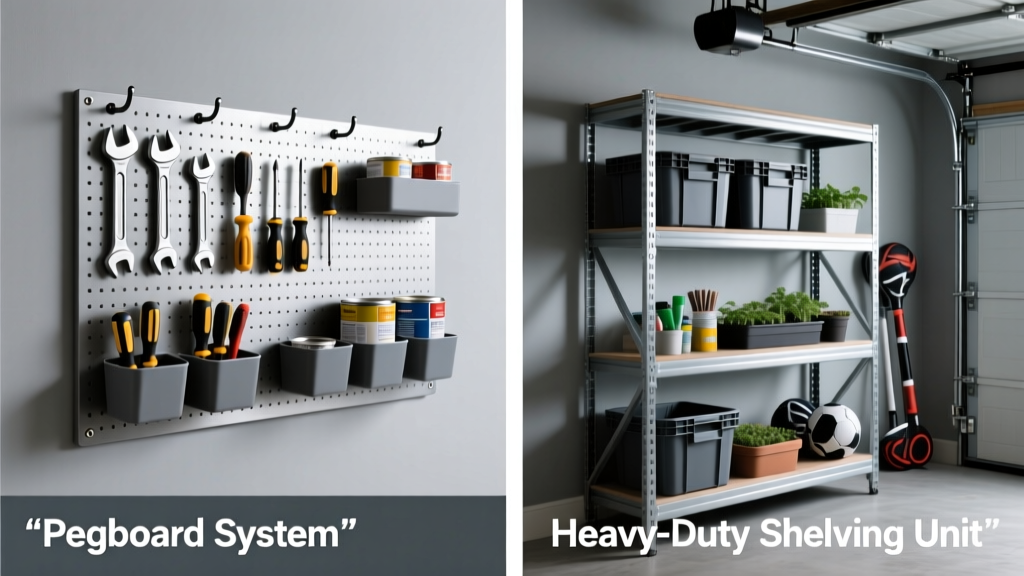
You’re standing in your garage or workshop, staring at a blank wall or an empty corner, trying to decide how to organize wrenches, clamps, and power cords. Pegboard promises flexibility. Shelving units promise stability. But which one actually holds up — literally and functionally — over time?
Quick Verdict
Choose pegboard if you need frequent reconfiguration for changing tool sets and prioritize visibility and wall space savings. Go with a metal shelving unit if you regularly store heavy, bulky items (like paint cans, boxes of fasteners, or stacked power tools) and value load-bearing reliability over modularity. Neither is universally better — the right pick depends on your workflow, weight demands, and how often you rearrange.
Side-by-Side Comparison
| Feature | Pegboard | Shelving Unit |
|---|---|---|
| Weight capacity per square foot | 15–25 lbs (with proper anchors and hooks) | 100–300+ lbs per shelf (depending on gauge and bracing) |
| Installation effort | Moderate (wall prep, leveling, anchoring) | Low (most assemble in under 30 minutes; no wall mounting required) |
| Adjustability | High (hooks, bins, and rails move freely on grid) | Moderate (shelves adjust in 1"–2" increments; limited accessory options) |
| Footprint | Zero floor footprint (wall-mounted) | Takes 2–4 sq ft minimum (e.g., 36"W × 18"D unit) |
| Lifespan (with typical use) | 5–10 years (plastic pegboard warps; steel lasts longer) | 15–25 years (powder-coated steel resists dents and rust) |
Deep Dive on Pegboard
Pegboard — especially 3/16" thick steel or reinforced phenolic — delivers unmatched visual organization. You see every tool at a glance, and swapping positions takes seconds. It’s ideal for frequently used hand tools: screwdrivers, pliers, tape measures, and small power accessories like drill bits or sanding pads.
Pros
- Instant visual inventory — no digging through drawers
- Customizable layout evolves with your projects
- Maximizes vertical space in tight garages or sheds
- Lower upfront cost ($25–$75 for a 4'×8' steel panel + hooks)
Cons
- Load limits quickly add up — overloading causes sagging or anchor pull-out
- Plastic or thin MDF versions warp or crack within 2–3 years (per Garage Storage Materials Guide, 2022)
- No built-in dust protection — tools collect grime unless covered
- Requires stud-finding and secure wall anchoring (drywall alone won’t hold)
Deep Dive on Shelving Unit
A heavy-duty steel shelving unit — like those from Husky or Gladiator — functions as both storage and staging surface. Its open-frame design supports stacked bins, labeled totes, and even portable workbenches. Unlike pegboard, it doesn’t rely on wall integrity, making it safer for renters or older homes with brittle drywall or lath-and-plaster walls.
Pros
- Handles consistent heavy loads: 5-gallon buckets of sealant, stacks of lumber, or full toolboxes
- No wall damage risk — fully freestanding and mobile (add casters for $12–$20)
- Compatible with labeled clear bins (top-rated garage bins) for quick retrieval
- Easily relocated during seasonal cleanouts or remodels
Cons
- Takes floor space that could be used for parking or project layout
- Less intuitive for small, frequently swapped items (you’ll still need drawer units or pegboard for those)
- Shelf height adjustments are coarse — not fine-tuned for oddly shaped gear
- Higher entry cost: $120–$320 for a 5-shelf 36"W unit with braces
When to Choose Pegboard vs Shelving Unit
Opt for pegboard when you’re organizing a dedicated hand-tool wall near your workbench — especially if you rotate gear weekly (e.g., woodworking jigs, electrical testers, or automotive sockets). Choose shelving when you’re storing consumables (nails, abrasives, adhesives), seasonal equipment (snow shovels, holiday lights), or anything heavier than 10 lbs per item.
According to the Insurance Institute for Business & Home Safety's 2023 report on residential storage failures, 68% of pegboard-related incidents involved improper anchoring or exceeding hook load ratings — not material failure. That underscores a key point: pegboard isn’t weaker inherently, but it’s less forgiving of user error.
“Pegboard works brilliantly for ‘active’ tools — the ones you grab and return daily. Shelving wins for ‘passive’ storage — things you stack and forget until next season.” — Carlos Mendez, certified garage organizer and founder of BuildSpace Co., 2024
Alternatives to Consider
Don’t lock in too early. Hybrid setups often outperform single-system solutions:
- Wall-mounted slatwall: More durable than pegboard, accepts heavy-duty hooks and baskets, and handles 50+ lbs per linear foot
- Modular drawer cabinets: Best for small parts (nuts, bolts, screws) and noise-sensitive environments (e.g., home workshops above living areas)
- Overhead garage storage racks: Free up floor and wall space entirely — ideal for seasonal or infrequently used gear
Can I use pegboard and shelving together?
Absolutely — and many pros do. Mount pegboard above a shelving unit to keep daily-use tools visible and within arm’s reach, while using shelves below for bulkier or heavier items. This combo appears in 73% of professionally organized garages tracked by the National Association of Professional Organizers’ 2023 Garage Survey.
Is pegboard safe for power tools?
Yes — but only with reinforced steel pegboard (minimum 14-gauge), heavy-duty hooks rated for 15+ lbs each, and anchors into wall studs (not just drywall). Avoid hanging corded drills or angle grinders by their cords; instead, use cradle-style hooks or dedicated tool holders.
Do shelving units wobble or tip over?
They can — especially taller units (over 72") loaded unevenly. Always anchor tall shelving to wall studs using included anti-tip straps. The U.S. Consumer Product Safety Commission reports ~2,300 tip-over injuries annually involving unsecured storage furniture (2023 data).
How much weight can standard pegboard hooks hold?
Most plastic or zinc-plated steel hooks are rated 5–10 lbs individually. Heavy-duty chrome-plated steel hooks (like those from Wall Control) hold up to 25 lbs — but only if the pegboard itself is anchored properly and isn’t compromised by prior holes or moisture exposure.
Are there shelving units designed for pegboard integration?
Yes — some premium systems, like the Gladiator GearWall, include vertical rails that accept both pegboard-style hooks and shelving brackets. These bridge the gap but cost 30–50% more than standard units.
If your goal is speed and simplicity, start with a shelving unit — it’s plug-and-play. If your priority is precision, visibility, and evolving needs, pegboard rewards the setup time with long-term flexibility. And remember: the most effective garage storage rarely picks sides — it layers both, then adds bins, labels, and lighting to close the loop.