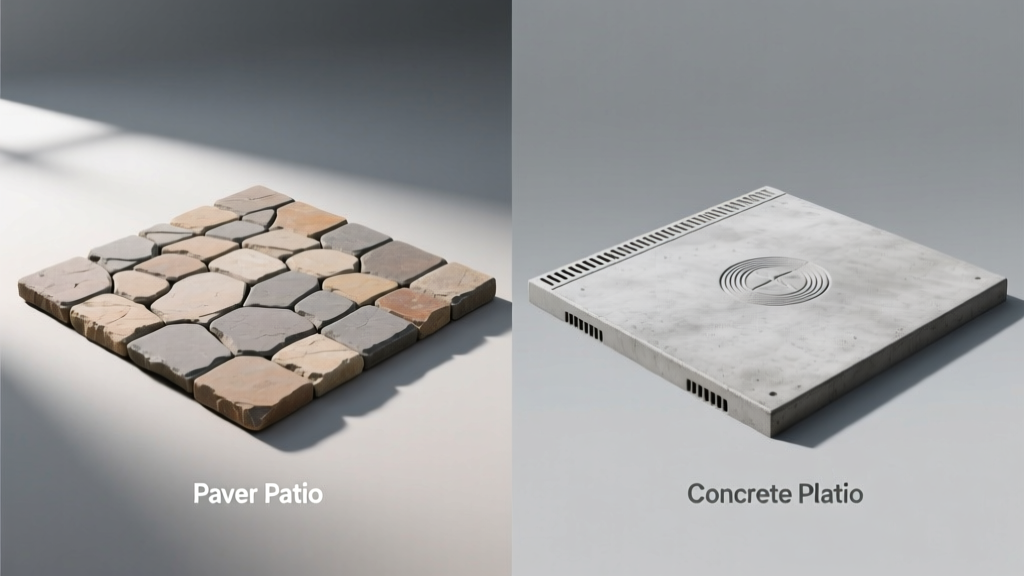
Faced with a blank backyard and big decisions? You’re not alone—homeowners in USDA Hardiness Zones 4–9 grapple with this choice every spring. Pavers promise charm and flexibility; concrete promises simplicity and speed. But which delivers better value over 15+ years?
Quick Verdict
Pavers win for design flexibility, repairability, and resale appeal—especially in freeze-thaw climates—but cost 30–60% more upfront. Concrete wins for budget-conscious builds under $8,000 and tight timelines, though cracking and staining become likely after year 7 without sealing. According to the National Association of Home Builders’ 2023 Outdoor Living Report, 58% of mid-range custom builds chose pavers when budget allowed, citing long-term ROI and customization as top drivers.
Side-by-Side Comparison
| Feature | Paver Patio | Concrete Patio |
|---|---|---|
| Upfront Cost (per sq ft) | $12–$25 (installed) | $6–$15 (installed) |
| Lifespan | 25–40 years (with occasional replacement) | 20–30 years (cracking common after 10) |
| Installation Time | 5–10 days (weather-dependent) | 3–5 days (including curing) |
| Repair Ease | Individual units replaceable in hours | Cracks require patching or slab replacement |
| Slip Resistance | Natural texture; no sealant needed | Requires broom finish or anti-slip additive |
| Maintenance | Weed control in joints; re-sand every 3–5 years | Seal every 2–3 years; pressure wash annually |
Deep Dive on Paver Patios
Pavers—interlocking concrete, clay, or natural stone units—offer unmatched visual versatility. You can mix colors, patterns (herringbone, basketweave), and even integrate lighting or drainage channels.
Pros
- Highly resistant to freeze-thaw damage—joints absorb expansion (critical in northern states like Michigan and Minnesota)
- No large-scale cracking; damaged units swap out without disrupting the whole surface
- Permeable options reduce runoff—ideal for homes near lakes or with strict municipal stormwater rules
- Resale value boost: Remodeling Magazine’s 2023 Cost vs. Value Report found paver patios recouped 63% of cost nationally
Cons
- Higher labor cost due to precise base prep and alignment
- Weeds and ants can infiltrate sand-filled joints without polymeric sand or annual maintenance
- Uneven settling possible if base isn’t compacted to 95% Proctor density (a common contractor shortcut)
Best for: Historic districts requiring brick-like authenticity, sloped yards needing tiered layouts, or homeowners planning to stay 10+ years.
Deep Dive on Concrete Patios
Poured-in-place concrete remains the go-to for straightforward, flat, high-traffic zones—think attached garages, pool decks with minimal grading, or rental property upgrades.
Pros
- Fastest installation: One pour, one cure, one finish—ideal for tight summer windows
- Seamless surface works well for outdoor rugs, modular furniture, and wheelchair access (when properly sloped)
- Staining, stamping, and acid-washing offer moderate aesthetic variation at lower cost than pavers
Cons
- Prone to hairline cracks within 2–3 years—even with fiber reinforcement and proper joint spacing
- Harder to modify later: Adding a fire pit or pergola post requires coring, not just lifting a paver
- Heat retention: Unshaded concrete hits 15–20°F hotter than pavers at noon (U.S. Department of Energy, 2022 urban heat island study)
Best for: First-time homeowners with tight budgets, HOA-restricted neighborhoods mandating monolithic surfaces, or temporary setups lasting under 8 years.
When to Choose Paver vs Concrete Patio
Choose pavers if you live where winter temperatures dip below 20°F regularly—or if your yard has more than 3% grade. Opt for concrete if your soil is stable clay (low settlement risk), your patio will be covered by a pergola or roof, or you need it ready before July 4th.
"In Central Pennsylvania, I’ve seen concrete patios heave and buckle in year 4—but pavers installed to ICPI standards still look factory-new at year 18." — Sarah Lin, ISA-certified hardscape designer, Keystone Hardscapes (2024)
Also consider local labor availability: In Phoenix and Austin, skilled paver installers are plentiful and competitively priced. In rural Maine, concrete contractors often outnumber paver specialists by 4:1—raising paver quotes significantly.
Alternatives to Consider
Before locking in either option, weigh these less common but situationally superior picks:
- Decomposed granite: $3–$7/sq ft; permeable and rustic—but not ideal for dining or wheelchairs
- Stamped concrete with polymer overlay: Mimics paver texture at ~70% of paver cost; lasts 12–15 years with UV-resistant sealers
- Porcelain pavers: Non-porous, frost-proof, and low-maintenance—but require specialized thin-set and substrate prep
For sloped sites, also explore retaining wall + patio combos, which combine structure and function.
Can I install a paver patio myself?
Yes—if you own a plate compactor, laser level, and have experience with gravel base work. DIYers typically save 40% on labor but risk uneven settling or misaligned patterns. Start with a 10'×10' test section; skip mortar-set pavers entirely unless certified.
How often does concrete need sealing?
Every 2–3 years for driveways and patios exposed to sun, rain, and de-icing salts. Unsealed concrete absorbs oil, rust, and tannins from nearby trees—stains that won’t lift with pressure washing. Use a breathable silane-siloxane sealer, not acrylic, for breathability (per ASTM C1315 standards).
Do pavers increase home value more than concrete?
In markets where curb appeal drives sales—like suburban Atlanta or Portland—yes. The 2023 National Association of Realtors® report noted paver patios added 3.2% more perceived value than concrete in buyer walk-throughs, especially when paired with matching walkways and fire pits.
What’s the best base material for each?
Pavers require 6" of compacted crushed limestone (¾" minus) topped with 1" leveling sand. Concrete needs 4–6" of compacted gravel base plus wire mesh or #3 rebar—never just sand, which leads to spalling. Skipping base prep causes 82% of premature failures, per the Interlocking Concrete Pavement Institute’s failure analysis database (2022).
Will either option work around a pool?
Both can—but pavers with polymeric sand resist chlorine leaching and allow easy drain tile access. For concrete, specify air-entrained mix and integral color (not surface stain) to prevent scaling from saltwater or chlorinated splashes.
How do they handle tree roots?
Neither handles aggressive root systems well—but pavers win here too. If a root lifts a section, you lift and reset 4–6 units. With concrete, root uplift usually means full removal and re-pour. For mature oak or maple zones, consider permeable paver systems with deeper aggregate reservoirs to deflect roots downward.
There’s no universal “better”—only what fits your soil, schedule, budget, and vision. If you prioritize longevity and adaptability, pavers earn their premium. If speed and simplicity matter most—and you’ll move within 7 years—concrete delivers reliable, no-surprise results. Either way, invest in a qualified installer who provides written specs, not just verbal promises.