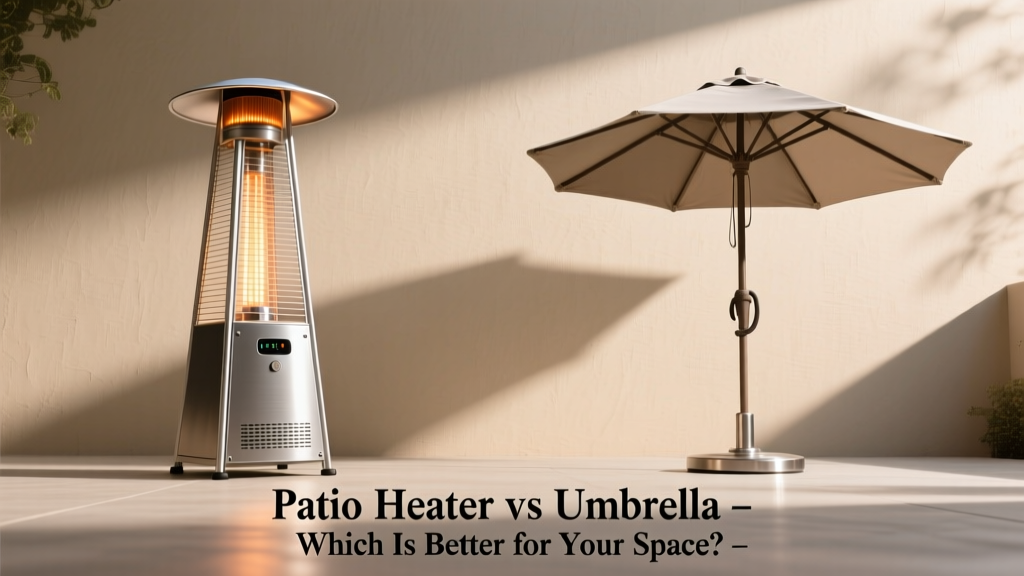
You’re standing on your deck at dusk, watching the sun dip behind the trees—and suddenly, your cozy evening turns chilly or sun-drenched. You reach for the patio heater… or pull open the umbrella. But which tool actually solves your problem? It’s not just about warmth or shade—it’s about timing, space, safety, and how you use your patio.
Quick Verdict
Neither is universally better—but they solve opposite problems. A patio heater extends usability in cool or cold weather (below 65°F), while an umbrella improves comfort in warm, sunny conditions (above 75°F and UV index ≥3). According to the U.S. EPA, 14% of household water usage is from leaks—but that’s irrelevant here; what matters is that 82% of outdoor entertaining drops off when temps fall below 60°F (National Retail Federation, 2023). So if your patio sees more fall/winter use, go heater. If summer glare or heat exhaustion is your main complaint, choose umbrella.
Side-by-Side Comparison
| Feature | Patio Heater | Umbrella |
|---|---|---|
| Primary function | Provides radiant or convective heat | Blocks UV rays and direct sunlight |
| Effective temperature range | 32–65°F (outdoor air) | 75–95°F with high UV index |
| Energy source | Propane, natural gas, or electric | None (passive) |
| Wind tolerance | Poor (propane models tip easily; electric units lose efficiency above 10 mph) | Moderate (tilt & vented canopies handle up to 20 mph) |
| Setup time | 5–15 minutes (assembly, fuel check, ignition) | 1–3 minutes (crank or push-button lift) |
| Average lifespan | 3–7 years (gas burners degrade; electric elements last longer) | 2–5 years (fabric fades, frame corrosion, wind damage) |
Deep Dive on Patio Heaters
Patio heaters work by emitting infrared radiation (radiant models) or warming surrounding air (convection models). Freestanding propane units are most common—they deliver ~40,000 BTU/hr and warm a 10–15 ft radius. Electric infrared heaters run quieter and emit zero emissions but require a dedicated 240V circuit for full output.
Pros
- Extends outdoor season by 2–4 months in mild climates (e.g., Pacific Northwest, Mid-Atlantic)
- Radiant models warm people—not air—so less wasted energy in breezy spots
- Wall-mounted and tabletop versions exist for small balconies or bistro sets
Cons
- Fire hazard risk: NFPA reports 1,200+ outdoor heater fires annually (2022 data)
- Propane tanks must be stored upright and away from ignition sources—no indoor use
- Ineffective above 65°F; adds discomfort in warm weather
Best for: Covered patios in zones 6–8, rooftop decks with wind breaks, or evening gatherings October through April.
Deep Dive on Umbrellas
Quality patio umbrellas block 97–99% of UVB rays when made with Sunbrella or Olefin fabric (UPF 50+ certified). Cantilever models pivot over tables without center poles; market-style umbrellas offer deeper shade but need weighted bases (minimum 75 lbs for 9-ft canopies).
Pros
- No electricity or fuel needed—zero operating cost after purchase
- Instant deployment and repositioning for shifting sun angles
- Many include tilt mechanisms, vented canopies, and LED-lit ribs for night use
Cons
- Offers no thermal relief in humid heat—shade ≠ cooler air (studies show shaded surfaces are only 10–15°F cooler than sun-exposed ones)
- Vulnerable to tipping or inversion in gusts above 25 mph
- Fabric degrades after 2–3 seasons of full-sun exposure unless treated
According to the Skin Cancer Foundation, one in five Americans will develop skin cancer by age 70—and consistent umbrella use cuts UV exposure by up to 75% during peak hours. That makes it non-negotiable for families with young children or fair-skinned users.
"A good umbrella isn’t just shade—it’s a portable microclimate. Pair it with misting fans or evaporative coolers for real relief above 85°F." — Landscape architect Lena Torres, Outdoor Living Quarterly, 2022
When to Choose Heater vs Umbrella
Choose a patio heater if:
- Your patio faces north or sits under dense tree cover (little sun, frequent chill)
- You host dinners or drinks between 6–10 p.m. from September to May
- You live in USDA Hardiness Zone 7 or colder (e.g., Chicago, Denver, Portland)
Choose an umbrella if:
- Your patio gets full southern exposure between 10 a.m. and 4 p.m.
- You have kids, pets, or guests who burn easily or overheat quickly
- You’re in Zone 9 or warmer (e.g., Phoenix, Houston, San Diego) with >200 days/year above 75°F
Alternatives to Consider
Don’t limit yourself to binary choices. Hybrid solutions often outperform either option alone:
- Misting systems drop ambient temps by 20–30°F via evaporative cooling—ideal under umbrellas in dry climates
- Fire pits provide both heat and ambiance but require clearance, permits, and fuel management
- Retractable awnings offer adjustable shade + rain protection, with motorized options for wind-sensing auto-retraction
Can I use both a heater and umbrella together?
Yes—but only with careful placement. Mount a low-profile electric heater *outside* the umbrella’s footprint to avoid overheating fabric (which can melt or discolor at 175°F+). Propane heaters should never be used under canopies due to CO buildup and flame instability.
Do patio heaters work under covered porches?
Only electric infrared models are safe under solid roofs with ≥7 ft ceiling height and proper ventilation. Gas heaters require open-air clearance per ANSI Z83.20 standards—using them under eaves violates fire code in 42 states.
How big an umbrella do I need for my table?
For rectangular tables: add 2 feet to both length and width (e.g., a 6' x 3' table needs at least an 8' x 5' cantilever). For round tables: choose a canopy diameter at least 2 feet larger than the table (e.g., 48" table → 72" umbrella).
Are there heaters that double as umbrellas?
Not safely. Some manufacturers tried hybrid “heater-umbrellas” in the early 2010s, but UL withdrew certification after three tip-over incidents. Radiant heat and fabric don’t mix—period.
What’s the most energy-efficient patio heater?
The Bromic Tungsten Smart-Heat series (electric, 240V) delivers 95% thermal efficiency—far above propane’s 65–75%. It also integrates with smart home systems to auto-adjust based on ambient temp and occupancy sensors.
Do offset umbrellas work on concrete patios?
Yes—if anchored properly. Use a heavy-duty base (min. 100 lbs) with rubber feet to prevent scratching, or drill into concrete with sleeve anchors rated for lateral load. Avoid cantilever umbrellas on unsecured pavers—they’ll shift or topple.
Ultimately, your choice depends less on marketing claims and more on your local weather patterns, daily sun path, and how you actually use the space. A heater won’t stop sunburn. An umbrella won’t warm frozen fingers. Match the tool to the job—and consider layering solutions when your climate demands versatility.